Strasbourg's curiosity-driven uproar
The Life and Opinions of Tristram Shandy, GentlemanStrasbourg’s curiosity-driven uproar is the collective obsession that overtakes Strasbourg after a stranger’s extraordinary nose becomes the subject of rumor. In Hafen Slawkenbergius’s embedded tale, curiosity does more than interrupt the city’s routine: it gathers people across social boundaries, draws an immense procession out of the gates, and leaves the city vulnerable to French entry. The episode makes the nose both an object of uncertain testimony and a force that redirects an entire population.
The rumor takes hold
The stranger has scarcely traveled half a league toward Frankfort when news of his nose sets Strasbourg in commotion. The Compline bells are ringing, but the calls to devotion go unheard amid movement through streets, doorways, and alleys. People repeat questions about whether anyone saw the nose and who saw it. The narrative presents the first effect of the rumor not as settled knowledge but as urgent circulation: the city is busy pursuing testimony before it can establish what the testimony proves.
The reports do not converge on a reliable description. A sentinel, a drummer, a trumpeter and his wife, the burgomaster’s widow, and the innkeeper and his wife differ in their accounts of the stranger’s nose. Yet their testimony agrees on two points: the stranger has gone to Frankfort, and he will not return until a stated day; he is also remembered as exceptionally handsome, courteous, and generous. His manner and appearance make the disputed nose more compelling, not less. The city’s desire is sustained by the combination of an elusive object and a stranger whose reported qualities invite admiration.
Curiosity crosses social boundaries
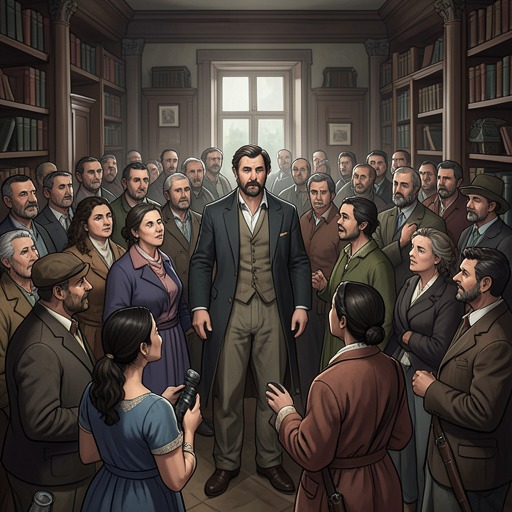
The fixation spreads through every rank and occupation named in the tale. Rich and poor, learned and unlearned, doctors and students, mistresses and maids, and religious women all spend their time attending to news of the stranger. Every eye longs to see the nose, and every finger and thumb longs to touch it. That escalation makes curiosity physical and collective: the crowd does not merely want an account but seeks access to the object itself.
The episode also makes uncertainty an engine of the crowd’s attention. Witnesses disagree about whether the nose is true or false, but they agree that the stranger is bound for Frankfort and will not return before the promised date. The unresolved question therefore has a timetable. Rather than ending speculation, the stranger’s absence prolongs it and gives the city a shared expectation around his possible return.
The promised return and the procession
The inhabitants are described as unable to eat, drink, sleep, pray, or attend to the ordinary demands of life for seven-and-twenty days. The tale’s narrator presents this sustained anticipation with a mixture of praise and irony: the account calls attention to how thoroughly curiosity has taken possession of the city, while treating the people’s endurance as a kind of collective ordeal. On the twenty-eighth day, when the stranger has promised to return, the inhabitants set out at sunrise to meet him on the road.
The procession’s reported scale turns private fascination into a public migration. The account lists seven thousand coaches, fifteen thousand single-horse chairs, and twenty thousand wagons, while immediately allowing that Slawkenbergius may have made an error in his numerals. Their passengers include civic dignitaries and religious figures as well as widows, wives, and virgins. The abbess of Quedlinburg travels in one coach with the prioress, deaness, and sub-chantress; the dean of Strasbourg and the four leading dignitaries of his chapter accompany them. Others follow on horseback or on foot, some led and some driven, with routes extending down the Rhine and in other directions. The procession’s extravagant figures and disorderly variety enlarge the episode into a comic spectacle, while keeping its central consequence clear: Strasbourg’s people have gone out to pursue the stranger.
The city left open
The tale gives competing explanations for Strasbourg’s eventual weakness. One account says that the inhabitants anticipated their revenues, burdened themselves with taxes, and exhausted their strength until they could no longer keep the gates shut; on that explanation, the French pushed the gates open. Slawkenbergius rejects the claim that the French were the decisive cause. He says curiosity had already pushed the gates open: while the men, women, and children of Strasbourg marched after the stranger’s nose, the French took the opportunity to enter.
The episode also connects the uproar with a longer decline in trade and manufactures. Commercial explanations are set aside in favor of the claim that noses have so occupied the Strasburgers’ minds that they could not follow their business. This is not simply a report of distraction: the tale makes attention itself consequential, showing how a city’s collective preoccupation can displace work, devotion, rest, and the maintenance of its defenses.
Narrative design and significance
The story’s movement from a rumor in the streets to a mass departure and a city exposed to entry gives curiosity a civic scale. The repeated questions, contradictory accounts, immense procession, and alternative explanations for the city’s loss make the nose less important as a verifiable physical object than as a center of attention around which the community reorganizes itself. The claimed uncertainty about the stranger’s nose remains unresolved even as the consequences of pursuing it become definite.
Slawkenbergius frames the episode with conspicuous narratorial interpretation. He praises the Strasburgers’ capacity to endure their expectation, then assigns curiosity responsibility for the open gates and the decay of business. The irony rests on the disparity between the crowd’s immense exertion and the uncertain object of its pursuit: people leave the ordinary life of the city to satisfy a desire that no conflicting testimony can settle. In the embedded tale, collective curiosity becomes both spectacle and explanation, linking fascination with the stranger’s nose to Strasbourg’s vulnerability and decline.