Strasburg
The Life and Opinions of Tristram Shandy, GentlemanStrasburg is the central setting of Hafen Slawkenbergius’s tale of a city undone, in the narrator’s account, by curiosity about a passing stranger’s nose. The episode turns a brief encounter into civic uproar: while residents pursue the stranger and wait for his return, the gates stand open and the French enter. Competing explanations blame political pride and exhausted finances, but Slawkenbergius assigns the decisive cause to curiosity itself. The story makes Strasburg at once a historical city, a comic spectacle of collective distraction, and a warning about how a crowd may abandon its ordinary duties in pursuit of what it cannot see or know.
Strasburg in the Embedded Tale
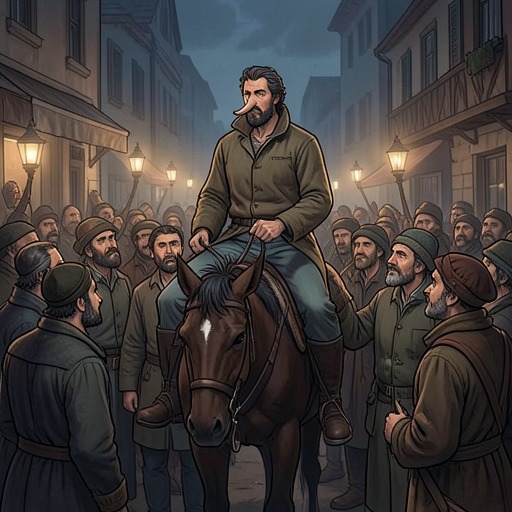
The stranger enters Strasburg late in August on a dark mule, carrying a small cloak-bag with a few shirts, shoes, and a pair of crimson-satin breeches. He tells the sentry that he has been to the Promontory of Noses, is travelling toward Frankfort, and expects to return to Strasburg in a month on his way toward Crim Tartary. The sentry looks at his face and recognizes that he has never seen such a nose. The tale gives the encounter a concrete point of departure, then makes the unseen object—rather than any public announcement or formal event—the focus of the city’s attention.
At an inn, the stranger promises that his nose will not be touched until a certain hour, but leaves the promised destination unfinished. He rides away without satisfying the innkeeper’s wife, and the uncertainty travels back into Strasburg ahead of him. The stranger’s silence is consequential: a withheld answer becomes the occasion for speculation, and the city’s interest grows around an absence of knowledge rather than an explanation.
Uproar and Collective Expectation
Before the stranger has gone half a league toward Frankfort, Strasburg is in an uproar. The Compline bells call the townspeople to prayer, but no one attends to them: men, women, and children move from street to alley asking who saw the nose. The narrator’s rapid accumulation of routes and repeated questions makes the city’s curiosity seem physically contagious. Residents who were at vespers, washing, starching, scouring, or quilting lament that they missed the sight; some wish they had been a sentry, drummer, or trumpeter so that they might have been near the stranger.
The stranger, meanwhile, continues gently on his mule, apparently unconcerned by the commotion. The contrast between his unhurried departure and the city’s frantic movement gives Strasburg’s episode its comic imbalance: one traveller’s unexplained appearance absorbs the attention of an entire population. The tale says the citizens neither ate, drank, slept, prayed, nor heeded ordinary bodily and religious duties for seven-and-twenty days. Their curiosity is not a momentary distraction but a prolonged civic condition, sustained by anticipation of the stranger’s promised return.
On the twenty-eighth day, when he is expected back, the city’s attention becomes a procession. Slawkenbergius supplies enormous figures—seven thousand coaches, fifteen thousand single-horse chairs, and twenty thousand wagons—and describes people setting out at sunrise to meet the stranger. Senators, counsellors, religious figures, widows, wives, and others travel by coach, horseback, or on foot; the procession’s order is itself comic, with its participants following as they can. The scale of the numbers is so extravagant that the narrative parenthetically doubts Slawkenbergius’s numeral characters, making the city’s mass response and the teller’s reliability part of the joke.
The Open Gates and Competing Explanations
As the uproar increases, Strasburg’s gates are set open. Slawkenbergius describes the citizens as exhausted by expectation, and presents his account not as an excuse for their surrender but as a panegyric to a population supposedly tested beyond endurance. The rhetoric elevates the crowd even as the episode exposes how completely its attention has been captured. The open gates are the consequential turn: a city absorbed in the stranger’s return has left itself vulnerable.
The tale then places this comic cause beside accounts framed in political and economic terms. One historian attributes Strasburg’s fate to civic pride: its people regarded an imperial garrison as an infringement on freedom, and consequently fell to a French one. Another says that the citizens anticipated revenues, burdened themselves with taxes, and weakened their capacity to keep the gates shut. These explanations connect the city’s fall to choices about autonomy and public resources, rather than to the nose that has occupied the tale.
Slawkenbergius’s answer revises both accounts without making the French irrelevant. In his explanation, curiosity has opened the gates: the people leave the city to follow the stranger, and the French, alert to opportunity, enter behind them. The tale therefore turns attention itself into a political vulnerability. Strasburg’s inhabitants do not merely wonder about the nose; in the story’s causal joke, they follow it out of the city and leave the way in open.
Historical Aftermath and Narrative Meaning
The embedded account connects Strasburg’s fate to a larger political design. One branch of the universal-monarchy system, described as having been commissioned by Colbert and presented in manuscript to Louis XIV in 1664, was to secure Strasburg as an entrance into Swabia and a means of disturbing the peace of Germany. The city eventually falls into French hands. This background prevents the tale’s comic explanation from erasing military and political purpose: the stranger’s nose supplies an immediate diversion, while the French project supplies a strategic context for taking the city.
Slawkenbergius also attributes the later decay of Strasburg’s trade and manufactures to the citizens’ continued preoccupation with noses, rather than to the causes commercial observers have assigned. He closes by treating Strasburg as one among fortresses won or lost through noses. The claim extends the episode from a single absurd distraction into a recurring satirical principle: private fascination can disrupt public life, and explanations of political change may depend on where the observer chooses to look.
Strasburg and the Book’s Form
The tale’s treatment of Strasburg belongs to a novel that repeatedly makes its own construction visible. At one point the narrator protests that two chapters have covered only the descent of one flight of stairs, then interrupts the progress with an abrupt chapter break and openly rejects a fixed rule for chapter-making. Elsewhere, a missing ten-page chapter is declared not to make the book imperfect; the book is said to be more complete for lacking it. Such formal digressions parallel the Strasburg episode’s conversion of a small incident into a sprawling civic consequence: narrative attention, like the city’s, does not proceed in a straight line.
The printed page participates in that play. The book presents two marble plates, a blank page associated with an invitation to imagine a woman, and later two more blank pages. These interruptions make absence and readerly expectation part of the work’s material form. In Slawkenbergius’s tale, the citizens strain toward a sight and an answer that remain elusive; in the surrounding narrative, the reader encounters blanks, missing pages, and an authorial voice that calls attention to the act of reading. Strasburg’s uproar thus reflects the novel’s wider interest in curiosity—not only as a motive within a story, but as a force that shapes how stories are followed and how their gaps acquire meaning.