The Shandy family's long-nose prejudice
The Life and Opinions of Tristram Shandy, GentlemanThe Shandy family's long-nose prejudice is a multigenerational conviction that a prominent nose helps determine a family’s rank and advancement. The belief makes physical appearance a theory of social destiny: Walter treats a succession of short noses as a threat to family standing and long noses as a source of preferment, while the narrator connects this inherited fixation to his own birth and misfortunes.
Inheritance and Reinforcement
The prejudice did not begin with Walter alone. The narrator says that for at least three generations the tenet in favor of long noses had been taking root in the family, supported both by tradition and by recurring material interest. Walter inherited the belief, in the narrator’s image, with his mother’s milk; his own contribution was to cultivate and elaborate it until it seemed fully established. The account therefore presents the notion not simply as one man’s eccentricity but as a family habit carried forward and strengthened over time.
This history gives the belief a double source of authority. It is justified by ancestral tradition, yet it is also repeatedly reinforced by the prospect of practical advantage. The narrator leaves open whether the doctrine is simply mistaken, but makes clear that its persistence owes as much to inheritance and interest as to Walter’s distinctive imagination.
Noses and Family Fortune
Walter measures dynastic prospects through noses. He argues that a great family could hardly withstand an uninterrupted succession of six or seven short noses, while a line of long, well-formed noses should raise its members into the kingdom’s best vacancies. In his account of family history, the Shandys had ranked highly in the time of Henry VIII, and their rise, he insists, owed not to political influence but to their noses.
That story of advancement is reversed by the image of the great-grandfather’s nose: Walter says the family never recovered from the blow of its turn in fortune. He likens the episode to an unfortunate card drawn in a game, turning the nose into both a bodily feature and a figure for chance. The family’s standing is thus narrated as a sequence of rises and reversals supposedly legible in its members’ faces.
The Narrator’s Birth and the Belief’s Consequences
The nose doctrine gives the narrator’s birth a place within the family’s history of supposed misfortune. Under the marriage settlement, Walter had agreed to provide money for Elizabeth Mollineux to travel to London for childbirth if he had retired to the country and she was pregnant. A separate clause penalized her if she falsely claimed the signs of pregnancy to secure such a journey. When Walter insisted on that clause in September 1717, the narrator says, the arrangements left him destined for a birth in the country and for his nose to be compressed.
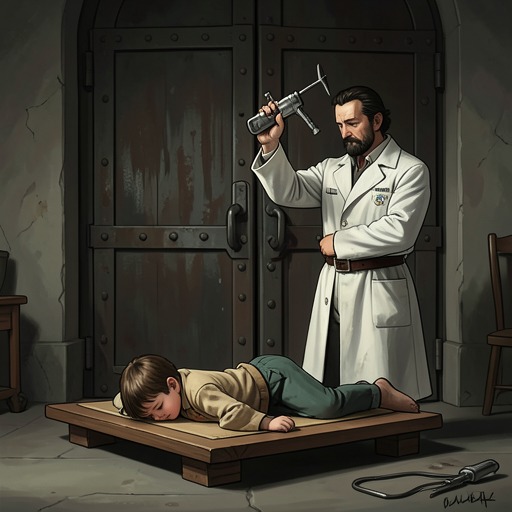
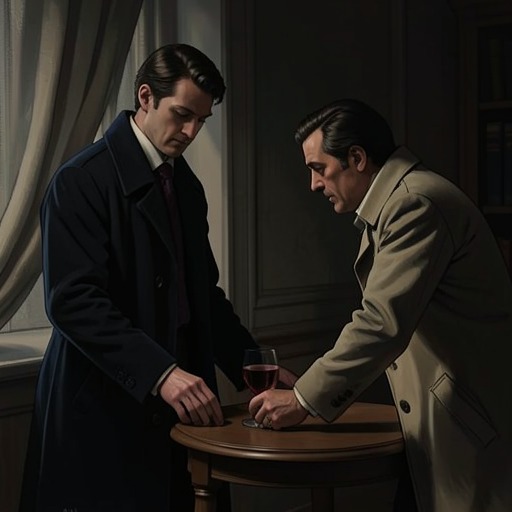
The narrator traces the consequence through the chosen midwife and the dispute over birth attendants. Elizabeth Mollineux was determined to rely on the experienced local midwife, while Walter wanted a male operator; the eventual compromise allowed the old woman to attend and the operator to drink wine with Walter and Toby Shandy for a fee. The narrator later reports Walter’s theory that ordinary delivery compresses a child’s head, and records his alarm at what he believed this might do to the brain. These passages place the long-nose prejudice within a wider Shandy preoccupation with birth, bodily form, and intellectual destiny, without making Walter’s claims independent proof of the family doctrine.
The narrator explicitly links the nose’s compression to a train of disappointments he will relate later. In that way, the inherited prejudice becomes part of the story’s organizing irony: the family treats the nose as a determinant of fortune, while the narrator’s own account makes the supposed family emblem a source of anxiety and retrospective explanation.
Family Belief and Narrative Irony
The narrator both explains the doctrine’s origins and distances himself from its certainty. He acknowledges Walter’s role in bringing it to maturity but emphasizes the long inheritance behind it; he also interrupts the account to clarify that the great-grandfather’s nose means the literal external organ, even as Walter’s family history has made that organ bear the weight of status and fate.
The result is a family theory that is at once intimate and absurdly expansive. A feature of the face becomes a measure of lineage, a cause of political advancement, and an explanation for personal adversity. By setting ancestral tradition and supposed material advantage beside the narrator’s own birth story, the account shows how a repeated belief can shape the interpretation of events even when its claims remain uncertain.