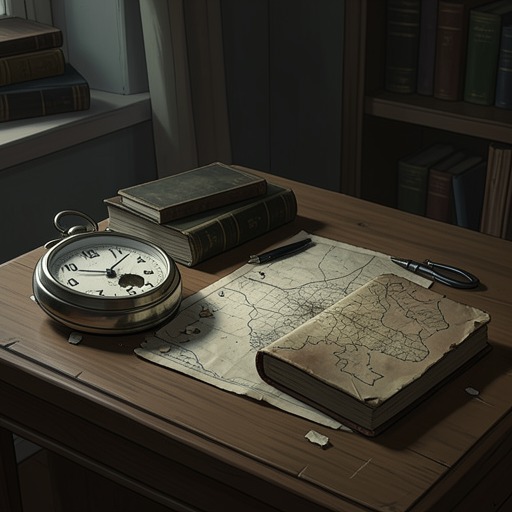
Tomb of Amandus and Amanda
The Life and Opinions of Tristram Shandy, GentlemanThe Tomb of Amandus and Amanda is a lovers’ shrine said to stand outside Lyon, built to commemorate two devoted lovers who die upon finding one another. For Tristram, the tomb is more than a local antiquity: reports of it give a romantic focus to his imagination and eventually draw him on a purposeful pilgrimage. When he reaches the place, however, there is no tomb. Its absence makes the shrine an emblem of the distance between travel-writing, cherished expectation, and what a traveler can actually find.
The legend and its memorial
The story attached to the tomb begins with Amandus and Amanda separated and unaware of each other’s course. Amandus is taken captive by the Turks and held for twenty years at the court of the emperor of Morocco; the princess who falls in love with him keeps him imprisoned because of her attachment. Amanda, meanwhile, wanders barefoot over rocks and mountains, searching for him and repeatedly calling his name. Their long separation ends by chance: traveling by different routes, they arrive at the gate of Lyon at the same moment and call out to ask whether the other is alive. They rush into one another’s arms and both die of joy.
A report from an itinerary gives the lovers’ reunion a lasting place in the geography of the city. According to that account, a tomb was built outside the gates in honor of their fidelity, and lovers continued to invoke the pair as witnesses to their own truthfulness. The memorial’s reputation therefore depends on both the romantic tale and the claim that the tale has a physical site. For Tristram, that promised conjunction of story and place gives the shrine a special authority.
A shrine in Tristram’s imagination
Tristram recalls that accounts of Lyon by Spon and other travelers supplied only fragments of information, as if their writing had strained the city’s history through a sieve. The story of the lovers’ tomb is what remains with him. It returns whenever he thinks or speaks of Lyon and can arise even at the sight of a Lyons-waistcoat. The recurrence shows how the shrine has become an imaginative association rather than merely one item in a guide to local sights.
He places the tomb last in his list of things to see in Lyon, but insists that it is not least in importance. In his own estimation, the neglected shrine is comparable in value to the shrine of Mecca and falls short of the Santa Casa only in wealth. That comparison treats the tomb as a destination of pilgrimage: its meaning is spiritual and personal, although the evidence for its existence comes through uncertain travel accounts. Tristram even says he would make the journey for the tomb alone, without any other business in Lyon.
The pilgrimage and its reversal
When the opportunity to consult a history of China in Chinese characters presents itself, Tristram’s interest cools as he draws nearer to the project. He admits that his time is short and that his heart is already at the Tomb of the Lovers. The contrast makes the pull of the shrine concrete: an initially tempting intellectual excursion gives way to the destination that has long occupied his imagination. The library visit falls away when the Jesuits are said to be suffering from an unprecedented bout of colic, and Tristram proceeds toward the tomb.
He knows its supposed position well: just beyond the gate on the right-hand turn leading to the Fauxbourg de Vaise. Before setting out, he has paid his inn bill, given the maid ten sous, and received Monsieur Le Blanc’s parting compliments for a pleasant voyage down the Rhône. These practical details mark the point at which an imagined pilgrimage becomes an actual departure. Tristram sends François to the boat so he can approach the site without a witness to his weakness, and walks toward it with evident anticipation.
At the gate that should lead to the tomb, Tristram addresses Amandus and Amanda as tender and faithful spirits and says that he has come at last to pay his long-delayed tribute. The expectation is immediately overturned: when he arrives, there is no tomb upon which to leave his tear. The account does not explain when or why the memorial disappeared, or establish whether it had ever stood where the itinerary placed it. The decisive fact is the absence encountered by the traveler, not a resolved history of the site.
Narrative significance
The tomb’s disappearance exposes the fragility of a place assembled from travelers’ accounts, remembered stories, and private desire. Tristram has treated the memorial as a stable destination for so long that even a Lyons-waistcoat can call it to mind; the journey finally tests that imagined constancy against the actual place. Instead of confirming the legend through a surviving monument, Lyon withholds the object of the pilgrimage.
The episode also makes the mismatch between expectation and experience part of the narrative’s movement. The projected homage ends in an empty site, and Tristram’s response is to imagine how much he would have valued his Uncle Toby’s whistle of Lillibullero. The abrupt appeal to that familiar tune gives the disappointment a comic outlet without restoring the missing shrine. Amandus and Amanda remain potent in Tristram’s imagination, but their tomb survives in the narrative as a reported, desired, and finally absent landmark.