Tristram’s French Travel Notes
The Life and Opinions of Tristram Shandy, GentlemanTristram’s French Travel Notes are both a record of a journey and a comic casualty of it. The notes promise wit and authority about France, but their fate is decided not by the quality of their observations: left in a post-chaise sold after it breaks down, they pass to a chaise-vamper and are found twisted into the curls of his wife. Their return, page by page into Tristram’s hat, makes the manuscript’s physical handling part of the story it was meant to tell.
The Notes and the Journey
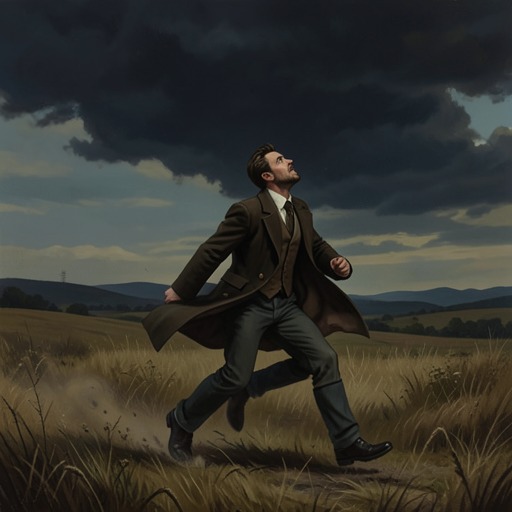
Tristram’s travel writing emerges amid a journey whose practical inconveniences repeatedly disrupt observation. Between Calais and Paris, he complains that three separate roads invite competing arguments from the towns along them, so that choosing a route can cost half a day. The choice is not merely geographical: one road is longer but more interesting and instructive, while another offers the prospect of Chantilly. Travel thus arrives already mediated by alternatives, advocacy, and the traveler’s limited time.
At Calais, Tristram makes the gap between travel experience and travel account explicit. He says he knows little of the town beyond what his barber told him while sharpening his razor. He had arrived in the dusk and departed in darkness, yet claims he could still compose a long, precise account from inference, assembling one detail from another until a reader might mistake him for the town clerk. The joke exposes the authority of the travel writer as something that can be manufactured from fragments and confident arrangement, rather than earned through sustained looking.
The account then performs the very convention it has mocked. Under the heading “Calais, Calatium, Calusium, Calesium,” it offers a history attributed to the town’s archives and estimates the city’s growth from a small village to a place with fourteen thousand inhabitants, plus four hundred and twenty families in the lower town. It proceeds to describe four convents and a single parish church dedicated to the Virgin Mary, reasoning about the church’s size from the population it might contain. The transition from admitted ignorance to elaborate topographical detail makes the Notes’ authority deliberately unstable: observation, report, inference, and comic invention occupy the same page without a firm boundary.
The Practical Frictions of Travel
The journey also supplies the Notes with material that no guidebook-like account can smooth away. Tristram describes how paying for horses at every stage defeats even the firmest intention to sleep in the carriage. The traveler must count three livres and fifteen sous, handle disputes over missing change or a payment for a post and a half, and consult a small-printed road book. Offers of snuff, requests for help, and arguments over watering the wheels then rouse the mind further. The interruption is not a single mishap but a recurring sequence in which the mechanics and expenses of movement keep breaking into the traveler’s private plans.
His observations of France similarly resist the simple confidence of a travel verdict. He declines to settle whether the French are misunderstood because they fail to explain themselves precisely or because outsiders fail to understand their language. Even the saying that whoever has seen Paris has seen everything becomes uncertain when applied to candlelight: Tristram distinguishes daytime from the poorly dependable illumination under which Paris’s hotels and their attractions are encountered. The Notes register not only places but the conditions under which a traveler can claim to know them.
When Tristram enters Lyons, the damage to his chaise briefly seems to offer a new route and a financial advantage. He imagines travelling by water to Avignon, then crossing the plains of Languedoc by mule or ass, saving four hundred livres while gaining the pleasures of motion and scenery. The projected passage down the Rhône, with Vienne and other cities, vineyards, castles, rocks, mountains, and cataracts glimpsed along the way, turns an accident into an anticipated renewal of travel. But the imagined itinerary is overtaken by the immediate question of what to do with the wrecked vehicle.
Loss and Recovery
Tristram later searches his coat pocket for his remarks so that he can record an imposition by the commissary. Finding nothing, he reacts as though the loss were much greater than the value of the paper: these were, he insists, his wisest and wittiest remarks. The commissary jokes that Tristram had dropped some singular ones in conversation, but those were only a few; the missing written remarks were the substantial treasure. The distinction between spoken and written wit gives the loss its comic scale while making the manuscript’s ownership and location suddenly urgent.
The confusion clears when Tristram remembers that he left the notes in the pocket of the post-chaise. By selling the vehicle, he sold the writing with it. He calculates that the notes were worth four hundred guineas, while the chaise itself was worth six louis d’or, and laments that both have gone to a chaise-vamper rather than to a bookseller who might have valued the writing. The passage makes the manuscript a literal part of the vehicle’s contents: literary work is not safely separate from luggage, upholstery, or the transactions of travel.
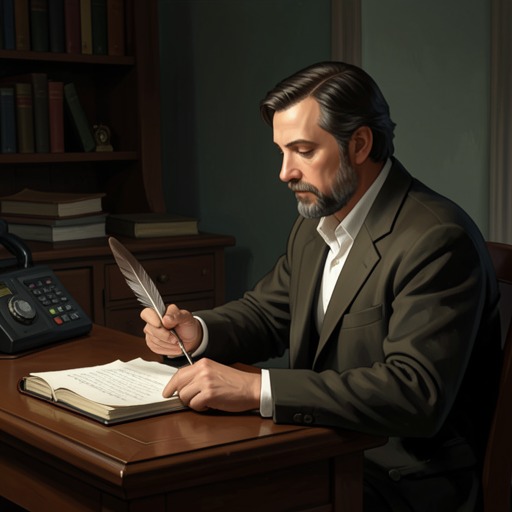
At the chaise-vamper’s house, the loss takes an even more tangible form. The wife opens the door while removing the papers from her hair, and one falls to the ground; Tristram recognizes his own writing. She has used the notes as papillotes, curling papers, so his account of France has been physically twisted into the shape of a stranger’s coiffure. She then removes the remaining sheets from her curls and places them, one by one, into his hat. The return restores possession but not the illusion of an untouched manuscript: the pages have travelled through the very domestic use that Tristram’s authorial pride cannot control.
Material Form and Narrative Irony
The episode makes the objecthood of writing inseparable from its meaning. Tristram calls the notes full of wit and worth a fortune, yet their immediate material value lies in their usefulness as curling papers; the contrast is not resolved by recovery, since the pages reach him altered in their arrangement and purpose. Writing circulates through sale, loss, bodily adornment, and return before it can circulate as a published travel account.
That physical comedy sharpens the Notes’ broader satire of travel literature. Tristram has already shown how a detailed description of Calais can be composed despite barely seeing the town, and how a traveler’s movement is shaped by roads, fees, darkness, and interruptions. Now the written record itself is caught up in the same contingencies. It is neither a transparent window onto France nor a stable possession of its author: it is a set of sheets exposed to inference, commerce, accident, and other people’s uses. The episode’s ending returns the notes to Tristram, but their detour through the chaise-vamper’s household leaves the central joke intact: the traveler may plan the account, but he cannot dictate the journey of the pages.