Tristram’s ill health
The Life and Opinions of Tristram Shandy, GentlemanTristram’s ill health is a recurring pressure on his time and mobility, but it does not define him as a passive sufferer: he measures his vulnerability against an ambitious writing life, credits his spirits with keeping him hopeful, and turns the threat of death into a reason to travel. The contrast between his frail body and his forward-driving voice makes illness both a practical constraint and a spur to narration.
Illness and the work of writing
Tristram recalls being tormented by a vile cough and fearing its return. The fear qualifies his extravagant promise that his book, conceived as a machine, could keep going at two volumes a year for forty years: that ambition depends not on confidence in lasting health but on the hope that the cough will allow him to write. His projected output thus stands beside bodily uncertainty, with the work imagined as capable of continuing only if life and health endure.
The book’s mechanical image gives that anxiety a concrete form. Tristram lays his pen and ruler crosswise on the table to lend credibility to his comparison, turning the writing desk into a model of sustained production. The gesture is comic, but the underlying condition is not simply dismissed: his plans remain contingent on a body he cannot command.
Spirits against decline
Tristram nevertheless gives his spirits little blame and much credit. He says they have helped him tread life’s path carrying its burdens, apart from its cares, and remembers no moment when they abandoned him or colored the world with gloom. In danger, they gilded his horizon with hope; even when Death knocked at his door, they answered with such careless cheer that Death doubted his commission.
That imagined exchange turns resilience into a narrative action rather than a claim of physical strength. Tristram’s spirits do not remove his illness or settle how long he has to live. Instead, they alter his response to danger, allowing him to answer mortality with humor and to keep his attention fixed on what remains unwritten.
Flight from Death
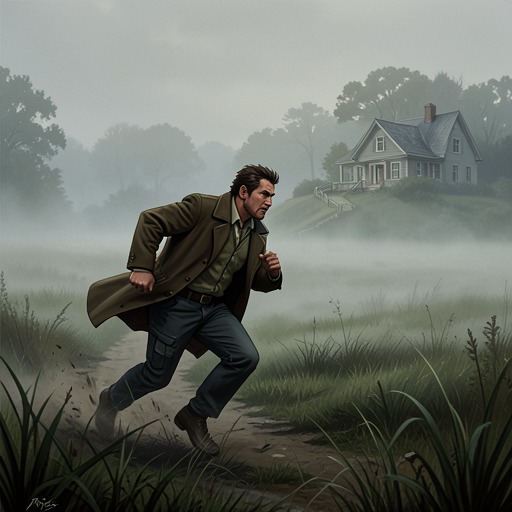
Later, Tristram describes Death as having found his lodgings and gotten him by the throat, while he is too weak to meet him in the open field. He points to his remaining spirits and his legs, which he calls spider legs, and asks Eugenius whether he should flee while he can still support himself. Eugenius advises him to do so. Tristram turns the advice into a journeying plan: he will gallop toward the Garonne, then escape farther if Death follows.
The scene makes travel a response to illness and mortality, not proof that either has been overcome. Eugenius’s affection and wit bring color back to Tristram’s cheek after months of absence; they then part, and Tristram is led to his chaise. He sets off at speed and reaches Dover in a few bounds. The departure supplies a temporary answer to the threat, while leaving the pursuit—and his bodily vulnerability—unresolved.
Travel as bodily constraint
The French journey also shows how ordinary travel frustrates the wish to rest. Tristram describes trying to sleep in a comfortable carriage, only to be woken at each stage by the need to pay for horses: counting out three livres fifteen sous, settling discrepancies, and checking the small print in a book of post-roads. Other requests and disputes keep the traveler alert. The passage makes movement no simple escape from physical limits; the route itself repeatedly demands attention and interrupts sleep.
His account of the journey is equally alert to the difference between what a traveler sees and what travel writing claims to know. He admits that he knows little of Calais, having landed in the evening and left in darkness, yet boasts that he could assemble a convincing chapter by drawing inferences and putting details together. The self-mockery exposes the gap between direct observation and polished description. Set beside his ill health, this admission also emphasizes the conditions under which his narrative proceeds: limited sight, interrupted rest, and a body that cannot guarantee the time or strength his writing requires.