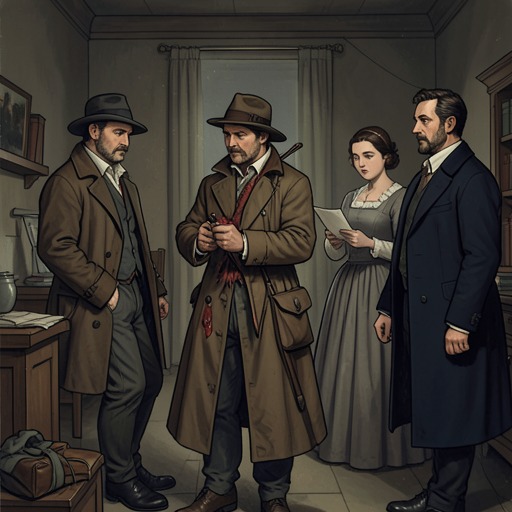
Uncle Toby falls in love with Widow Wadman
The Life and Opinions of Tristram Shandy, GentlemanUncle Toby falls in love with Widow Wadman as his military ardor ebbs and a new, delicate pursuit takes its place. The narrator refuses to define love before telling the story, announces the attachment in plain terms, and then unsettles its chronology by placing news of Toby’s prospective marriage before the moment when he supposedly falls in love. The event begins a courtship while also making the act of narrating it part of the joke.
From military ardor to gentler pursuits
The change comes against the background of Toby’s declining enthusiasm for war. He and Corporal Trim briefly revive their spirits by discussing the demolition of Dunkirk: their imagined retreat proceeds from the outworks and Fort Louis toward the town, then to the mole, the harbor, and finally the citadel, before they embark for England. The consultation offers Toby a short return to the pleasures that are slipping away from him, but it cannot restore their former force.
The narrator gives that loss a sustained contrast. Names of places where Toby’s military imagination once ranged—Amberg, Rhinberg, Limbourg, Huy, Bonn, Landen, Trerebach, Drusen, and Dendermond—no longer quicken his blood. Saps, mines, blinds, gabions, and palisades no longer keep at bay the stillness settling over him. Even his imagined advance through France to Paris, crowned by the royal standard on the Bastille, belongs to a fading repertoire of military dreams. War’s trumpet gives way to the lute, a change in the narrative’s governing image as much as in Toby’s disposition: his next adventure is to concern love rather than fortification.
The narrator’s refusal to define love
Before reporting Toby’s attachment, the narrator anticipates the reader’s expectation that a treatise on courtship should begin by defining love. He declines to do so. Speculations about whether love is partly divine and partly diabolical, or wholly one or the other, are presented as disputatious abstractions rather than necessary preliminaries to telling a story. The narrator’s stated test is practical: the ordinary word will suffice until the account becomes unintelligible without further explanation.
That refusal also makes language itself part of the episode. The narrator objects to the idiom of having “fallen in love,” since it seems to imply that love is beneath a man, and rejects the philosophical premise he associates with that implication. Yet, after contesting the phrase, he uses it to report the event, then restates it more simply: Toby falls into love. The small shift turns a familiar expression into a comic problem of wording without obscuring what happens.
The account does not offer a scene of courtship or explain the process by which Toby’s feelings arose. Instead, it establishes their force through the narrator’s confident announcement and his extravagant endorsement of Widow Wadman as an object of desire. The episode’s emphasis is therefore less on a documented sequence of romantic actions than on the transition itself: Toby’s attention has moved from military plans toward a woman, and the narrator presents that movement as the beginning of a new narrative course.
A courtship announced ahead of itself
The story’s order complicates the announcement. The narrator explains that Susannah had received an express from Mrs. Bridget reporting Toby’s falling in love with her mistress fifteen days before it happened. Susannah passed the news to Toby’s sister-in-law, Mrs. Shandy, the following day. This advance report gives the narrator an opportunity to begin the account of Toby’s amours a fortnight before their existence, so that the courtship enters the narrative first as news of what is yet to come.
Mrs. Shandy brings the report to Mr. Shandy while he is holding one of his second “beds of justice” and considering the hardships of matrimony. She tells him that his brother Toby is going to marry Mrs. Wadman. Mr. Shandy responds not by asking how the news came about, but by imagining what marriage would cost Toby: he would no longer be able to lie diagonally in his bed. The reply makes the report comic through its mismatch of scale. Marriage is announced as a major change in Toby’s life, while Mr. Shandy immediately translates it into a question of bodily comfort and sleeping space.
The advance report is not simply a piece of family gossip. It lets the narrator distinguish between the chronology of events and the order in which they are told, making anticipation precede its supposed cause. The reader hears that Toby is on his way to marriage before the account reaches his falling in love. This structural displacement keeps the outcome in view while the narrative pauses over the meaning of love, and it turns the courtship into a test case for the narrator’s freedom to digress and rearrange time.
Significance of the turn
Toby’s new attachment redirects a character whose imagined life had been organized around campaigns, sieges, and military maps. The contrast does not erase his earlier military interests; it shows that their hold on him has weakened enough for gentler concerns to enter. The lute replacing the trumpet anticipates that change without supplying details the narrative has not yet given about the courtship itself.
The episode also sets the terms for the story that follows. The narrator calls Toby’s courtship a subject capable of supporting both a system of love and a practical account of love-making, but immediately resists turning that promise into a conventional definition or orderly exposition. His handling of the event—announcing the attachment, questioning the words used to name it, and then beginning the tale before it occurs—makes courtship inseparable from the book’s comic treatment of explanation and narrative sequence. At this point the evidence establishes the beginning of Toby’s love and the family’s expectation of marriage, not the courtship’s resolution.