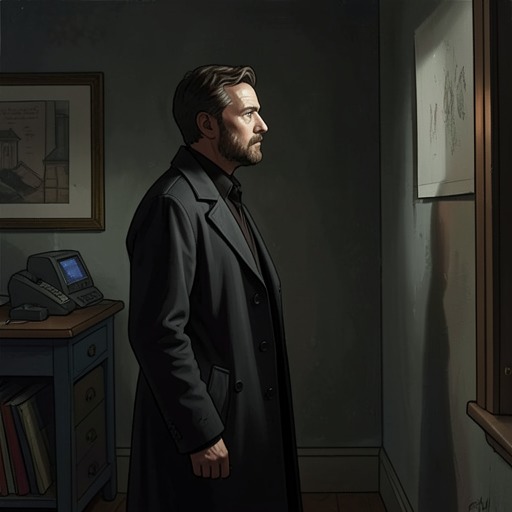
Uncle Toby’s military maps and plans
The Life and Opinions of Tristram Shandy, GentlemanUncle Toby’s military maps and plans are working instruments of his military imagination and, in his courtship with Widow Wadman, props that make strategy legible as flirtation. A plan pinned inside his sentry-box draws the widow into carefully staged approaches; a map of Namur later records the distance and location of his wartime wound, while helping to expose the bodily misunderstanding that unsettles their encounter. These papers do more than depict fortifications: their pins, stains, and measured distances become evidence in the intimate plots played out around them.
Use in the Sentry-Box
During Uncle Toby and Corporal Trim’s campaigns, Toby keeps a plan of whichever town or fortress they are working on pinned inside the sentry-box, on the side to his left. The map is secured by two or three pins at the top but left loose at the bottom, so he can lift it to his eye when circumstances require. Its arrangement makes the plan immediately useful for examining the ground, but also leaves it ready to be handled by someone standing at the box.
Widow Wadman exploits that arrangement. When she reaches the sentry-box door, she extends her right hand, edges her left foot forward, and takes hold of the map or plan. She stretches her neck toward it, while Uncle Toby catches the opposite corner in his left hand. The document provides a shared object and a reason for their hands to meet: a military consultation becomes one of the widow’s attacks, and Toby’s passions catch fire. The scene’s comedy depends on the difference between what the map is for and what it enables. It remains a plan of a fortress, yet in the sentry-box it also serves as an instrument of approach.
The Plan of Bouchain as a Record
The novel later gives this flirtation a material trace. Among a bundle of original papers and drawings preserved by Walter Shandy is a plan of Bouchain, still in excellent condition. On the lower right-hand corner, a mark made by a snuffy finger and thumb is attributed, with deliberate qualification, to Widow Wadman. The opposite side of the margin, supposed to have been Uncle Toby’s, is entirely clean.
The map preserves more than the stain. Two puncture marks remain visible on the opposite corner, partly grown over but still identifiable as the holes through which the plan had been pinned inside the sentry-box. Its physical details allow the narrator to treat it as an authenticated record of one of Widow Wadman’s attacks: the dirty corner suggests her touch, while the pinholes connect the surviving sheet to the arrangement that made their encounter possible. What might otherwise have passed as a fleeting, equivocal gesture is made durable by the paper.
The narrator prizes this relic above the relics of the Roman Catholic Church, while making an exception for the reputed marks associated with Saint Radagunda. The comparison turns the map into a mock sacred object: its stains and punctures are not devotional traces but evidence of a courtship conducted through military props. The plan’s value lies precisely in its ordinary material history, preserved in marks that the narrative interprets as intimate testimony.
The Map of Namur and the Wound
A different map enters the courtship when Widow Wadman asks Uncle Toby where he received his wound. She glances toward the waistband of his red plush breeches, expecting him to point to his body as the shortest answer. Toby understands the question geographically instead. He remembers that the stone struck him before the Gate of St. Nicolas, in a trench traverse opposite the salient angle of the demi-bastion of St. Roch, and says he could place a pin on the exact spot where he had stood.
That recollection brings his large map of the town and citadel of Namur and the surrounding area into the scene. Toby had bought it and, with Corporal Trim’s help, pasted it onto a board during his long illness; it has remained with other military equipment in the attic. The corporal is sent to fetch it. The map thus connects the present conversation to Toby’s convalescence and to the precise terrain of his injury, translating a bodily question into a military account of place.
With Widow Wadman’s scissors, Toby measures thirty toises from the returning angle before the Gate of St. Nicolas and places her finger on the location. The narrator calls attention to her modest manner as she touches the map, but also to the mistake that prevents her from explaining what she believes she has established. The object supplies a location with apparent exactness; it does not, however, resolve the difference between the place Toby indicates and the bodily implication Widow Wadman had expected him to address. The more meticulously the ground is measured, the more conspicuous the misunderstanding becomes.
Reappearance and Narrative Function
The Namur map does not end in the room where Toby and Widow Wadman examine it. It is carried down into the kitchen, where Corporal Trim uses it to explain the terrain to Bridget. He points out the Meuse and Sambre, the town and citadel of Namur, and the positions of the French, then identifies the trench in which Toby received the wound that crushed him so miserably. As he speaks, Trim takes Bridget’s hand and presses its back slightly toward the part he feels for before letting it fall.
Bridget observes that they had thought the wound was more in the middle; Trim replies that such a location would have undone them forever. The map has now passed from Toby’s military recollection to Trim’s demonstration for Bridget, repeating the comic displacement between a wound’s place on a map and its imagined place on the body. It serves first as a record of Toby’s service, then as the instrument of a mistaken reading, and finally as a prop in another charged exchange.
Across these episodes, the maps and plans make space tangible while exposing how easily it can be misread. Their military function remains real: they show fortresses, rivers, streets, and the position of troops. Yet the narrative repeatedly turns them toward intimate encounters, where a loose corner invites Widow Wadman’s hand, an old pinhole authenticates a flirtatious maneuver, and a measured distance cannot prevent confusion about Toby’s wound. The papers preserve the physical world of Uncle Toby’s military hobby even as they reveal how its geography shapes, redirects, and complicates courtship.