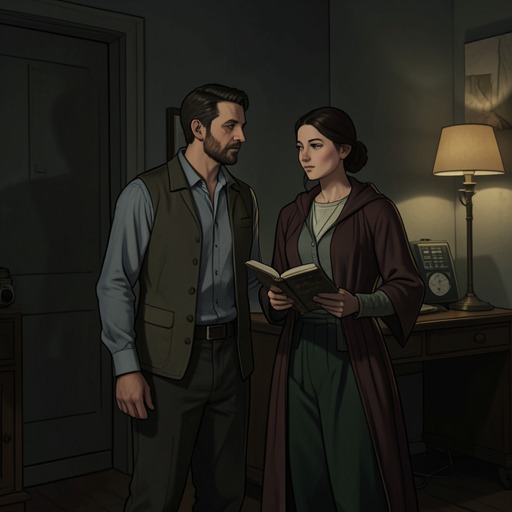
Walter Shandy and Mrs. Shandy
The Life and Opinions of Tristram Shandy, GentlemanWalter Shandy and Mrs. Shandy are spouses whose relationship appears both in consequential legal arrangements and in the quiet, comic coordination of household life. Their marriage settlement gives Mrs. Shandy a conditional right to travel to London for childbirth, while the later courtship of Uncle Toby brings the couple together as observers and supporters. Their exchanges suggest familiarity and affection, but also preserve differences in temperament and in how they interpret one another.
Marriage and the Settlement
The marriage settlement gives the relationship an unusually explicit legal framework. If Walter had retired from business to the country while Mrs. Shandy could still bear children, he was to provide money for her journey and lying-in in London. The covenant specified £120, paid through trustees, to hire a coach and capable horses and cover incidental expenses. Mrs. Shandy was also permitted to choose where and with whom she would stay in London, as though unmarried, despite her existing coverture.
The arrangement made her ability to travel depend on the terms of the deed, and it anticipated possible disagreement between the spouses. A further clause required her to forfeit the right to the next London journey if she had given false signs of impending delivery. The narrator says that his uncle Toby had prompted the concern about unfair play. In the narrator’s rueful account, this provision’s consequences fell on him: in September 1717, Walter insisted on the clause when Mrs. Shandy had taken him to London, and the narrator connects that decision to the compression of his nose before birth.
Walter’s Counsel to Toby
When Uncle Toby begins preparing to court Widow Wadman, Walter turns his attention to his brother’s prospects. He writes Toby a letter of instructions about women and courtship, presenting it as a token of brotherly love. The letter is composed while Mrs. Shandy is close beside him, preparing for bed; Walter remarks that Toby’s need for guidance gives him an occasion to write. His counsel includes a reminder to seek God’s protection before setting out on the enterprise, as well as practical advice about his appearance.
Walter’s advice becomes an instrument in the planned approach. As Toby and Corporal Trim prepare to make their attack the next morning, Walter and Mrs. Shandy decide to walk down to Toby’s to encourage him. Walter puts the letter into Toby’s coat pocket before joining Mrs. Shandy in wishing him success. The scene makes the marriage a partnership in attending to Toby: Walter supplies instruction, while both spouses lend their presence and support.
Curiosity, Teasing, and Reconciliation
Mrs. Shandy says she would like to look through the keyhole, out of curiosity. Walter invites her to do so, but pointedly tells her to call the impulse by its proper name. The narrator presents the remark as an insinuation and leaves room for differing interpretations of her wish to watch Toby’s courtship. Walter’s teasing is not the last word: he is described as frank and open to conviction, and his conscience troubles him almost as soon as he has spoken.
Their physical exchange remains slight but meaningful. Mrs. Shandy’s left arm is linked under Walter’s right, her hand resting on the back of his; she raises and lowers her fingers in a gesture the narrator says might be read as either remonstrance or confession. Walter understands it as a rebuke, turns his face away, and then meets her eye as she moves in front of him. The moment does not establish a new dispute so much as show their capacity to register and answer one another without a formal explanation.
A Difference in Temperament
The narrator contrasts Mrs. Shandy’s composure with the suggestive implication Walter has made. He describes her as temperate in every season and says that neither devotional reading nor Walter’s example stirred the kind of fancy attributed to her. In the same passage he turns the contrast back toward himself, noting that he is writing in August 1766 and recalling Walter’s prediction that he would neither think nor act like another man’s child. The claim belongs to the narrator’s comic self-portrait, not to an independent account of Mrs. Shandy’s inner life; her supposed lack of desire is framed through his and Walter’s interpretations.
Kinship and Household Bonds
A legal debate over the estate of the Duke of Suffolk gives the couple’s family relationship an unexpected, comic complication. In the cited case, lawyers concluded that a mother was not legally kin to her son under the rule being discussed. Uncle Toby asks what the duchess herself had said, interrupting the confident legal argument. Later, Yorick applies the conclusion to the Shandy family: Mrs. Shandy is said to be no kin to Tristram, and Walter, through the maternal line, is said to be even less related. Walter shakes his head at the conclusion, while Toby insists that there must have been some kind of consanguinity between the duchess and her son.
The episode places the spouses within the book’s recurring collision between formal definitions and lived family attachment. The legal reasoning can describe Mrs. Shandy’s connection to her child as negligible, but the household scenes show her alongside Walter in decisions, gestures, and shared concern for Toby. Their marriage is thus represented not by a single declaration of intimacy, but through a settlement that regulates family life, a joint act of encouragement, and the familiar exchanges that expose both affection and comic misunderstanding.