Association of ideas
The Life and Opinions of Tristram Shandy, GentlemanAssociation of ideas is the mind’s tendency to connect one perception or thought with another, and in Tristram Shandy it is both a comic source of misdirection and a fundamental account of how belief, memory, and reasoning take shape. A clock winding, a bell ringing, or a chestnut picked up from the floor can set off chains of thought whose consequences far exceed their causes; the same associative power, deliberately harnessed, becomes an instrument of education.
Accidental Associations and Domestic Memory
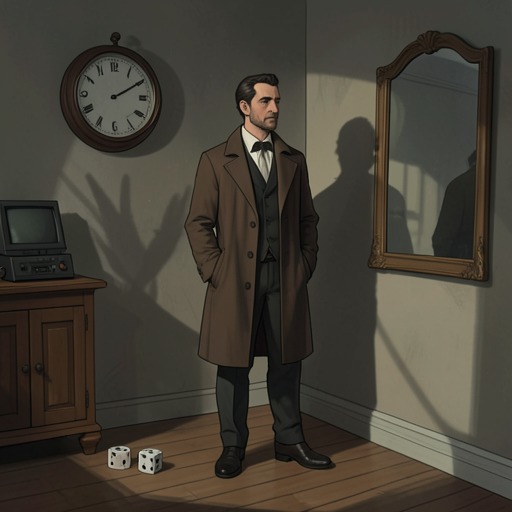
The household clock makes the concept concrete. Walter Shandy, a man devoted to regularity, winds the large clock on the back stairs with his own hands on the first Sunday night of every month. He has arranged other family concerns to coincide with that recurring task, hoping to get them all out of the way at once. But the regular act acquires an unintended mental companion: through an association with no natural connection, Tristram’s mother cannot hear the clock wound without other thoughts intruding, and those thoughts in turn summon the clock. The sound thus becomes entangled with matters that ought to have remained separate.
The narrator invokes Locke’s account of how such arbitrary connections can produce prejudice and distorted conduct. The clock is not merely a timekeeping device in this passage; its repeated sound has become a cue that pulls the mind along a route it did not choose. The episode also turns a mechanical household routine into a small demonstration of how an accidental pairing can govern future thought. The narrator briefly sets the incident aside, but its logic recurs throughout the novel: minds do not always proceed from causes to conclusions by a straight path.
Habit, Wit, and the Growth of Belief
Walter’s opinions offer a longer, more deliberate version of the same process. He is not formally trained in logic and does not know the names of its tools, yet he continually defends a multitude of comic, skeptical notions. Some begin as whims, entertained for amusement and then dismissed. The danger, as Tristram describes it, is that ideas first admitted in jest may remain in the mind long enough to establish themselves there, working like yeast or a passion that begins playfully and ends in earnest conviction.
The doctrine of Christian names shows that this transformation has occurred. Walter is serious about the influence names exert; he becomes systematic in defending the hypothesis and will twist evidence from nature to support it. His certainty is not presented as simple proof that every unusual opinion is false: Tristram leaves open whether Walter’s judgment has become the dupe of his wit or whether he may be right in some of his claims. The emphasis falls on how an idea gains its footing and becomes a governing system. Once repeatedly entertained and defended, a thought can cease to be a passing amusement and start organizing what its holder notices and believes.
The Same Signal, Different Trains of Thought
A bell and a knock at the door expose the distance between stimulus and response. Walter concentrates on the interval between the ringing and the rap, measuring their distance and pursuing the problem so intently that he cannot turn from it to draw a useful conclusion. His mind is captured by the mechanics of the signal. The narrator compares this narrowed attention to a familiar weakness of mathematicians: strenuous work on a demonstration can consume the very strength needed to apply its result.
The same sounds produce a different association in Toby. They bring the engineer Stevinus into his mind, though the connection to the immediate situation remains unexplained. The contrast matters: a shared event does not produce a shared thought. Each mind supplies its own chain, and Toby’s line is left unresolved for the moment rather than forced into an immediate explanation. The episode makes the gap between perception and understanding part of the comedy, while the narrator’s postponement turns the reader’s curiosity into another link in the chain.
A Chestnut Becomes Evidence
The hot-chestnut episode shows an association hardening into accusation. After Phutatorius flings the chestnut to the floor, Yorick rises from his chair and picks it up because he considers it still worth having. For Yorick, the act has no deeper significance. Phutatorius, however, reads it as an admission that the chestnut was Yorick’s and, by extension, that Yorick was responsible for the prank. The narrow, parallelogram-shaped table between them supplies an apparent opportunity, and Phutatorius’s suspicious look makes his conclusion visible to the others.
The inference spreads beyond the two men. Because Phutatorius is presumed to know more about the matter than anyone else, his opinion becomes the general one and soon passes beyond dispute. Those present then search backward for a cause: they recall Yorick’s disapproval of Phutatorius’s treatise on retaining concubines and interpret the prank as a satirical attack on that book. The sequence moves from an incidental gesture, through a private inference, to a public explanation. Each new interpretation seems to confirm the last, although the original act was simply the recovery of a chestnut that Yorick thought had not been spoiled.
The narrator explicitly draws attention to the weight of trifles in forming and governing opinions. A slight incident can plant belief so firmly that even Euclid’s demonstrations would not dislodge it. The chestnut therefore functions as more than a prop in a comic misunderstanding: it shows how association supplies a story where evidence is incomplete, and how suspicion, reputation, and an available motive can make that story seem settled. The later search for a first cause does not correct the mistake; it gives the mistake a persuasive explanation.
Association as a Method of Thought
The novel does not treat associative thinking solely as error. Walter’s account of auxiliary verbs turns it into a possible educational method. A word can be elaborated into a metaphor, but the mind then rests until another idea enters. Auxiliary verbs, by contrast, can set the soul working upon the materials supplied to it, opening new paths of inquiry so that one idea may engender many. Walter proposes that a child’s memory be exercised through questions about whether something has been, ought to be, or might be, and through chronological and hypothetical variations.
His white-bear example puts the method to work. Though Trim has never seen a white bear, Walter argues that he can nevertheless discourse about one by considering whether he has ever seen one, might have seen one, is ever to see one, ought to have seen one, or can see one. The exercise distinguishes possession of a direct perception from the mind’s ability to generate questions and possibilities around an idea. Where the chestnut episode shows associations producing an unwarranted certainty, the white bear shows directed verbal prompts multiplying lines of thought without requiring firsthand experience.
Across these episodes, association links the novel’s comic mishaps to its account of how minds operate. An arbitrary connection can burden a household sound with unrelated meanings; a repeated whim can mature into a system; an ambiguous gesture can become public conviction. Yet the same capacity for connection can also be cultivated, turning even an unseen bear into material for inquiry. The concept helps explain why trivial incidents in Tristram Shandy are rarely trivial for long: once an idea catches hold, the mind carries it onward, sometimes into error and sometimes into discovery.