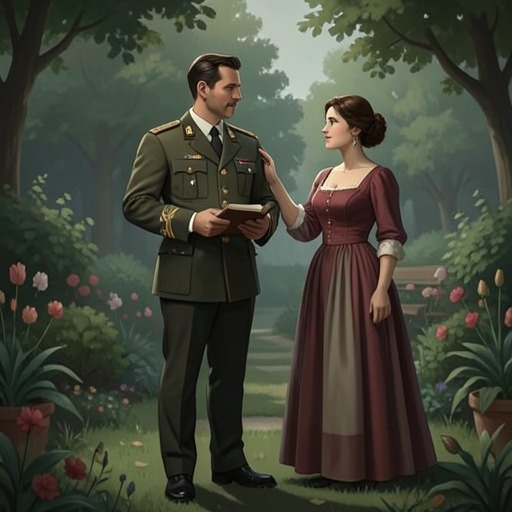
Corporal Trim’s knee wound
The Life and Opinions of Tristram Shandy, GentlemanCorporal Trim’s knee wound is a lasting injury from the Battle of Landen, but the novel makes it more than a record of battlefield damage: it becomes the turning point that places Trim in Uncle Toby’s care and, later, the fulcrum of a disagreement about pain, sympathy, and the suggestive difference between knee and groin. The injury is first interpreted through providence and gratitude; much later, its position on the body becomes the basis for Trim’s pointed correction of Toby’s ideas about compassion.
The wound at Landen
Trim recalls that a shot disabled his knee during the Battle of Landen. In his account, the wound’s significance is not exhausted by the pain or by its military cost. He believes the shot was directed at his knee so that he would leave King William’s service and enter Uncle Toby’s, where, as an older man, he would be better cared for. Toby accepts this providential interpretation: for both master and servant, the accident has become part of the story of their bond. The narrator notes that the two men are alike subject to sudden emotional overflow, and their exchange falls briefly silent before Trim resumes in a gayer tone.
That shift in tone makes room for another consequence of the injury. Trim says that without the single shot he would never have fallen in love. The wound thus marks a change in his life beyond the battlefield: it removes him from one service and places him in a new domestic and personal world. The novel does not detach this development from the physical accident; the knee injury is the hinge on which military misfortune turns into attachment and care.
Battlefield suffering and bodily detail
The recollection also gives the injury a concrete setting of abandonment and delay. With the wounded so numerous that each man had to think of his own safety, Trim says he was left on the field. Toby acknowledges that this happened. Trim was not exchanged and put into a cart with thirteen or fourteen other wounded men until noon the next day, when they were to be carried to the hospital. His account distinguishes the immediate battlefield from the long wait for removal and treatment, without turning the wound into a generalized emblem detached from those circumstances.
Trim describes a knee wound as capable of causing intolerable anguish and supports his claim by pointing to the many tendons around the joint. Toby counters that the groin is more sensitive, also invoking its tendons before leaving the comparison unfinished. The exchange is comic in its anatomical evasions, but it is grounded in the men’s own experience of injury: Trim argues from his wounded knee, while Toby’s answer redirects attention to his own old groin wound. Their disagreement places two damaged bodies beside one another, and lets the language of pain carry a second, sexually suggestive meaning.
The wound as a test of compassion
Much later, Toby invokes Trim’s injured knee while discussing the difference between a mistress and a maid. He asks how often Mrs. Bridget enquires after the wound Trim received at Landen. Trim answers that she never enquires about it at all. Toby treats this absence of attention as evidence that a woman’s compassion would be different if the same mischance had happened to him: he imagines that Mrs. Wadman would have asked repeatedly about the circumstances of his wound. He insists that pain is equally excruciating in either location and that compassion should apply to both.
Trim rejects the comparison’s premise. In his view, a woman’s concern would not be determined by the abstract intensity of pain: Mrs. Wadman would not trouble herself about Toby’s knee any more than Bridget troubles herself about his. He lowers his voice and explains that the knee is far from the body’s main part, whereas the groin lies at the very curtain of the place. The injury therefore becomes evidence in an argument Toby thinks concerns compassion but Trim understands as sexual interest. The bodily distinction exposes the gap between Toby’s hopeful interpretation of Widow Wadman’s concern and Trim’s more worldly reading of what might draw her attention.
Narrative significance
The knee wound returns in separate conversations, first as the origin story of Trim’s service and later as a comparison that brings the wounded body into Toby’s courtship anxieties. Its meaning changes with its narrative use: the battlefield injury is first framed as an outcome of chance made providential by the friendship it enables; in the later exchange, the same injury supplies the counterexample that reveals the limits of Toby’s reasoning. Trim’s knee is real enough to be left untreated on the field and to occasion a discussion of acute pain, yet in Toby’s argument it becomes a device for imagining how Widow Wadman might behave.
The episode’s humor rests on the distance between Toby’s benevolent account of compassion and Trim’s frank attention to bodily location. That contrast does not erase the care between the men: Toby remembers the wound, asks after it, and imagines the pain as deserving sympathy. But Trim’s reply shows that sympathy and desire are not interchangeable, and that Toby’s hopeful expectations may be shaped by what he wants the widow’s concern to mean. Across both recollections, the injured knee binds military contingency to domestic attachment while repeatedly exposing the difference between what Toby believes an injury signifies and what Trim thinks other people will notice.