Diego's nose
The Life and Opinions of Tristram Shandy, GentlemanDiego’s nose is the extraordinary feature around which Hafen Slawkenbergius’s tale turns, transforming a stranger’s passage through Strasburg into a public fixation. Seen from afar, disputed at every stop, and ultimately left without a verdict, the nose becomes an engine of rumor and collective expectation: the city’s inhabitants agree on the stranger’s courtesy and promised return even as they disagree about the feature that has captivated them.
Arrival and First Impressions
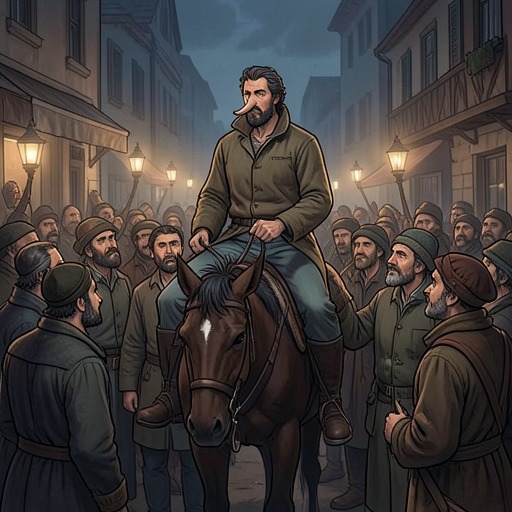
At the end of a sultry August day, a stranger rides into Strasburg on a dark mule, carrying a small cloak-bag with a few shirts, shoes, and crimson satin breeches. He tells the sentinel that he has been to the Promontory of Noses, is bound for Frankfort, and expects to return to Strasburg in a month on his way toward the borders of Crim Tartary. The sentinel looks up at his face and immediately recognizes that he has never seen such a nose.
The stranger handles the attention with conspicuous courtesy. He gives the sentinel a florin, then explains that he has no scabbard for his short scimitar and carries the weapon ready to defend his nose. The gesture makes the feature seem both a source of distinction and something under threat. As he proceeds slowly through the streets, he hears the dispute about him but does not offer the onlookers the access they want.
A Body Under Dispute
The stranger’s promise that his nose will never be touched gives the growing curiosity a definite boundary. With his hands crossed over his breast, he makes a vow to Saint Nicholas; he then continues through the principal streets without answering a burgomaster’s wife who asks what he means. The nose is publicly visible, yet its owner insists on control over how others may approach it.
At the inn, attention hardens into an argument about authenticity. The innkeeper calls the nose false, while his wife insists it is true. Their disagreement is not settled by what they can see. Instead, the nose becomes a test that observers try to resolve through assertion, rumor, and the hope of closer inspection. The tale thus makes its central object vivid in its effects while withholding the simple certainty that would end the dispute.
The stranger’s conduct complicates the crowd’s fixation. When he later describes his journey as more than six hundred leagues and says that he has acquired one of the finest noses ever allotted to a single man, he presents it as a fortunate possession. The innkeeper and his wife continue to inspect it, but the narration also emphasizes the stranger’s generosity and courteous bearing. The nose draws notice, yet it does not exhaust the account of the man who carries it.
Strasburg’s Collective Expectation
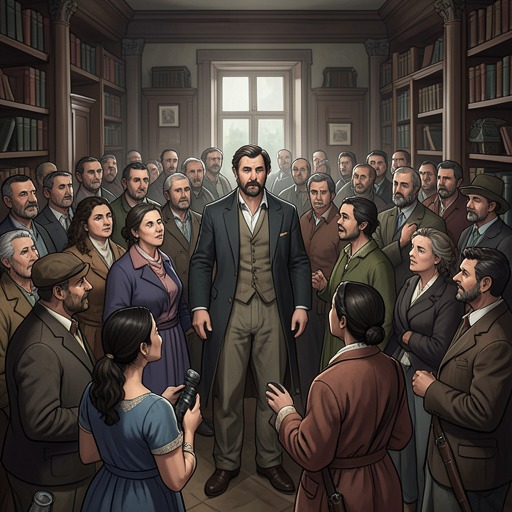
The disagreement spreads far beyond the inn. The sentinel, drummer, trumpeter, trumpeter’s wife, burgomaster’s widow, and innkeeper’s household give differing descriptions, but agree that the stranger is exceptionally handsome, generous, and courteous. They also agree that he has gone to Frankfort and will not return until the appointed day a month later. Agreement about his character and departure gives the city’s speculation a shared timetable, even while the object of that speculation remains unresolved.
The tale describes curiosity overtaking ordinary life: people across social and religious divisions spend their time seeking news, and the city’s inhabitants long to see or touch the nose. The stated desire for contact is precisely what the stranger has refused. That contradiction drives the episode: the more firmly he withholds access, the more completely the nose occupies public conversation and imagination.
When the promised day approaches, the expectation becomes a mass movement. The narrator says that the Strasburgers have gone seven-and-twenty days without eating, drinking, sleeping, praying, or attending to ordinary bodily and religious calls. At sunrise on the twenty-eighth day, an immense procession sets out to meet the stranger. Its reported scale—seven thousand coaches, fifteen thousand single-horse chairs, and twenty thousand wagons—is so extravagant that the narrator himself notes that Slawkenbergius may have misread the numerals. The numbers make the crowd’s appetite for confirmation part of the tale’s comic excess.
The Stranger and the Limits of Proof
The nose’s effects continue to outlast the stranger’s passage. At an inn, a traveler learns that the stranger has occupied the best bed, because the maid Jacinta thought there was not room in a camp-bed for his nose. Hearing this, the traveler kneels and declares that his pilgrimage has reached its end: he identifies the stranger as Diego. The nose, which had been a subject of distant reports and competing descriptions, now helps connect the stranger to the personal search made on behalf of Julia.
The tale nevertheless refuses to answer its defining question at this point. When asked whether the nose was true or false, Slawkenbergius says that answering in advance would injure one of the best tales in the Christian world. He reserves the resolution for the concluding tale of his work, presenting that future disclosure as the ending after which no further tale could follow. Diego’s nose therefore remains both a physical feature and an unresolved narrative promise: it sets the city in motion, brings a search to its destination, and keeps certainty just beyond the reader’s reach.