Eugenius
The Life and Opinions of Tristram Shandy, GentlemanEugenius is both the affectionate companion who keeps Yorick and Tristram company and the unsparing adviser who sees dangers they prefer to dismiss. His recurring role is to test confidence against consequence: he warns Yorick that good intentions cannot prevent others from taking offence, confronts Tristram with the instability of words, and meets the approach of death with sorrowful loyalty and wit. Across these episodes, friendship is not merely a source of comfort; it is the voice that names risk, and the hand that remains when argument can do no more.
Identity and Character
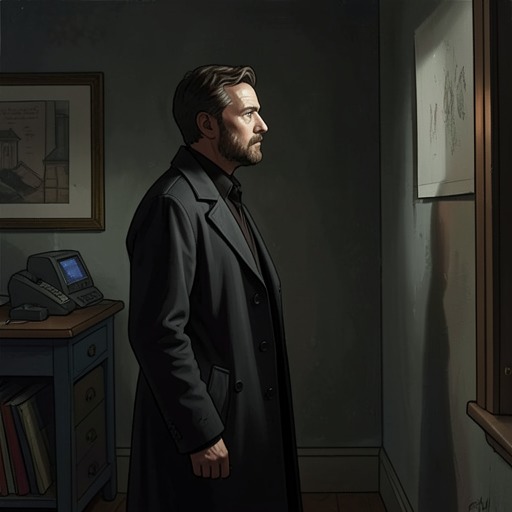
Eugenius is presented chiefly through his relationships and speech. He is Yorick’s intimate friend, repeatedly concerned for Yorick’s safety, and a companion of Tristram in conversations that move freely between serious reasoning and comic digression. The novel gives him no separate biographical account in these episodes; instead, his character emerges from the consistency of his care and from the contrast between his prudence and his friends’ impulsive spirits.
That contrast is clearest with Yorick. Yorick treats the small debts created by his jokes as though their good-humoured origins will ensure they are forgotten. Eugenius rejects that easy arithmetic. His judgment is not that Yorick acts from malice: he explicitly credits him with honesty and sportiveness. The danger, he insists, lies in the gap between the joker’s intention and the injured person’s interpretation, and in the allies who may gather around a perceived grievance.
Counsel to Yorick
Eugenius’s warning about Yorick’s jokes is a compact account of how social retaliation can grow beyond its initiating act. A person laughed at may regard himself as injured; family, friends, and relations may then join in under a sense of shared danger. Eugenius estimates that ten jokes may produce a hundred enemies, not because each target is equally powerful, but because resentment can recruit others. He predicts that revenge may take the form of dishonourable stories, attacks on Yorick’s character and work, and blows directed at the ordinary weaknesses to which everyone is vulnerable.
The warning is especially pointed because Eugenius distinguishes moral innocence from practical safety. He believes that Yorick’s sallies lack spleen or deliberate malevolence, yet argues that fools may not recognize that distinction and knaves may refuse to recognize it. A good heart, in his account, does not make its possessor immune to hostile interpretation. His advice therefore anticipates Yorick’s later persecution: the friend who once predicted that a swarm of enemies would gather around the witful man is also the one who recognizes the cost when that conflict finally overwhelms him.
Yorick does not readily accept the lesson. When Eugenius repeats that he will eventually be called to account, Yorick answers with a dismissive exclamation and, when they are outdoors, a hop, skip, and jump. In the more confined setting of a fireside conversation, where he cannot as easily escape the subject, Eugenius continues his lecture on discretion. The contrast turns their disagreement into a recurring pattern: Eugenius makes the consequences legible; Yorick’s buoyant movement temporarily evades them.
Language, Argument, and Comic Companionship
Eugenius also serves as a reader of language’s double meanings. Walking with Tristram, he points to the word “Crevice” and observes that it carries two senses. Tristram answers by distinguishing a “dirty” road from a “clean” one, then declares that to define is to distrust. Eugenius chooses the clean interpretation, but Tristram claims victory over him and immediately qualifies that triumph as foolish. The exchange makes Eugenius a participant in the novel’s play with equivocation, not simply a guardian of a single, stable meaning. His attention to ambiguity exposes the interpretive choice that a supposedly plain word can demand.
A comic conversation about a minor mishap to Phutatorius gives Eugenius another kind of verbal authority. Asked for advice, he proposes a sheet of freshly printed paper as a neat, safe outward application. Yorick speculates that the paper’s oil and lamp-black do the work; Eugenius agrees, then praises the prescription’s fine distribution of its supposed healing particles, especially when the type is small. The joke depends on treating printing as both practical material and an absurdly precise medical instrument. Eugenius’s mock seriousness gives the exchange its polish, while Yorick’s interventions keep its decorum unstable.
The two friends also share an appetite for intellectual digression. When Tristram celebrates the possible discovery of knowledge through the collision of bodies and proposes sacrificing one of his shirts to an experiment with flint and steel, Eugenius punctures the enthusiasm by reminding him that he owns only a dozen shirts and would break up his set. His practical objection does not end the speculation; it gives the comic argument its human scale. Again, Eugenius acts as counterweight: neither a hostile critic nor a passive audience, he keeps extravagant thought in contact with ordinary cost.
Friendship in the Face of Death
Eugenius’s bond with Yorick reaches its fullest expression in the hours before Yorick dies. He visits intending to take his last farewell. Yorick thanks him for the many proofs of friendship and says that, if they meet again, he will thank him repeatedly. He then tells Eugenius that he is only hours from escaping his enemies forever. Eugenius answers through tears and urges him not to abandon hope, even imagining that enough of Yorick may remain for him to become a bishop. Yorick asks him to look at his head and explains that the blows given by his enemies have left it too damaged for even a heavenly shower of mitres to fit him. His final jest retains a trace of the spirit Eugenius knew, but its wit cannot conceal the damage that has been done.
Eugenius reads that moment as confirmation that Yorick’s heart is broken. He squeezes Yorick’s hand, walks softly out of the room, and weeps as he goes. Yorick watches him reach the door, closes his eyes, and never opens them again. The farewell is structured around small gestures rather than any recovery: a hand held, a hand squeezed, a friend’s departure, and the final closing of Yorick’s eyes. Eugenius cannot reverse the persecution he once foresaw; his presence can only bear witness to its consequence.
After Yorick’s death, Eugenius lays a plain marble slab over his grave, with the three words “Alas, poor Yorick!” serving as both epitaph and elegy. The inscription becomes part of the parish’s daily life: passers-by stop beside the grave, look at the stone, and sigh as they continue on their way. Eugenius’s private grief thus receives a public form, and the brief inscription preserves the pity and esteem that Yorick’s attackers failed to extinguish.
Eugenius and Tristram
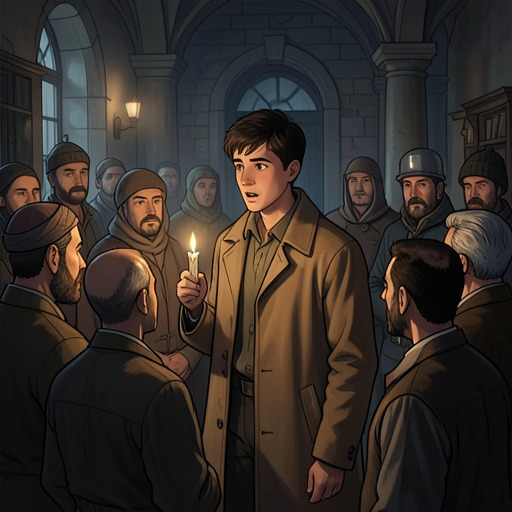
With Tristram, Eugenius’s companionship takes a more immediately comic form, but it retains the same protective impulse. Tristram is telling him an irreverent story about a nun who imagines herself a shellfish and a monk punished for eating a mussel when Death interrupts. Eugenius observes that Tristram has had a narrow escape. Tristram complains that Death has found his lodging and is pressing him, and Eugenius accepts the figure of Death as a pursuer while reminding him that Death entered the world through sin. Their exchange lets Tristram turn fear into banter without pretending that the threat is unreal.
Tristram says he has forty volumes to write and forty thousand things to say and do, and asks whether he should flee while his remaining spirits and his legs can still carry him. Eugenius advises him to go. Tristram imagines a route from the banks of the Garonne to Mount Vesuvius, then Joppa, and finally the end of the world; Eugenius answers that the pursuer would run greater risks there than Tristram would. The reply does not defeat mortality by argument. It gives the threatened traveler a moment of comic courage, and Eugenius’s wit and affection visibly bring colour back to Tristram’s face. He leads him to his chaise, and Tristram sets off at speed, reaching Dover in half a dozen bounds.
Narrative Role
Eugenius connects several registers of the novel without reducing them to one. His counsel on jokes is serious because it anticipates the destructive force of collective resentment; his dispute with Tristram over definition is comic because meaning can split in two; his advice to Phutatorius turns print into a mock medical device; and his final exchanges with Yorick and Tristram make friendship the human measure of mortality. Across these scenes, he is a voice of foresight, but not one granted the power to prevent what he foresees.
His importance lies as much in what he witnesses as in what he advises. Yorick’s buoyancy cannot cancel the enemies gathered against him, and Tristram’s flight cannot abolish Death. Eugenius remains beside both men at the point when their habitual comic defences meet their limits: he warns, jokes, counsels, grieves, and gives a dead friend a remembered name. The pattern makes him a steady presence within a narrative otherwise delighted by digression and instability—a friend who cannot secure safety, but can make danger intelligible and loss shared.