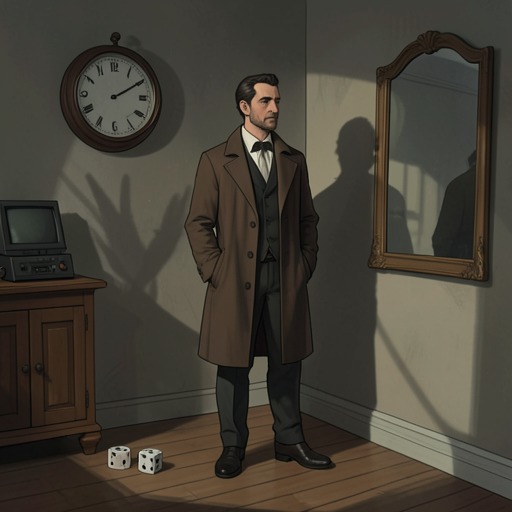
Fate, contingency, and free will
The Life and Opinions of Tristram Shandy, GentlemanFate, contingency, and free will are not settled into a single doctrine in The Life and Opinions of Tristram Shandy, Gentleman. Instead, the novel lets apparent design and accidental occurrence coexist: the circumstances of Uncle Toby’s courtship seem almost providentially arranged, while Toby distinguishes what may happen from what need not happen, and Corporal Trim gives his own life a meaning shaped by both predestination and retrospective interpretation. The tension matters because it turns private experience into competing explanations of how a life takes its course.
Design and the Courtship
The narrator frames Uncle Toby’s and Widow Wadman’s amours as if the Fates had anticipated them. From the creation of matter and motion, they have supposedly fastened causes and effects together so tightly that Toby could scarcely have lived in another house or occupied another garden without losing the very setting that brings him alongside Widow Wadman. The claim makes geography feel like destiny: the neighboring properties appear to have been prepared for this courtship before either participant could direct its course.
The arrangement is also strikingly practical. A thickset arbour in Widow Wadman’s garden, planted along the hedge-row of Toby’s, lets her observe his movements and learn his councils of war. Toby’s trusting permission for Corporal Trim, through Bridget’s mediation, to make a wicker gate between the gardens enlarges her walks and gives her a route toward the sentry-box. The image of love as a military campaign is thus joined to a chain of ordinary permissions and garden features. What looks like fate operates through particular circumstances, and those circumstances also leave room for Widow Wadman’s initiative: she can approach, observe, and sometimes attack Toby in the sentry-box.
Happenstance and Limits
In a conversation about the King of Bohemia, Toby insists on the accuracy of Trim’s word “happening.” The king and his queen might have gone for a walk on a summer evening, or they might have stayed in; the choice is a contingency, ordered by chance rather than made inevitable. Toby supports the distinction with a geographical argument. Bohemia is inland, bordered by Silesia and Moravia to the east, Lusatia and Upper Saxony to the north, Franconia to the west, and Bavaria to the south. The sea could not be brought to Bohemia without flooding much of Germany and destroying millions of people unable to defend themselves. To Toby, that destructive impossibility also speaks to the lack of compassion such an act would imply in the father of creation.
This reasoning does not dismiss providence. It instead makes Toby wary of treating every occurrence as necessary: a walk may or may not happen, while an imagined alteration of the natural world would carry consequences that rule it out. The discussion holds contingency beside moral and physical limits. Chance is not presented as proof that the world has no order; neither is a general belief in order allowed to erase the difference between what could happen and what actually does.
Trim’s Wound as Destiny
Trim introduces a more personal account of predestination. He recalls King William’s belief that everything in the world was predetermined and his saying to the soldiers that “every ball had its billet.” Trim applies that principle to the shot that disabled his knee at the Battle of Landen. He believes it was directed there to remove him from the king’s service and place him in Toby’s, where he would be better cared for in old age. Toby accepts this interpretation without reservation, promising that the shot will never be construed otherwise.
The moment reveals how an injury can be made legible as the beginning of a different attachment. The shot is first a battlefield wound and a loss of military service; in Trim’s account, it is also the cause of his life with Toby and the care he receives. The master and servant are both overcome by feeling, and a brief silence follows. Their shared emotion gives the story of destiny a relational consequence: the interpretation consoles and binds them, even though the account cannot independently establish that the shot was aimed for that purpose.
One Shot, More Than One Future
After the silence, Trim adds that without that single shot he would never have been in love. This extension shifts the same accident from service and care to romantic experience. Asked by Toby whether he was once in love, Trim begins to recount it, specifying that it was on a Sunday afternoon. He says that he had escaped falling in love up to that point and would have continued to the end of the chapter had it not been predestined otherwise; there is, he says, no resisting fate. The recollection then opens onto a still, hushed scene around the house.
The account does not resolve whether Trim’s love was inevitable or only appears so when he looks back over the turning points of his life. The shot can be described as chance, as predestined, or as the beginning of a chain whose meaning becomes visible only afterward. Toby’s qualification about the king’s walk and his acceptance of Trim’s personal reading therefore remain side by side rather than collapsing into a doctrine. The novel makes that unresolved balance part of its narrative method: events invite causal stories, but the stories themselves expose the distance between an occurrence and certainty about why it occurred.