France
The Life and Opinions of Tristram Shandy, GentlemanFrance is more than the destination of Tristram Shandy’s journey: it is the country through which the novel tests the difference between movement and knowledge. Its roads, towns, tolls, and travel regulations repeatedly frustrate the traveller’s plans, while the narrator turns those frustrations into satire of guidebook certainty and literary convention. France also provides a landscape for imagined freedom and escape, and a political example that Walter Shandy invokes in his argument about power and local influence.
Routes, towns, and the limits of sight
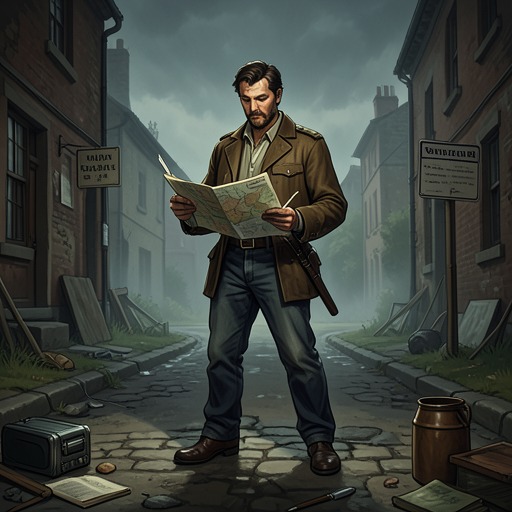
Between Calais and Paris, the traveller faces three competing roads, each advocated by deputies from the towns along it. The choice can consume half a day before the journey has properly advanced. The alternatives promise different attractions: the route by Lisle and Arras is longer but more interesting and instructive, while the road by Amiens offers access to Chantilly. The practical question of where to travel thus becomes an early example of the way a journey expands into deliberation and competing descriptions.
Calais makes the gap between seeing a place and writing about it especially explicit. Tristram arrives at dusk and leaves in darkness, admitting that he knows scarcely more of the town than what his barber told him while sharpening his razor. Yet he claims that by joining fragments of information and drawing one thing from another, he could produce a detailed account convincing enough to make him seem the town clerk. The joke is not simply that he has failed to look; it is that fluent description can simulate firsthand knowledge even when the supposed observer has barely seen the place.
He then performs that very confidence under the mock-scholarly heading “Calais, Calatium, Calusium, Calesium.” The account attributes the town’s growth from a small village to the gradual passage of time, and repeats an archival population figure of fourteen thousand, with another four hundred and twenty families in the lower town or suburbs. Its church description follows the same method: because the population is large, the church must be large enough to hold them—or else another church ought to have been built. The cross-shaped church, central spire, four supporting pillars, eleven altars, and white-marble high altar near sixty feet high give the description a convincing accumulation of particulars, even as the narrator has already shown how insecure its observational basis is.
Montreuil exposes another difference between representation and experience. On the map it looks better than any town in France; in the post-road book it looks less impressive, and in person it appears pitiful. The innkeeper’s daughter, by contrast, is singled out as handsome. Her education in Amiens and Paris has taught her needlework, knitting, dancing, and small coquetries; the narrator then scrutinizes the dropped loops in her white stocking and turns the stop into a comic exercise in the traveller’s gaze. The town is reduced by comparison with its cartographic promise, while a person encountered on the spot draws the narrator’s attention into a very different kind of description.
Travel as interruption and expense
The French road does not permit uninterrupted sleep, even when the country is beautiful, the carriage comfortable, and the traveller believes he could sleep for fifty miles. At every stage the payment for horses requires him to reach into his pocket and count three livres and fifteen sous. Preparing the precise amount in advance does not solve the problem: a further two sous may be wanted for drink, a coin may be refused, or money from the previous stage may be disputed. The traveller must consult the small print in his road book to discover whether the charge covers one post or a post and a half, and the effort of calculation brings his mind awake again.
Other interruptions make rest still less attainable. A priest offers snuff; a poor soldier displays his leg; a religious figure presents a box; and a woman responsible for watering the wheels insists on doing so although the traveller believes they do not need it. Each encounter demands attention or argument. The passage makes travel less a smooth crossing of distance than a succession of small claims on money, judgment, and wakefulness. Even the plan to sleep becomes another project the road can defeat.
The post-chaise itself becomes an object lesson in how an apparent misfortune can be converted into a new itinerary. Walking into Lyons beside the baggage cart, Tristram is glad that his chaise has been broken to pieces: he calculates that he can go by water to Avignon for seven livres, travel a hundred and twenty miles, and then hire mules or asses to cross the plains of Languedoc. He imagines saving four hundred livres and gaining pleasure as well as economy. The Rhône, the cities of Vienne, Valence, and Vivieres, the vineyards, castles, rocks, and cataracts become part of this freshly invented prospect. As he looks at the wreck, however, it seems to shrink in value; a chaise-undertaker appears, and Tristram agrees to sell it, reckoning the ironwork at forty livres and the glass at another forty. The broken vehicle is at once a loss, a prompt to change course, and a resource to be liquidated.
That change of travelling mode collides with French postal regulation. A commissary explains that someone who sets out from Paris in a post-chaise cannot simply change his intention without paying the fermiers for two additional posts beyond the place where he changes his mind. The rule, as explained, protects revenue from a traveller’s fickleness. Tristram’s reading of the ordinance becomes a comic confrontation between the literal burden of regulation and its stated administrative purpose; he concludes that if fickleness is taxable, the best course is to make peace with France. The joke rests on a real constraint within the journey: changing how one travels is not merely a private choice when the system attaches a charge to changing one’s mind.
The country, the traveller, and travel writing
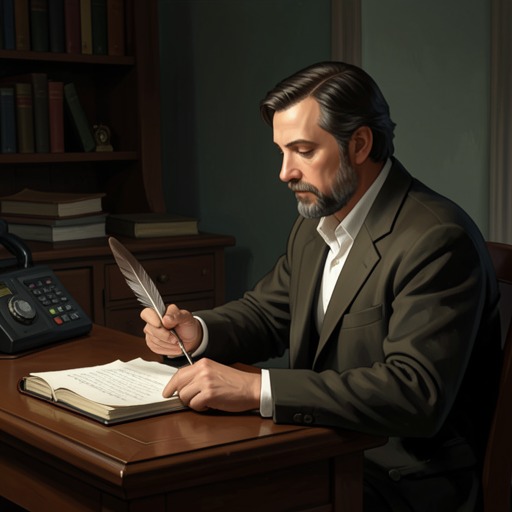
France also supplies the narrator with a running argument about what travel books do to experience. He objects to the convention that a writer must pause in every town and draw a pen at every crossing, producing an account simply because the place has been reached. He distinguishes among writers who travel and write, those who write while galloping, and those who attempt to write at a gallop. The caricature makes speed and observation sit uneasily together: the traveller may be moving through a place while the prose follows inherited habits rather than what the traveller has actually seen.
The uncertainty is not limited to Calais. When Tristram considers the saying that those who have seen Paris have seen everything, he refuses to settle whether the French are at fault for failing to explain themselves precisely or whether outsiders misunderstand their language. He narrows the claim by distinguishing daylight from candlelight. In artificial light, Paris offers five hundred grand hotels and, on a modest estimate, five hundred good things to be seen, felt, heard, and understood; yet hardly one person in fifty can get properly among them. The city’s abundance therefore becomes less a stable inventory than an experience of limited access and unreliable illumination.
Tristram’s own view of the journey is shaped by bodily condition and disposition as much as by the places passed through. He concedes that travel across France and Italy brings theft, overcharging, and inconvenience: a pistol tinder-box is stolen at Sienna, and hard eggs cost five pauls at Raddicoffini and again at Capua. Yet he rejects the idea that such troubles make a journey wholly bad, provided a traveller keeps his temper. Roads must have ups and downs to lead into the valleys where nature spreads her tables; a charge for greasing wheels supports the peasant who needs butter for bread. He urges travellers to pay rather than let disappointment cloud the departure, and says that a sisterly kiss from each hostess and her attendants can be worth the extra expense.
This expansive goodwill has a narrative cause as well as a traveler's philosophy: thoughts of Uncle Toby’s love affairs run through Tristram’s mind and make him feel generous toward everything he encounters. The chaise’s motion, whether the road is rough or smooth, seems to set off some inward spring of sentiment or rapture. When he hears Maria playing her pipe, the postillion identifies her and describes her sitting on a bank with her little goat beside her, playing her vespers. The scene joins the physical progress of the carriage to the narrator’s readiness to be moved: the journey’s meaning changes with the associations he carries into it.
Distance, escape, and political contrast
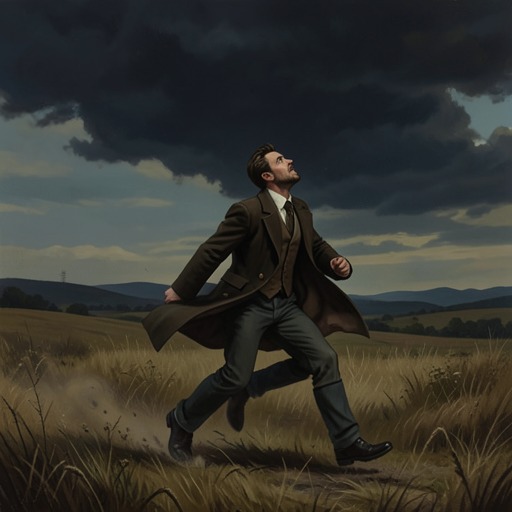
Once he has a mule beneath him, Tristram imagines traversing the south of France from the Rhône to the Garonne at leisure. He has left Death behind—or thinks he has—and pictures the pursuer lagging, his expression softened by every lost step. Yet Death continues to follow, while Tristram continues to flee cheerfully. The pursuit turns the geography of France into a measure of temporary reprieve: the plains and the slow mule promise a different pace from the rattling course that came before, not a final escape.
The same plains also provoke a satirical contrast between the traveller’s pleasure and the travel writer’s problem. A wide, rich plain can delight a person crossing it, but trouble a writer looking for dramatic variety. Once the prose has called it delicious or delightful and praised its grateful soil and abundance, the landscape may seem to offer nothing more to report; it carries the traveller to the next town, which may chiefly serve as a starting point for the next plain. The route is continuous, but conventional description risks making it repetitive. France thus exposes a formal difficulty: a landscape need not be empty of value merely because it resists the familiar catalogue of sights.
France also figures in Walter Shandy’s political reasoning. He asks why so few palaces and gentlemen’s seats remain across its provinces, and why the châteaux that survive are dismantled, unfurnished, and ruinous. His answer is that men in France lack a country interest to support: what local influence exists is concentrated at court and depends on the Grand Monarch’s favor. Frenchmen, in this account, live or die by the sunshine of the sovereign’s countenance or the clouds that pass across it. Walter connects that diagnosis to his opposition to a country confinement for his wife’s lying-in, arguing that such an arrangement would strengthen the gentry and add to their already usurped constitutional influence. France is therefore not only the setting of Tristram’s mobile, comic encounters; it is also a political comparison through which Walter makes a case about power at home.
Across these episodes, France is never a single, settled object of knowledge. It is a route chosen amid competing claims, a town reconstructed from scant evidence, a network of stages that breaks sleep and taxes changes of plan, a landscape that rewards slow motion, and a political example filtered through Walter’s argument. The country’s narrative importance lies in that instability: the traveller keeps moving, but what the movement means depends on what he sees, what he cannot see, what he has been told, and what his own associations lead him to notice.