Mules
The Life and Opinions of Tristram Shandy, GentlemanMules recur throughout the book not as interchangeable transport but as consequential presences in travel scenes: they carry people and baggage over long distances, slow or interrupt journeys, and sometimes appear to decide for themselves when movement will stop. Their practical labor is repeatedly drawn into comic contrast with human impatience and grand plans. The result is a creature that enables travel while also setting its pace and limits.
The Stranger’s Mule
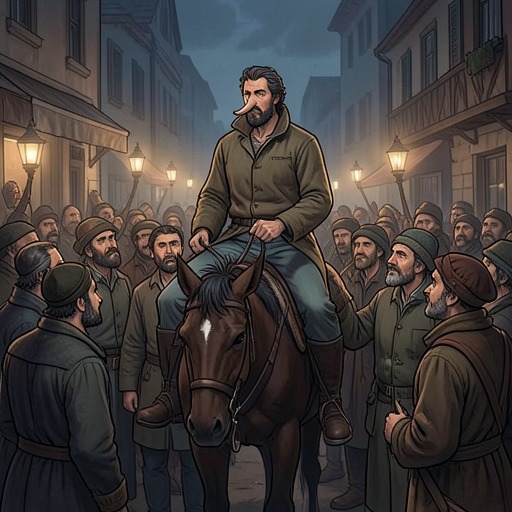
In Hafen Slawkenbergius’s embedded tale, a stranger enters Strasburg on a dark mule with a small cloak-bag containing shirts, shoes, and crimson-satin breeches. The mule proceeds so slowly that its rider hears the arguments about his enormous nose among the sentry, drummer, trumpeter, and the trumpeter’s wife. The pace makes the animal an unwilling escort to the public curiosity gathering around its master.
The stranger’s attachment to the mule is more than practical. He hopes the innkeeper has treated the faithful animal kindly, strokes its face, and says it has carried him and his cloak-bag more than six hundred leagues. He also gives the mule the name Julia, addressing it as a companion while riding and speaking aloud to it. After the stranger leaves Strasburg, he keeps his promise to see that it is cared for at the inn, then takes it onward with him.
The animal’s slowness also contributes to the tale’s comic timing. The stranger’s slow progress through the streets delays his departure, while later the mule carries him onward as he talks through his fears of being driven away unheard and untouched. The narration plays with the boundary between human intention and animal understanding: at one point it remarks that the mule takes its master’s words for what they are and carries the traveller and his horse past. The mule is thus both a vehicle for the tale’s movement and a quietly comic participant in its miscommunications.
An Unwanted Result at Home
The mule also appears in a domestic episode about expectation and blame. Walter Shandy has arranged for his favourite little mare to be bred to a beautiful Arabian horse, hoping to obtain a riding pad. He speaks of the anticipated offspring with confidence, as though it were already raised, broken, bridled, and saddled. Through an apparent neglect by Obadiah, the result is instead a mule, described as exceptionally ugly.
Walter’s family expects this failure to bring severe consequences for Obadiah. Yet when Walter points to the mule and demands to know what the servant has done, Obadiah denies responsibility; Walter answers that he cannot know whether the denial is true. The exchange amuses Walter so much that his anger ends. The mule’s arrival therefore overturns a breeding plan, but its presence also produces an unexpected reprieve: a witty exchange displaces the punishment everyone anticipated.
Labor, Resistance, and Travel
Mules form the working basis of another journey when the Abbess of Andouillets sets out with Margarita. The convent’s preparations make the practical infrastructure visible: an old carriage is brought into the sun, two old mules are harnessed, the gardener becomes the muleteer, lay-sisters repair the lining, and four dozen bells are fitted to the harness. The road is not an abstract route but a collective undertaking sustained by repairs, care, and animal labor.
That arrangement does not guarantee obedience. As the mules climb a hill without the muleteer immediately behind them, they stop partway up. The narrator gives their refusal a voice: one declares that she will go no farther, and the other answers that if she does, they may make a drum of her hide. When the Abbess and Margarita later call in fragmented syllables, the two mules respond only by striking their tails against each other; the novice observes that the calls may work later, but movement does not resume at once. The episode turns a difficult climb into a scene in which human commands meet animal resistance rather than automatic compliance.
The traveller’s own mule likewise halts during a journey across southern France when music and dancing draw his attention. The rider identifies the fife and tambourine and urges the animal onward, but the mule says it is frightened and refuses to take another step. Rather than argue, the traveller dismounts, throws one boot into a ditch and the other into a different ditch, and goes to join the dance. The mule’s stop changes the traveller’s course from riding onward to participating in the scene.
Pace, Knowledge, and Narrative Form
Elsewhere, the narrator announces that he has changed his mode of travel once again: after a precipitate, rattling course, he imagines traversing the rich plains of Languedoc on a mule, as slowly as a foot can fall. The contrast makes slowness a counterpoint to hurried travel. A mule can carry a traveller through the landscape, but it also resists the expectation that a journey should be measured only by speed or by the next destination.
The book’s travel writing repeatedly exposes how much a traveller’s account depends on the conditions of observation and movement. The narrator jokes about choosing among the roads from Calais to Paris, describes the interruptions that prevent a traveller from sleeping in a post-chaise, and admits that darkness left him knowing little of Calais firsthand even as he could compose an apparently detailed account from inference and borrowed information. Against such claims to mastery, the mule stands for the material conditions that make travel possible: the animal carries the baggage, moves at its own pace, and may stop altogether. Its recurring presence joins practical mobility to the book’s larger comic interest in delay, contingency, and the distance between a traveller’s intentions and what happens along the way.