Shandy Parish
The Life and Opinions of Tristram Shandy, GentlemanShandy Parish is the rural home of the Shandy family and the setting of Walter Shandy’s retirement, family routines, and local affairs. Its significance lies in the contrast between the country estate as the family’s settled base and the marriage covenant that gives Elizabeth Mollineux the means to leave it for childbirth in London.
Estate and Setting
Walter, formerly a Turkey merchant, leaves business to retire to his paternal estate at Shandy Hall. The settlement describes the manor and lordship of Shandy through an expansive inventory of its houses, barns, stables, gardens, fields, woods, waters, rights, and the parish rectory and its tithes. This legal catalogue presents the estate not merely as a dwelling, but as a network of land, income, jurisdiction, and inherited property.
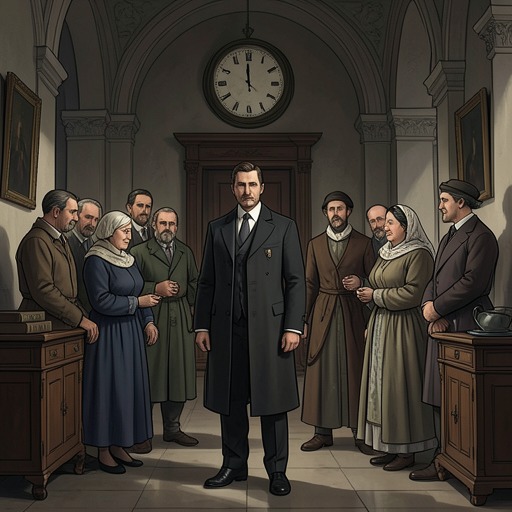
The estate also frames Walter’s carefully ordered domestic life. He keeps a large house-clock on the back stairs and winds it himself on the first Sunday night of every month. Other family concerns are gradually arranged to coincide with that regular task, so that they can be dealt with together. The clock’s place in the household makes the country home a setting for Walter’s characteristic exactness and system.
The Marriage Settlement and London
The settlement governing Walter’s marriage to Elizabeth Mollineux anticipates a future in which he has left business and retired to Shandy while she is still bearing children. In that circumstance, it secures her right, with notice before her expected delivery, to receive £120 for a coach and horses to carry her to London and to cover expenses connected with childbirth and lying-in there.
The covenant also gives Elizabeth freedom to choose where and with whom she stays in London, expressly allowing her to make those arrangements according to her own will despite her married status. Thus the family’s connection to Shandy Parish does not make it the compulsory place of childbirth: the agreement makes London an available alternative, at the husband’s expense, whenever its conditions apply.
Family Conflict and Local Affairs
The settlement’s provision is qualified by a clause intended to guard Walter against what the family regards as a false alarm. If Elizabeth sends him to the trouble and expense of a London journey on false signs of impending childbirth, she forfeits the right only for the next occasion. The narrator connects this safeguard to the intervention of Toby Shandy and notes that the burden of the arrangement ultimately falls on the narrator himself.
Shandy Parish also belongs to a larger local community in which reputations and motives are contested. When the parson pays the expenses of the ordinary’s licence for the midwife, a story circulates that he acted in the hope of recovering the cost through renewed prosperity. The narrator contrasts this suspicion with the community’s earlier failure to discover the parson’s explanation when it might have reflected well on him. The midwife, meanwhile, is described as a person of consequence throughout the village and township, whose reputation reaches across the local community.
Narrative and Significance
The parish is presented through different kinds of detail: the legal language of the estate inventory, the measured recurrence of Walter’s clock-winding, and the narrator’s shifting account of local reputation. Together, they show a household that seeks to order property, time, and family life while remaining vulnerable to uncertainty, disagreement, and gossip.
Most consequentially, Shandy’s status as the family’s country home is set against Elizabeth’s contractual right to go elsewhere for childbirth. The estate’s comprehensive legal description cannot resolve the human and practical conflict embedded in that arrangement; instead, the parish becomes the point from which the family’s movements and disputes are measured.