Strasburgers
The Life and Opinions of Tristram Shandy, GentlemanThe Strasburgers are the people of Strasburg in Hafen Slawkenbergius’s tale of the stranger with the remarkable nose. Their response makes curiosity a force capable of reorganizing an entire city: rumor becomes a common obsession, ordinary duties fall away, and a vast procession leaves Strasburg in pursuit of a promised sight. In the tale’s ironic account of the city’s fate, the people’s departure opens the way for the French to enter, making their collective fascination both comic spectacle and a cause of political consequence.
Identity and Introduction
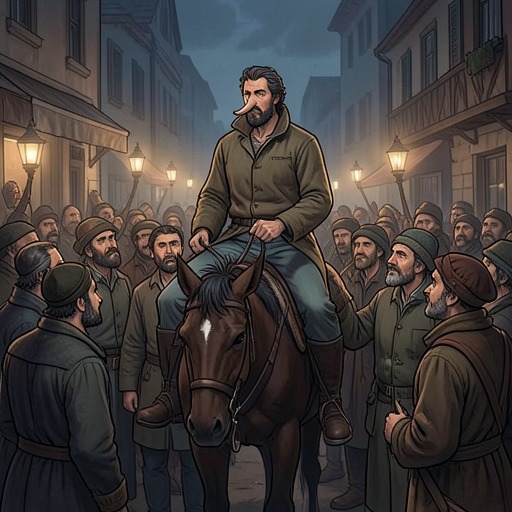
The Strasburgers are presented not through individual biographies but as a population acting together. When the stranger rides away toward Frankfort, the city is thrown into commotion. The bells are ringing for Compline, but no one attends to the call: men, women, and children hurry through streets and alleys, asking who has seen the stranger and his nose. The narration depicts the city’s attention as suddenly unified, while its inhabitants move in every direction at once.
That first confusion develops into an obsession shared across social distinctions. Rich and poor, learned and unlearned, doctors and students, mistresses and maids, and members of religious communities all hear reports about the stranger. Every eye longs to see him; the desire to touch the nose spreads through the city as well. The narrator stresses the breadth of this response: curiosity belongs not to one class or occupation, but to the whole community.
Curiosity and the Abandonment of Ordinary Life
The inhabitants are caught between competing and sometimes contradictory accounts. A sentry, drummer, trumpeter, the trumpeter’s wife, the burgomaster’s widow, and the innkeeper and his wife differ in their descriptions of the nose. Yet their reports agree on two consequential points: the stranger has gone to Frankfort, and he will not return to Strasburg until a specified day. The uncertainty surrounding the object of attention does not check the crowd’s desire; it helps keep talk and expectation in motion.
The account measures the obsession by the duties it displaces. The Strasburgers are said to have gone without eating, drinking, sleeping, or praying, and to have ignored both religious obligations and the calls of nature for seven-and-twenty days. The tale’s hyperbolic language presents this interval as an ordeal of expectation. Their attachment to the anticipated return is not simply a passing curiosity: it occupies the time and attention that ordinarily sustain civic and personal life.
The Procession and the Failed Pursuit
On the twenty-eighth day, the courteous stranger is expected to return. The response is described on an extravagant scale: seven thousand coaches, fifteen thousand single-horse chairs, and twenty thousand wagons are said to crowd with people setting out to meet him. Hafen Slawkenbergius immediately casts doubt on the figures, remarking that the account must contain a mistake in its numerals. The questionable numbers are part of the episode’s comic excess, but the procession itself makes the scale of public expectation unmistakable.
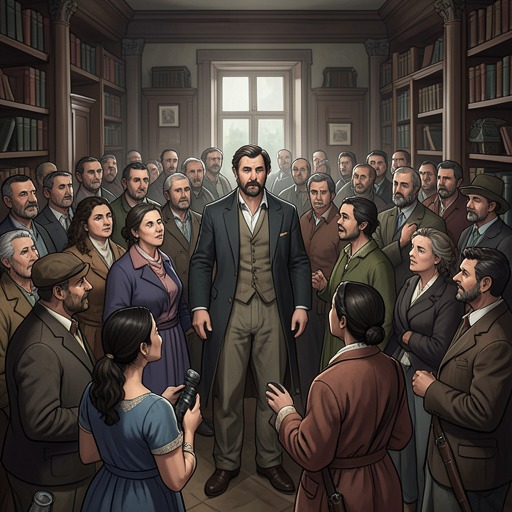
The crowd is a cross-section of the city and its institutions. Senators, counsellors, syndics, members of religious communities, widows, wives, virgins, canons, and concubines are all included in the departure. The Abbess of Quedlinburg travels with senior women of her community, while the Dean of Strasburg and leading members of his chapter accompany the procession. People go on horseback and on foot, some led and some driven, in different directions and by different routes. The city’s social order is represented as having been drawn outward by the same anticipation.
The pursuit fails because the stranger is not on the Frankfort road. By the time the Strasburgers set out, Diego, Julia, and Fernandez have crossed the Pyrenean mountains and reached Valladolid. The tale pauses to make the geographical impossibility explicit: the stranger cannot be met on that road while in Spain. Nevertheless, curiosity keeps the Strasburgers on the Frankfort road for three days and nights before they submit to returning home. Their effort has been organized around a report that cannot lead them to its object.
Political Consequences and Narrative Significance
The return does not restore the city to its former position. Slawkenbergius introduces the fate of the Strasburgers as a revolution in their affairs and supplies competing explanations. One account blames their anticipation of revenues, taxation, and exhaustion: the people became too weak to keep their gates shut. Slawkenbergius rejects that explanation as incomplete, insisting instead that curiosity pushed the gates open. The French, he says, saw the inhabitants marching out after the stranger and entered the city.
The outcome makes the group’s defining behavior consequential beyond its comic scale. The Strasburgers do not merely lose time in a fruitless search; their departure leaves the city exposed to French control. The tale then extends the consequences into economic life, attributing the decay of trade and manufactures to the people’s continuing preoccupation with noses, which prevents them from attending to their business. In this account, collective curiosity is at once a comic subject, a civic weakness, and an explanation for lasting decline.
The episode is also shaped as a story within a story. Slawkenbergius announces and arranges its catastrophe, while the surrounding narrator draws attention to the embedded tale’s performance and excess. That framing lets the Strasburgers function as a collective character: their many voices and social ranks become a single citywide appetite. The movement from missed prayers, to streets filled with rumor, to the enormous procession, and finally to the open gates gives that appetite a political arc. The satire does not depend on establishing the truth of every report or number; its force lies in showing how an unverified promise can command common attention and carry a community away from its responsibilities.