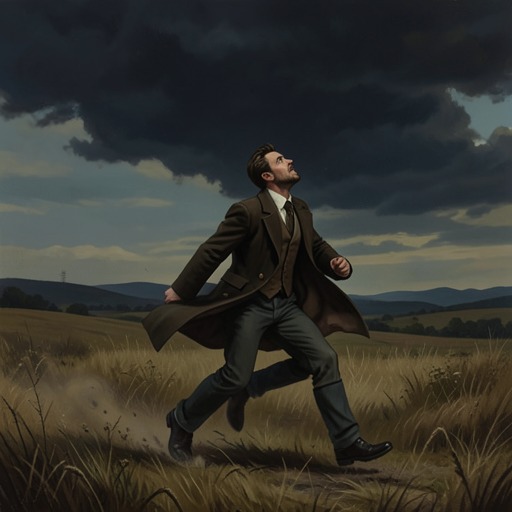
Tristram Shandy’s journey through France
The Life and Opinions of Tristram Shandy, GentlemanTristram Shandy’s journey through France is at once a southward passage and a demonstration of how travel, danger, and narration keep changing direction. Fearing that Death may be nearer than he thinks, he presses onward; but every setback invites a new itinerary, and every itinerary opens into digression. The broken chaise becomes the occasion for an imagined bargain with misfortune, the Rhône offers a route he has already described before taking, and a chance encounter on the road ends in dancing rather than the straight narrative he had planned. Movement is his answer to mortality, but the book makes that movement anything but linear.
Departure and the Road South
The journey gathers urgency from the traveler’s awareness that Death may be closer than he imagines. Rather than remain where he is, he wishes himself at Abbeville, partly to see its carders and spinners, and sets off. The wish is modest and specific, but it quickly becomes another thwarted expectation: arriving at Abbeville, he finds the workers already gone to bed. The scene makes the road’s promise and its limits inseparable. Distance can be covered, yet arrival does not guarantee the sight that set the traveler moving.
Paris follows as an impression of sound and repetition. Hearing the wheels crack, he exclaims that this is Paris, then repeats the city’s name, calling it the first, finest, and most brilliant before adding that its streets are nasty. The abrupt qualification punctures the grand approach: the city’s brilliance is not denied, but it must share the sentence with an unflattering fact. The journey presents places less as settled destinations than as occasions for a traveler to revise his judgment aloud.
The Broken Chaise and the Profitable Detour
At Lyons, the chaise and baggage have been thrown into disarray, with the baggage riding in a cart that moves slowly ahead. The damage appears at first to be a vexation, but Tristram immediately turns it into a calculation. He imagines traveling by water to Avignon, covering a hundred and twenty miles for less than seven livres, then hiring mules—or asses, since nobody knows him—to cross the plains of Languedoc at little cost. He estimates that the accident could put four hundred livres into his purse, while giving him pleasure worth twice the money.
The imagined route is vivid enough to rival the practical account. Tristram pictures himself flying down the rapid Rhône, with the Vivarais on one side and Dauphiny on the other, passing Vienne, Valence, and Viviers, and snatching a grape from Hermitage or Côte-Rôtie as he goes. Castles, mountains, rocks, and cataracts supply the moving panorama. The wreck has not merely forced a change in transport; in his account it has released a more pleasurable version of travel, one measured in speed, scenery, and revived spirits as well as money.
That recovery remains partly an act of perspective. As Tristram looks at the damaged chaise, it seems to shrink before him: its fresh paint fades, its gilding loses its lustre, and the whole vehicle appears contemptible. When a chaise-undertaker asks whether Monsieur would have it refitted, Tristram refuses; asked whether he would sell it, he agrees, valuing its ironwork at forty livres, its glasses at forty more, and leaving the leather to the buyer. His response converts wreckage into salvage, just as his earlier calculations converted inconvenience into imagined profit. The book lets the material loss remain visible even while Tristram makes it serve his appetite for onward motion.
Lyons, Delay, and the Route by Water
Lyons presents a different obstacle: not simply damage, but the vexation of being in a rich and flourishing city without being able to see it. Tristram calls this vexation upon vexation, then notes that he has the morning to spare because the boat does not depart until noon. After two dishes of milk coffee, he considers a walk to the cathedral and its celebrated clock, even though he confesses a profound lack of understanding of mechanisms. The gap between the attractions listed in a traveler’s itinerary and the traveler’s own limited aptitude unsettles the authority of travel writing: a famous object does not automatically become an intelligible experience.
The water journey is introduced with a further disturbance of sequence. Tristram reaches the boat in time, and before he has sailed a hundred yards the Rhône and Saône meet and carry him downstream. But he immediately remarks that he has described this voyage before making it. The route therefore exists twice: first in narration, then in the traveler’s physical passage. The reader encounters the account not as a faithful diary advancing one step at a time, but as an arrangement in which telling may precede travelling.
At Avignon, Tristram says there is little to detain him beyond the old house in which the Duke of Ormond resided. He soon crosses the bridge on a mule, accompanied by François on horseback with the portmanteau, while the owner of the mule and horse walks ahead carrying a long gun and a sword, lest the travelers run off with his animals. Tristram treats this armed precaution kindly rather than taking offense, and plans to give the owner his breeches at the end of the journey in recognition of the trouble. Practical mistrust and comic generosity occupy the same small episode: the guide protects his property, while the traveler turns his own embarrassment into a prospective gift.
Pursuit, Leisure, and the Plain
From the Rhône to the Garonne, the south of France lies open before Tristram to traverse on his mule at his own leisure. That leisure is shadowed by pursuit. He imagines that he has left Death far behind, hears the pursuer acknowledge that he has never followed anyone through France at such a mettlesome pace, and nevertheless recognizes that Death continues after him. The pursuit loses some of its terror as Death falls behind and softens in appearance, but it does not end. Tristram’s cheerful flight changes the emotional charge of the chase without abolishing its cause: travel offers distance from Death, not proof of escape.
After the rattling haste of the earlier route, Tristram changes his mode of travel once more and imagines crossing Languedoc slowly on muleback. The broad plain is an opportunity for the traveler and a problem for the travel writer. Its richness may please the eye, but a writer who has called it delicious or delightful and praised its abundance still has to find something to say about an unvaried landscape that carries the traveler toward the next town—and that town toward another plain. Tristram’s complaint exposes a convention of travel description: abundance alone cannot sustain a narrative, and repeated praise may conceal the writer’s lack of material. His own journey makes that problem part of its subject rather than pretending that every mile supplies a fresh spectacle.
Dance and the Interrupted Narrative
On the road through the south, a transient spark of amity passes between Tristram and Nannette. The words “Viva la joia!” are on her lips and in her eyes; Tristram imagines, for a moment, settling into a contented life with her, dancing, singing, praying, and going to heaven with the nut-brown maid. Her head bends to one side and she dances toward him insidiously. He responds by deciding it is time to dance away, and the encounter becomes motion rather than a settled attachment.
The dance carries Tristram from Lunel to Montpellier, then through Pézenas, Béziers, Narbonne, Carcassonne, and Castelnaudary, until he reaches Perdrillo’s pavilion. The long sequence of place-names is not a conventional itinerary laid out for orderly inspection; it is the rhythm of a danced departure. At the pavilion he draws out a paper of black lines, intending to proceed straight ahead without digression or parenthesis into his uncle Toby’s amours. That declaration of a straight course arrives after the account has turned travel into a succession of reversals, visions, and improvisations. The episode gives the journey its characteristic shape: France is crossed by changing conveyances and changing intentions, while the narrator’s promise of directness becomes one more point from which the story can wander.