Tristram’s birth-injured nose
The Life and Opinions of Tristram Shandy, GentlemanTristram’s birth-injured nose gives bodily form to Walter Shandy’s conviction that his son’s entry into the world has gone disastrously wrong. Walter treats the forceps injury as a threat not only to Tristram’s appearance but to the family’s fortunes, linking a particular physical mishap to his wider theories about childbirth, intellect, and health.
Birth and Medical Precautions
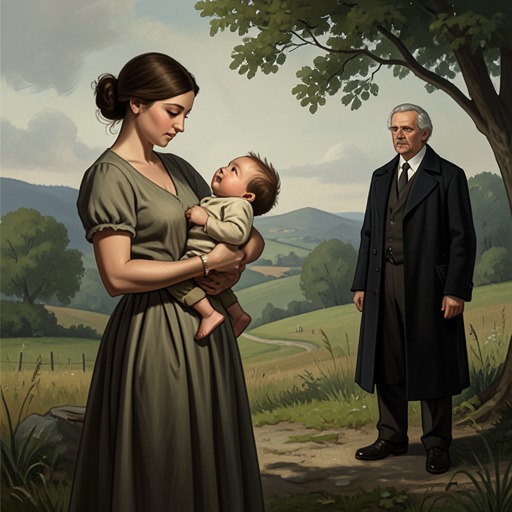
Before the birth, Walter and Elizabeth disagree over who should attend her. Elizabeth insists on the parish midwife, whose nearly twenty years of practice have brought children into the world without an accident attributable to her. Walter instead wants a trained male operator, believing expert intervention could prevent harm. He argues the matter from personal, familial, and political positions; Elizabeth maintains her right to choose her own attendant. Their settlement leaves the midwife in charge, while the operator is permitted to drink wine with Walter and Toby Shandy in the back parlour for a fee of five guineas.
Walter’s concern is shaped by books and speculative medical theories. Having read an account of childbirth, he imagines the pressure upon an infant’s head to average 470 pounds and fears that it will damage the delicate structures associated with understanding. He reasons that extraction by the feet would avoid the danger he associates with a head-first birth. These claims are presented as Walter’s learned hypothesis and alarm, not as an established medical account; the novel makes his reliance on technical authorities part of the comic portrait of a father trying to master uncertainty through theory.
The Injury and Walter’s Interpretation
After the forceps damage the part of Tristram’s body Walter considers crucial to the family’s prospects, Walter measures the accident against an almost impossible calculation: among all the body’s parts, the instrument has struck the one whose injury, he says, will break down the family’s fortunes. Toby answers that matters might have been worse, recalling that Dr. Slop had predicted a hip presentation. The exchange turns the injury into a contest between Walter’s catastrophic interpretation and Toby’s comparatively steady effort to put the mishap in perspective.
In his lament, Walter describes Tristram as having suffered misfortune before birth and since it, and singles out the damage caused by coming head first as the injury that defeats his precautions. He imagines the head subjected to the same 470-pound pressure and says there is a ninety-per-cent risk that the intellectual web has been torn. Yet he also insists that, despite a broad range of possible physical conditions, fortune’s door would remain open if the child had a nose. This makes the nose the decisive bodily feature in Walter’s account: the injury matters not simply as damage, but as the point at which his hopes for Tristram become entangled with family destiny.
Health, Intellect, and Narrative Significance
Walter’s theories extend beyond the birth itself. He describes health as depending on a balance between radical heat and radical moisture, and later argues that the latter is an oily, life-bearing substance rather than animal fat. In his formulation, the two principles decline together, producing disorders of heat or moisture. The birth-injured nose belongs to this wider habit of explaining bodily condition through elaborate systems, in which medical learning, family anxiety, and conjecture repeatedly overlap.
The injury therefore functions as more than an isolated physical consequence. Walter folds it into a chain of anticipated and actual misfortunes, while the narration exposes the distance between his elaborate preparations and the contingency that defeats them. The nose becomes a concentrated emblem of that gap: a particular bodily injury is made to carry Walter’s fears about intellect, health, and the Shandy family’s future, even as Toby’s reply and the comic form keep those fears from settling into unquestioned fact.