Uncle Toby’s sentry-box
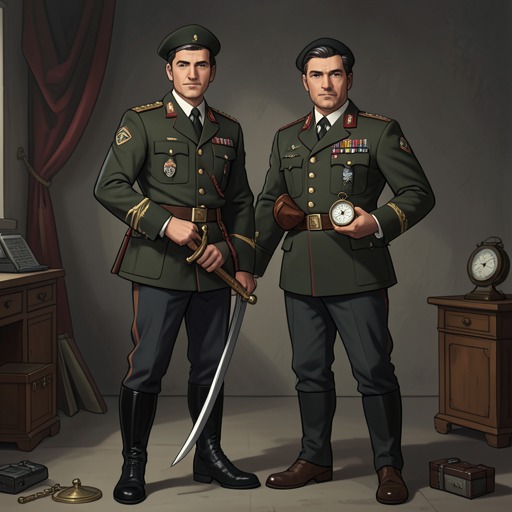
The Life and Opinions of Tristram Shandy, GentlemanUncle Toby’s sentry-box is a small military shelter whose maps and working arrangements make it the command post of his miniature campaigns—and, by its position beside Widow Wadman’s garden, an intimate theater for her courtship. The box’s usefulness to Uncle Toby becomes the very condition that lets Widow Wadman study his habits, approach him, and convert military explanation into a series of carefully staged advances.
Position and Purpose
The sentry-box stands in Uncle Toby’s garden beside Widow Wadman’s house and garden. A thick arbour in her garden, planted along the hedge-row of his, gives her a place from which to observe his movements and learn the councils of war that occupy him. The shared boundary turns the setting into a passage between his private military world and her campaign of courtship.
That access is made more direct by a wicker gate. Uncle Toby, trusting Corporal Trim and acting through Bridget, has allowed the corporal to make the gate as a means of enlarging Widow Wadman’s walks. The practical courtesy also gives her a route to the sentry-box door, where she can sometimes make an attack on Uncle Toby himself. The fortification that protects and organizes his play at war is thus positioned within reach of a neighboring approach.
Maps and Military Attention
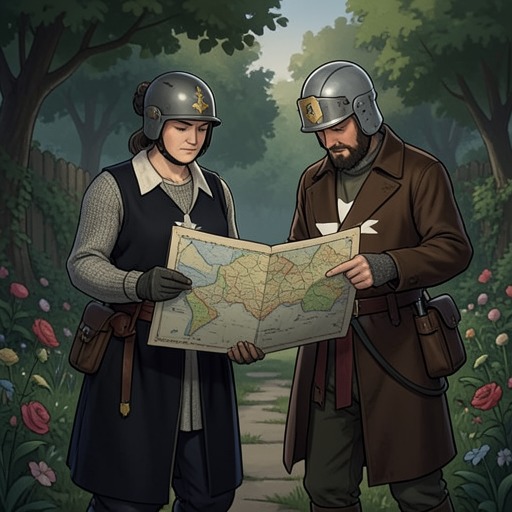
Inside the box, Uncle Toby keeps the plan of whichever town or fortress Corporal Trim is working on. The plan is pinned at the top on the left-hand side, facing inward, but left loose at the bottom so he can hold it up to his eye when an occasion requires. This small practical detail supplies Widow Wadman with a dependable opening: at the door she can reach out, take hold of the plan, and draw his attention into an explanation.
The map makes the sentry-box a place where Uncle Toby’s attention can be captured without his suspecting the purpose. He takes the other corner in his left hand and begins to explain; his pipe, held in the other, serves as a pointer. Widow Wadman then finds an excuse to take the pipe from him, ostensibly to point more distinctly to a redoubt or breastwork. The sequence begins in military instruction, but the objects that sustain it—the plan and pipe—bring the pair close enough for a different kind of engagement.
A Courtship Staged as an Assault
Widow Wadman’s approaches are narrated as military maneuvers: advances, attacks, wings, and a center thrown into disorder. The language makes the box serve two campaigns at once, one mapped in fortifications and the other in flirtation. When she follows Uncle Toby’s finger along the turns and indentations of his works, the contact is no longer merely a pointer tracing a route. The military plan provides a pretext for touch, and its intricate lines furnish the movements of a close encounter.
When the map falls against the side of the box, Uncle Toby lays his hand flat on it to continue the explanation. Widow Wadman places her own hand beside his, opening what the narrator presents as a channel for sentiment. Her finger draws his thumb and then his whole hand into the encounter; she repeatedly moves or presses his hand aside, while her leg presses lightly against his calf beneath the box. Uncle Toby, pressed on both sides, finds his center unsettled and exclaims in frustration. The sentry-box’s constrained space makes these advances possible while leaving their meaning disguised as incidental contact.
The Attack Misfires
The box’s military fittings do not always serve Widow Wadman’s design. After Corporal Trim finishes the story of his love affair—told by Uncle Toby on his behalf—Widow Wadman leaves the arbour, replaces the pin in her cap, passes through the wicker gate, and advances toward the sentry-box. The moment seems favorable: Corporal Trim has wheeled away the pioneer’s shovel, spade, pickaxe, stakes, and other stores lying on the ground where Dunkirk stood, clearing the field around it.
But the plan hanging in the box is now the plan of Dunkirk, and the story of Dunkirk is a tale of relaxation. Instead of supporting the impression she hopes to make, the map turns Uncle Toby’s attention back toward military matters. The account also notes that the hand maneuvers Widow Wadman might have repeated have just been surpassed by those in the story of the fair Beguine. Her established method, successful on other occasions, would at this moment be a heartless attack. She changes tactics rather than persisting with the plan.
The Box as a Scene of Exposure
Widow Wadman’s new approach is to arrive holding a cambric handkerchief to her left eye and say that a mote, sand, or something else has entered it, asking Uncle Toby to look. She edges in beside him and sits on the corner of his bench, positioning herself so that he can examine the eye without rising. The sentry-box’s bench, doorway, and close quarters again make its physical arrangement part of the courtship: a request for assistance draws Uncle Toby into proximity under the appearance of innocent concern.
The narrator stresses Uncle Toby’s innocence as he looks into her eye, comparing his absorbed gaze to that of a child looking into a raree-show box. The comparison returns the episode to the sentry-box’s central irony: Uncle Toby sees a scene as an occasion for straightforward attention, while Widow Wadman knows how to use its setting and objects to shape an encounter. The structure that supports his military hobby becomes a recurring instrument of courtship, but neither its plans nor its familiar routines guarantee that every approach will succeed; when the map of Dunkirk diverts his attention, the attacker must improvise.