Yorick’s sermon on conscience
The Life and Opinions of Tristram Shandy, GentlemanYorick’s sermon on conscience is both a moral argument and a material survivor: misplaced inside a borrowed book, read aloud by Corporal Trim, and ultimately traced through a history of loss and appropriation. Its central claim is that conscience cannot be trusted as an isolated judge. Human beings may mistake inclination for innocence, so moral judgment must be tested against religion, reason, justice, and truth. The sermon’s principles become more than propositions when its denunciation of the Inquisition makes Trim fear for his brother Tom, and the manuscript’s own wandering history gives the recovered work a second life beyond its author.
Discovery and Reading
The sermon enters the scene by accident. Walter Shandy asks Corporal Trim to look inside a book for a sailing chariot. Trim searches the leaves, then shakes the volume; what falls out is a text that begins with a scriptural passage and proceeds like a sermon. Toby Shandy is astonished that such a work could have found its way into his Stevinus. Walter, intrigued by the coincidence, asks Trim to read a page or two while the company waits for Obadiah.
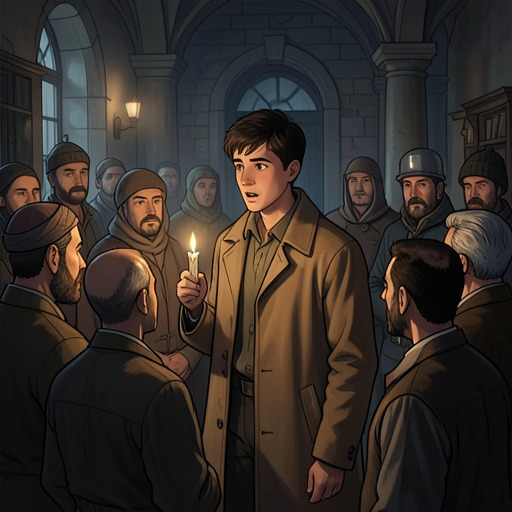
Trim is not merely assigned a reading part. He says that he served two whole campaigns in Flanders as clerk to his regiment’s chaplain, and Toby calls him the best scholar in his company. Trim takes the manuscript into the middle of the room, where he can see and be seen by his audience. Its physical appearance and his ceremonious performance make a lost paper into a public address, while his responses repeatedly interrupt the distinction between reading a text and experiencing its claims.
The sermon begins from Hebrews xiii. 18, “For we trust we have a good Conscience.” It immediately questions the confidence contained in that assurance: people may know their own thoughts and remember their pursuits, but self-knowledge does not guarantee impartial judgment. The speaker’s opening challenge establishes the problem the rest of the sermon develops: inward access to one’s motives can expose conscience to bias as readily as it can produce certainty.
The Argument About Conscience
The sermon explains that people judge wrongdoing unevenly. Actions encouraged by inclination and custom can be dressed in flattering appearances, while actions for which a person feels no propensity look shameful and deformed. Its example contrasts David’s remorse after cutting the skirt of Saul’s robe with his lack of recorded compunction over Uriah’s death, which cleared the way for David’s lust. The contrast makes conscience’s failure concrete: it can react sharply to a lesser offense while neglecting a graver one.
From this failure the sermon draws its principal conclusion. Conscience is intended as a judge within a person, but a sequence of causes and impediments may make it inattentive or corrupt; it therefore cannot safely govern alone. To judge a person’s merit as an honest man, useful citizen, faithful subject, or servant of God, the sermon calls for religion and morality to be brought in as standards. Calm reason and the obligations of justice and truth must also inform the judgment before conscience determines the matter.
The sermon does not simply discard conscience. Properly guided, it can offer confidence that a person’s self-judgment accords with divine judgment, anticipating the final account of human actions. Its model of a good heart is therefore not unexamined inward feeling but a heart informed by external moral obligations. Such a heart, the sermon says, can provide a better guide to conduct than the multiplying restrictions of human law, which it describes as a necessity created by human mischief rather than an original choice.
The Inquisition and Trim’s Response
The argument turns from general moral instruction to a scene of persecution. The sermon asks its listeners to enter the prisons of the Inquisition and depicts religion, mercy, and justice bound beneath a tribunal supported by instruments of torture. It describes a prisoner brought out for a mock trial, weakened by sorrow and confinement, subjected to torture, returned to a cell, and then dragged out again to face the flames and insults of his last agonies. The passage argues that a religion separated from mercy produces cruelty in the name of serving and honoring God.
Trim can no longer keep the sermon at a reader’s distance. At the mention of the Inquisition, he thinks of his brother Tom; as the prisoner’s suffering is described, Trim turns pale, begins to weep, and finally drops the sermon, crying out that the victim may be his brother. Walter and Toby sympathize with his distress, and even Dr. Slop acknowledges pity. Trim first hopes that the prisoner has survived, then, hearing that he has been led toward the flames, gives thanks that the man is dead and beyond further pain. The sermon’s imagined case has, through Trim’s fear, become a personal crisis without ceasing to be a warning about institutional cruelty.
Walter takes over the reading when Trim cannot continue, though Trim insists on staying to hear the ending. The sermon offers a practical test for disputed beliefs: trace the consequences they produce and compare those consequences with the spirit of Christianity. Its rule, “By their fruits ye shall know them,” shifts judgment from professed principle to observable results. A loud attack on religion may arise from passion rather than reason, it adds, and a person without conscience in every matter cannot be trusted. In the concluding distinction, conscience is not itself the law: God and reason make the law, and conscience is charged with declaring it faithfully, not remaking it according to passing passions.
Authorship and the Manuscript’s Afterlife
At the end, Walter praises Trim’s reading, while Dr. Slop objects that the comments weakened it. Trim replies that he would have read it better if his heart had not been so full; Walter answers that the feeling was precisely what enabled him to read it well. Their exchange echoes the sermon’s concern with the relation between moral knowledge and lived experience. Walter calls the work dramatic because its characters hold attention, and disputes Dr. Slop’s preference for sermons populated only by patriarchs, martyrs, or saints: this sermon’s less exemplary figures, he argues, do not make it worse.
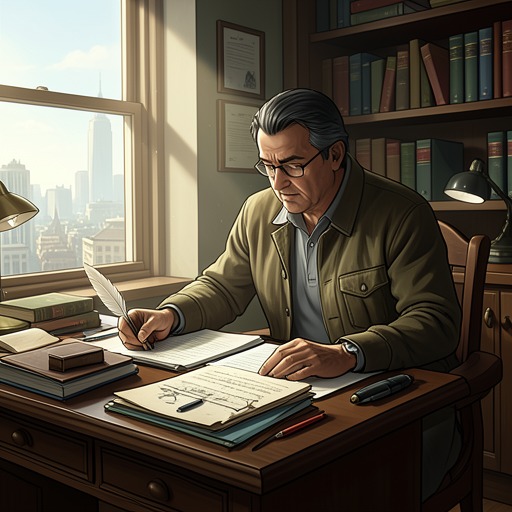
Toby wonders who wrote the text and how it came to be in his book. Walter recognizes the style and manner of the preaching heard in his parish church and identifies the author as Yorick. The attribution is confirmed the next day, when Yorick sends a servant to Toby’s house to inquire after the sermon. Yorick had borrowed Stevinus, placed the newly composed manuscript inside it, and then, through an act of forgetfulness, sent the book back with the sermon still enclosed.
Recovery does not end the manuscript’s misfortunes. It slips through an unsuspected hole in Yorick’s pocket, sinks into the dirt beneath the hind foot of his horse, remains buried in mire for ten days, and is recovered by a beggar. Sold for a halfpenny to a parish clerk, it passes to the clerk’s parson and disappears from Yorick’s possession for the rest of his life. The narrator presents the account as a belated restoration of the sermon and a means of giving rest to Yorick’s ghost.
The account also exposes a later act of literary appropriation. The sermon was preached at an assize in York Cathedral before a thousand witnesses, the narrator says, and printed by a prebendary only two years and three months after Yorick’s death. Although the prebendary was reportedly on charitable terms with Yorick, printed only a few copies, and could have composed a sermon of his own, the narrator regards the posthumous use of the work as a form of plunder. Publishing the story both sets out that grievance and announces that the Shandy family possesses enough of Yorick’s sermons to make a substantial volume, now offered to the public. The object recovered from Stevinus thus becomes not only a lesson in moral judgment but evidence in a dispute over authorship, memory, and who has the right to preserve a dead writer’s work.