Andrea and Nella’s marriage
The Lying Life of AdultsAndrea and Nella’s marriage is the troubled family bond at the center of Giovanna’s childhood and adolescence: once remembered as a loving partnership, it becomes a relationship marked by secrecy, estrangement, and an unresolved aftermath. Giovanna first understands her parents as a close couple whose life together had seemed secure; later, the marriage’s collapse reaches her through overheard exchanges, suspected betrayals, and the changes in both parents after their household breaks apart.
Early Marriage and Family Life
As Giovanna understands it, Andrea and Nella had loved one another since they were young and married early. Their decision to have a child came relatively late in their marriage, and Giovanna was born when Nella was thirty and Andrea had just turned thirty-two. The account of their romance had reached their daughter only in fragments: Andrea spoke with playful detachment, while Nella recalled it with emotion. In Giovanna’s early picture of the family, their mutual attachment was a fact of life rather than a source of conflict.
The strain surrounding Giovanna’s birth temporarily altered the household. Nella experienced a difficult pregnancy and a torturous birth on June 3, 1979; Giovanna’s frequent crying and other difficulties in her first two years contributed to Nella’s long depression and disrupted her teaching and proofreading work. Andrea, a history and philosophy teacher at a prominent Naples high school, took on private lessons amid his worries about the future. As Giovanna became a quieter child, her parents gradually recovered a new equilibrium: their love for her came first, but Andrea’s studies and Nella’s work again occupied important places in their lives.
That early family order continued to shape Giovanna’s later sense of what was being lost. She had regarded her parents as good-looking and happy together, and their marriage as the secure framework within which her own place was assured. When that framework weakened, she did not experience the change as a simple disagreement between adults; it unsettled her understanding of family, intimacy, and her mother’s attention.
Secrecy and the Household’s Fracture
The marriage’s deterioration becomes visible through everyday signs before Giovanna can explain them. Andrea begins accusing Nella in a low, insistent voice of spending too much on unnecessary things. Nella answers that the money is hers to spend because she earns it. At the same time, she shifts from treating Andrea’s political and intellectual meetings as a private amusement to attending them herself, including gatherings in other people’s homes, to Andrea’s explicit annoyance. These changes make the household’s private tension perceptible without initially revealing its full cause.
At a gathering with Mariano and Costanza, Giovanna observes an intimacy between Nella and Mariano that she cannot interpret with confidence. Nella is hesitant when Angela asks for Giovanna to stay overnight; Mariano intervenes to arrange the visit, and Nella eventually agrees. As Andrea and Nella leave, Nella and Mariano exchange a brief kiss on the cheek. Giovanna also recalls contact between their legs beneath the table. The gestures leave her uncertain whether she has witnessed innocent familiarity or evidence of an affair, and she chooses not to tell Vittoria, fearing that her aunt would turn the ambiguous scene into an accusation.
Afterward, Giovanna watches Nella for signs that might confirm her suspicion. She reads the mother’s hurried telephone calls, lowered voice, and attention to choosing clothes as possible indications of secret meetings. Her observations are entangled with jealousy: she had assumed that Nella’s body, perfume, and thoughts belonged to her in a special way, even though she knew that her parents shared a marital life. The suspicion therefore threatens not only the image of Andrea and Nella as a couple but also Giovanna’s sense of exclusive closeness to her mother.
Confrontation and Separation
The conflict between the adults erupts at Mariano and Costanza’s apartment on Via Cimarosa. What begins like one of Andrea and Mariano’s familiar arguments about politics and public affairs becomes a violent quarrel. Mariano orders Andrea out; Andrea answers by shouting insults in dialect, a register he had not used with Giovanna. When Costanza tries to leave, Mariano insults her, and Andrea runs after her. Angela and Ida are frightened, while Giovanna and the girls struggle to understand what the adults’ argument has exposed.
Giovanna suspects that the quarrel concerns sex rather than the political subjects the adults discussed. She imagines that Vittoria may have repeated information Giovanna had shared, that Andrea confronted Mariano, and that Costanza learned of Mariano’s closeness with Nella. These are her inferences, not a complete account of what the adults said or decided. The narrative keeps the precise disclosures partly obscure, showing the rupture through its consequences: Costanza visits Giovanna with Nella present and returns a white-gold bracelet that had belonged to her; Mariano disappears from the household at Via San Giacomo dei Capri; and Giovanna sees Angela and Ida less often. The returned bracelet becomes a concrete sign of a broken friendship network surrounding the marriage, even as its meaning remains bound up with what Giovanna cannot fully know.
Aftermath and Giovanna’s Distance
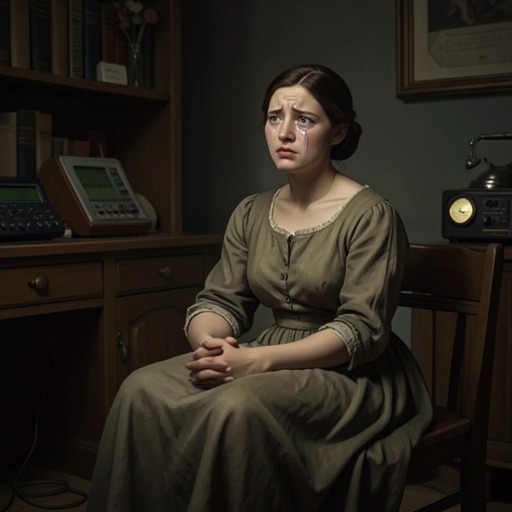
In the aftermath, Giovanna describes Nella as increasingly malnourished and plaintive, still guarding the belongings she had prevented Andrea from taking. She imagines her mother as Andrea’s widow although he is alive, comfortable, and still able to reach her by telephone. Nella remains emotionally oriented toward her absent husband, as if preserving the marriage’s remnants and waiting for contact from it. Giovanna also believes Nella sometimes sees Mariano to learn what Andrea is occupied with, though she presents this as her own interpretation rather than established fact.
Andrea’s absence does not immediately free Nella from the routines and attachments of married life. She continues her daily duties, including caring for Giovanna, but no longer supervises her daughter’s schoolwork as closely. Her increasingly frequent instruction that Giovanna is grown up and must manage for herself coincides with the girl’s growing independence. Giovanna welcomes the reduced oversight, yet her detachment is also a response to the parents’ damaged bond and to her disappointment in Andrea.
As she grows older, Giovanna deliberately begins calling her parents by their names, Andrea and Nella, rather than by parental titles. She understands this choice as part of a rejection of the bond that had once defined her family. Although her academic recovery briefly makes her parents proud again, she finds little comfort in their approval. She increasingly values the guidance she receives from Roberto over Andrea’s advice, which she regards as unreliable, and she limits her contact with Nella, telling her she will go to Pascone simply because she wants to. The marriage’s fracture thus alters the parent-child relationships around it: Giovanna seeks freedom from both parental authority and the family’s expectations.
Narrative Significance
The marriage is presented first through a child’s idealized account of parental love, then through scattered evidence that she must assemble without adult explanation. A household argument about money, a mother’s new attendance at meetings, a pause over an overnight visit, and a brief farewell gesture all acquire weight because Giovanna has no reliable account of what is happening between the adults. Her uncertainty is not resolved by the quarrel; instead, the rupture makes her more alert to omissions and more inclined to construct explanations from gestures and objects.
The consequences extend beyond Andrea and Nella as a couple. Their crisis entangles Mariano and Costanza, affects the children’s friendships, and leaves Giovanna carrying suspicions she does not know how to disclose. Later, she stands in a family where Nella remains attached to Andrea’s memory and Andrea’s conduct has lost her confidence. The marriage’s decisive significance is therefore not only its deterioration, but the way its unspoken history becomes part of Giovanna’s own separation from the family that once seemed secure.