Blood ties and belonging
The Lying Life of AdultsBlood ties and belonging in the novel is not a simple inheritance or a ready-made refuge: it is a relationship Giovanna must travel toward, learn to recognize, and negotiate amid family estrangement. Vittoria’s introductions to her father’s relatives give Giovanna an unexpected sense of welcome and a new name for herself, while the adults’ fixed enmities and hidden entanglements show how blood can bind people together without reconciling them.
A City Divided by Family
For Giovanna, her mother’s family has familiar names and a settled place in the city, while her father’s relatives are initially almost unknown. They appear at weddings and funerals, where forced greetings feel awkward; afterward, her parents become tense and seem mutually to put the encounters behind them. The contrast is not only between two branches of the family but between two geographies of belonging. Giovanna knows the Vomero and the streets around Villa Floridiana, where she spent happy hours as a child with Angela and Ida. Her father’s relatives, by contrast, seem to live somewhere nameless below her known world.
Reaching them means descending through Naples: her parents usually go willingly only as far as the Vomero and visit her maternal grandparents in Museo with some reluctance. The more familiar parts of the city are associated with school friends, gardens, flowers, and play; the lower districts are less known to Giovanna, and her parents’ journeys there carry visible fatigue and anxiety. The physical route makes the paternal family’s exclusion concrete. To approach that kinship is to cross a boundary in the city as well as in the family.
On the drive to the neighborhood where he grew up, Andrea tries to speak about his origins. He recalls that his family was poor and gestures toward rows of apartment buildings; at the building where he lived, and where Vittoria still lives, he stops and sighs. The visit thus begins with a partial disclosure from a father otherwise described as living autonomously, almost as though he had no blood relatives. Giovanna’s encounter with his family brings into view a history and social world that his household has kept at a distance.
Vittoria’s Claim on Giovanna
After meeting Vittoria, Giovanna tests the possibility that she resembles her aunt by dressing up in her mother’s jewelry and studying her reflection. The comparison leaves her feeling diminished: she sees no evidence of Vittoria’s force or warmth in her own face. What changes her mood is not a physical likeness but Vittoria’s claim that Andrea has deprived her of a large family because he considers them uneducated. Vittoria’s angry account gives Giovanna a sense of connection that appearance alone could not provide: she is not only her parents’ child but also belongs to the family from which her father came.
That sense of belonging becomes concrete in Giovanna’s promise to meet Vittoria on May 23 and go with her to the cemetery. Vittoria has given precise instructions: Giovanna is to skip school and meet her at nine in the morning in Piazza Medaglie d’Oro beside her old, dark-green Fiat 500. As the date approaches, the prospect brings Giovanna to tears and laughter before the mirror. Her response links an anticipated family encounter to a renewed feeling of energy, in marked contrast with the painful self-portrait she had just made.
The relationship with Vittoria persists after the first visit. Giovanna begins telephoning her and values being addressed in Vittoria’s rough manner, as if she were an equal in age. She talks about her aunt when Angela and Ida boast of wealthy relatives, and, with her parents’ permission, sees Vittoria several times. By autumn, the meetings have become routine. The bond is therefore not a single revelation but a continuing attachment that Giovanna actively sustains.
Meeting the Paternal Family
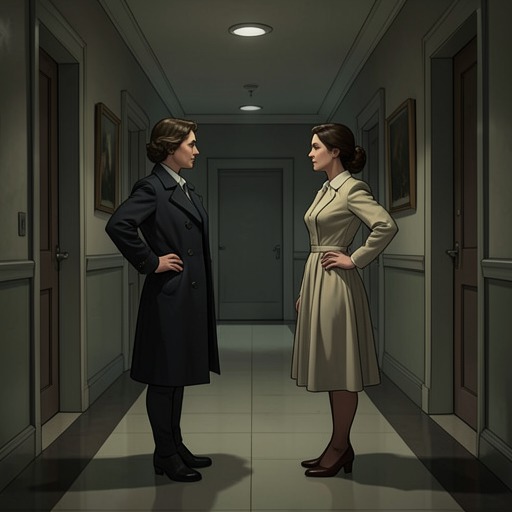
Giovanna initially imagines that her relationship with Vittoria might bring Andrea and his sister closer. Instead, the adults maintain what the narration presents as a ritual of coldness. Giovanna’s mother drives her to Vittoria’s home but waits in the car; when Vittoria collects Giovanna near San Giacomo dei Capri, she does not come to the family door. Neither woman invites the other in. Giovanna abandons the hope of acting as mediator and recognizes that the siblings’ hostility will continue.
That estrangement complicates, rather than cancels, her own attachment to Vittoria. Giovanna comes to think of the separation as advantageous: if her father and aunt made peace, she fears, her encounters with Vittoria would no longer be exclusive, and she might lose her place as friend, confidante, and accomplice. Her thought reveals that belonging is not simply the restoration of a united family. For Giovanna, the intimacy she has gained depends in part on the very division she had hoped to heal.
Vittoria then takes Giovanna, without warning, to meet Andrea’s other siblings: Uncle Nicola, the eldest brother according to Vittoria, and Aunts Anna and Rosetta. Their route carries them through Cavone, Campi Flegrei, and Pozzuoli in Vittoria’s green Fiat 500. Vittoria calls the excursion a meeting with Giovanna’s blood. The phrase makes kinship something to be encountered through people and places, not merely learned as a fact about descent.
The relatives’ welcome contrasts with Giovanna’s earlier uncertainty about whether she even remembers their names. Their apartments are small and plainly furnished, and their speech moves between dialect and Italian. Giovanna makes room for Neapolitan cadences in her own careful Italian. Although the relatives do not ask after Andrea or ask Giovanna to greet him for them, they make clear that their hostility toward him does not extend to her. They call her Giannina, the name Vittoria uses and her parents do not, and Giovanna feels unusually open, relaxed, and funny among them. The name seems to bring forth a different version of herself, not by changing her parentage but by changing the terms on which she is received.
The welcome is expressed in small acts of attention. Uncle Nicola remembers that Vittoria likes strawberry gelato; when he learns that Giovanna likes it too, he sends one of his children to buy some for everyone. As they part, he kisses Giovanna on the forehead and says, “Luckily you’ve got nothing of your father in you.” The gesture affirms her place in the gathering, but the remark also exposes the relatives’ continuing opposition to Andrea. Their tenderness toward Giovanna coexists with a family conflict that has not been settled.
Belonging Amid Secrecy and Conflict
Giovanna’s growing sense that Vittoria’s household and relatives might be “her blood” extends to the younger generation. She likes Tonino, Giuliana, and Corrado, as well as Margherita, but feels the pain of arriving late, not sharing their language, and lacking the intimacy they already possess. Kinship offers her new attachments without erasing the time and familiarity she has missed.
Her place within this overlapping network becomes more difficult when she notices signs of an unspoken adult conflict. At a gathering with Mariano and Costanza, she observes Mariano’s attention to her mother and his unusual manner toward her. Later, when he asks that Giovanna stay overnight with Angela, her mother hesitates before agreeing; Giovanna senses that their exchange contains a meaning hidden from the others. In the dark, she remembers her aunt’s command to look carefully, but decides she cannot report what she has seen to Vittoria, whose interpretation, she fears, would turn the scene into an accusation against her mother.
The family’s private tensions soon surface in a violent quarrel between Andrea and Mariano at Mariano’s home on Via Cimarosa. Angela tells Giovanna that an argument which began with the subjects their fathers had long discussed—politics, Marxism, history, and economics—became a personal rupture. Costanza leaves, Mariano shouts after her, and Andrea runs after her. The children cannot make sense of the scene, though they suspect it concerns their parents’ lives rather than the political topics that seemed to explain it. The quarrel damages Giovanna’s ordinary closeness with Angela and Ida: Mariano disappears from San Giacomo dei Capri, and she sees the girls less often.
Giovanna’s uncertainty shows how family knowledge travels through divided loyalties. She worries that Vittoria may have told Andrea what Giovanna confided, and tries to connect that possibility to the quarrel and to Costanza’s subsequent visit. She also recalls Costanza’s remorseful manner and the restitution of a white-gold bracelet, which Costanza’s mother places on Giovanna’s wrist. Giovanna cannot fully explain the gestures surrounding it, but understands that the bracelet has arrived within a dense exchange of glances, words, and family histories. Blood ties give her access to these relationships while making her a witness to conflicts she is not yet able to interpret.
The importance of kinship is also visible in Giovanna’s later approach to Giuliana. When Giuliana invites her to meet Roberto in Piazza Amedeo, Giovanna is intensely anxious, but the invitation is framed through a friendship already formed within Vittoria’s family circle: Giuliana asks her to come as a friend who studies and speaks well. Across these encounters, belonging is neither a settled status nor a guarantee of harmony. It is made through visits, names, shared attention, and invitations, while estrangement and secrets continue to shape who can meet whom and what each person can know.