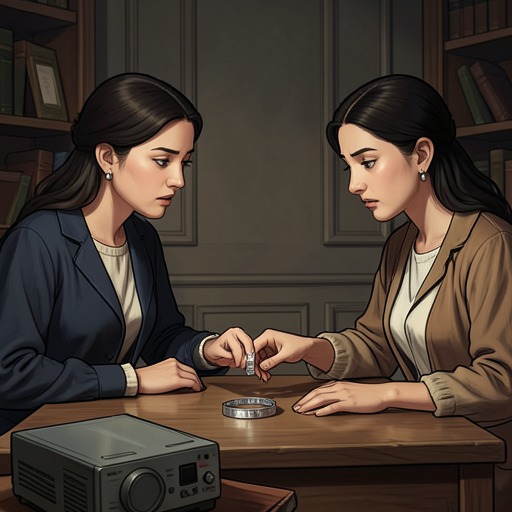
Costanza’s platinum bracelet
The Lying Life of AdultsCostanza’s platinum bracelet is a conspicuous heirloom whose changing ownership turns an admired piece of jewelry into evidence of a hidden family connection. Its flower of diamonds and rubies catches the light and attracts Vittoria’s attention; years later, Costanza returns it to Giovanna with the explanation that she had mistaken it for her own. The bracelet’s importance lies not only in its beauty but in the reversal between possession and belonging: what Costanza has worn for years was, her words reveal, Giovanna’s all along.
Appearance and First Significance
The bracelet is made of white gold and bears a flower whose petals are diamonds and rubies. Its brilliance makes it immediately memorable: Giovanna recognizes it as the bracelet especially admired by Angela and Ida’s mother, and even Giovanna’s mother envies it. This is no incidental accessory in the scene. The object draws attention across the gathering, becoming a focus through which the women look at one another and register admiration, attachment, and unease.
Vittoria studies the bracelet after touching and praising Costanza’s earrings, necklace, and dress. She holds Costanza’s hand and touches the bracelet’s surface with apparent sincere admiration, then asks whether Costanza is attached to it. Costanza says that she is fond of it and has had it for years. Vittoria’s warning that a thug might snatch such a pretty object breaks the sequence of praise: she lets go of Costanza’s hand as though disgust has suddenly displaced admiration. The shift makes the bracelet’s beauty feel exposed to threat, while leaving Vittoria’s abrupt change in tone unresolved.
In the Family Gathering
After releasing Costanza’s hand, Vittoria turns back to Angela and Ida and says that the girls are more precious than all the bracelets in the world. The contrast sets the costly ornament against the value of children, but the gesture is not simply a tender declaration: Vittoria’s praise of Costanza’s belongings has just turned cutting, and she leaves without saying goodbye. Giovanna calls after her with feigned cheer, while Costanza asks the girls to behave and says she will wait for them at two. The bracelet thus remains behind as a charged detail in a strained social encounter, not a neutral mark of wealth.
Later, after the visit, Vittoria again admires Costanza’s appearance, touching or praising her dress, hairstyle, makeup, earrings, necklace, and bracelet. Giovanna interprets this renewed attention as mockery and imagines the insult Vittoria might be withholding. That interpretation belongs to Giovanna’s perception; Vittoria does not voice the imagined accusation in the scene. Still, the bracelet’s recurrence alongside the earlier warning gives the object a double register: it is something Vittoria can genuinely admire and something whose display intensifies Giovanna’s suspicion and discomfort.
Return to Giovanna
The bracelet’s ownership changes meaning when Costanza visits Giovanna’s home without her daughters and gives it to her. Costanza’s face is severe and sallow; Giovanna’s mother, whose eyes have been puffy and reddened for days, oversees the encounter. Giovanna, bewildered, asks why Costanza is giving it to her. Her mother corrects her: Costanza is not giving it away but returning it.
Costanza’s mouth quavers before she manages to say that she had thought the bracelet was hers, but it was Giovanna’s. The distinction between gift and return transforms the earlier scenes. Costanza had worn and valued the bracelet for years, and her attachment was real; nonetheless, the family’s account places its prior belonging with Giovanna. The moment supplies no further explanation of how the bracelet came to be in Costanza’s possession, so its exact history remains unstated. What changes decisively is the understanding of ownership: Costanza’s long possession did not make the object hers.
Meaning and Narrative Function
The bracelet gathers together beauty, attachment, and the instability of family knowledge. Its dazzling flower first makes it an object of public admiration, and Vittoria’s warning introduces the possibility that it can be taken. Its eventual return turns that threat into a different kind of reversal: the significant loss is not a street theft but the discovery that a cherished possession has been held under a mistaken understanding of whose it was.
The object also links the encounters around Costanza to Giovanna’s family history. At first Giovanna recognizes the bracelet through other people’s admiration of it; later, the bracelet is placed in her own hands and named as something that belongs to her. The return is therefore both concrete and revelatory. Without supplying a complete account of the bracelet’s past, the scene makes an heirloom expose a boundary between appearance and fact: a woman may wear an object for years, love it, and still learn that it belongs to someone else.