Enzo
The Lying Life of AdultsEnzo is a police officer whose relationship with Vittoria becomes one of the defining stories in her life and in the Trada family’s history. Though he is encountered chiefly through what the living remember, he remains vividly present in the narrative: as Vittoria’s first great love, Andrea’s friend and then adversary, Margherita’s husband, and the subject of an image that outlasts him. His legacy is not simple romantic idealization. The love Vittoria remembers as complete is entangled with a house dispute, the exposure of the affair to Enzo’s wife, and a family heirloom stolen to honor the relationship.
Identity and Introduction
Vittoria recalls first meeting Enzo at a dance party, where the two danced together. When she tells Giovanna this, she marks the memory’s distance precisely: the encounter took place seventeen years before May 23. Music and movement frame the recollection; in the present, Vittoria dances as she tells the story, directing Giovanna’s attention toward the singer so that her father, waiting outside, might hear and remember. Enzo’s introduction is therefore inseparable from an act of remembrance, and from Vittoria’s effort to make the past audible to the next generation.
The evidence identifies Enzo as a police officer and as a married man with three children. He is also Andrea’s friend and Vittoria’s brother, a position that makes him both confidant and participant in the family conflict. Vittoria’s account describes Andrea as initially acting like Enzo’s friend and seeking to know about him; later, Andrea turns against him. Enzo’s personal ties cross the boundaries between friendship, sibling loyalty, marriage, and an illicit love affair, leaving him at the center of conflicts that the family cannot keep separate.
Love and the Family-House Dispute
Vittoria’s account places the affair alongside a dispute over the house their parents left to their five children. She says she had put money into the property while helping her parents and argued that, because she had no job or settled life while her siblings did, the others agreed that she should keep the house. Andrea insisted that it be sold and the proceeds divided among all five, including the share he wanted. The argument lasted for months, with Andrea on one side and Vittoria and the other siblings on the other.
Enzo intervened on Vittoria’s behalf. He argued that she could not pay Andrea for his share and offered to have the house appraised and cover that share himself. Andrea responded with insults and accused Enzo of being a thief in uniform if he had the money to do so. The dispute thus turned the private affair into a public point of attack: Andrea accused Enzo of seeking both his sister and a share of the family home. Enzo threatened to shoot Andrea if the insults continued; according to Vittoria, Andrea then fell silent and left.
The confrontation’s consequences extended beyond the two men. Andrea went to Margherita, Enzo’s wife, and disclosed the affair in front of their three children. Vittoria blamed him for making a mess of her life, Enzo’s, Margherita’s, and the children’s. Her account presents the exposure not as an isolated revelation but as the point where the house dispute and the secret relationship became one family crisis. Enzo’s attempt to defend Vittoria, and his offer to pay Andrea, could not prevent the affair from being used against them.
The Relationship as Vittoria Remembers It
Vittoria later describes the relationship as having been consummated eleven times, after which Enzo returned to his wife and she had no further sexual relationship with anyone. Her declaration to Giovanna gives this limited history an uncompromising meaning: she considers even that brief intimacy a complete experience of love and pleasure, and rejects the idea that Andrea deprived her of what mattered. The account is startling to Giovanna, who is thirteen and recognizes that Vittoria has spoken to her without the usual protections of adult conversation with a girl. The force of Enzo’s place in the story is therefore conveyed not only through what Vittoria says happened, but through the lasting shock of her telling it.
Vittoria’s recollection stands in contrast to Giovanna’s later understanding of her mother, Nella. Giovanna had admired Vittoria’s continued fidelity to a lover who had loved her in return. Reflecting on Nella’s attachment to Andrea, despite his betrayal, she begins to see her mother’s persistence as a different and perhaps nobler form of love. Enzo’s relationship with Vittoria thus becomes a measure through which Giovanna first interprets fidelity, then recognizes that devotion can endure even when it is not returned. The comparison enlarges his narrative role beyond the lovers’ history: what Vittoria remembers as fulfilled love sharpens Giovanna’s perception of the pain and strength in Nella’s unfulfilled attachment.
Memory, Photographs, and the Bracelet
Enzo remains present in the family’s material traces. Vittoria keeps family photographs, including images stored in a metal box, and one evening shows Giovanna a black-and-white snapshot hidden inside an Italian dictionary she had owned since high school. In it, the young Vittoria and Enzo appear alongside Andrea and a small, stern-looking woman. The picture catches a period when Andrea and Enzo were not yet at odds, and when Vittoria smiles at her brother. Its concealed location and the absence of marks over Vittoria in the photograph distinguish it from other family images that had been blacked out. The photograph preserves a version of the family that later conflict and concealment have obscured.
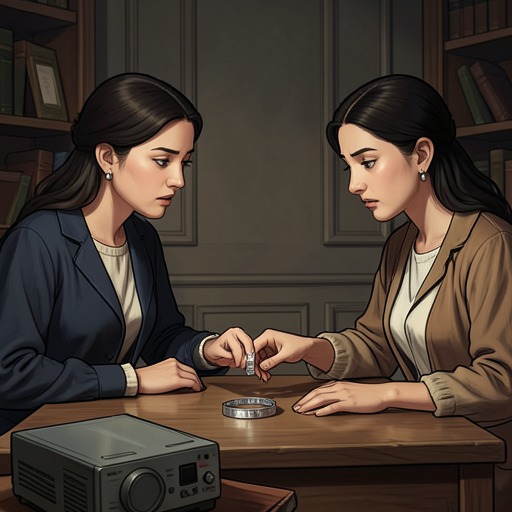
The story of the bracelet gives Enzo’s history another material consequence. Giovanna learns that he secretly took it from his wife’s dying mother, then gave it to Vittoria’s mother. The act joined the two women through an object associated with Enzo’s image, while also revealing the harm and unequal loyalties behind that connection. Giovanna reads the police-uniform photograph of Enzo as an image of him still watching over his wife and lover, both held together by the cult of his memory. The heirloom’s passage therefore complicates remembrance: Enzo’s continuing power rests not only on Vittoria’s account of love, but also on an act of theft that affected the women around him.
Narrative Role and Legacy
Enzo has no sustained present-day action in these episodes; his character is assembled from Vittoria’s passionate testimony, Giovanna’s observation of her aunt, the family snapshot, and the bracelet’s history. These different forms of evidence do not settle into a single portrait. The defender who offers to pay Andrea’s share is also the married man whose affair brings pain to his wife and children; the beloved remembered as the source of Vittoria’s lasting fulfillment is also the man whose image and gifts keep the women around him bound to a troubled family past.
That tension gives Enzo his decisive significance. Death does not end his influence: his love is preserved in Vittoria’s fidelity, his conflict with Andrea in the family’s account of the house, and his image in photographs and possessions that continue to travel between relatives. To Giovanna, this legacy offers no uncomplicated model of romance. It reveals how a private bond can survive as memory while its consequences remain distributed among a spouse, children, siblings, and women connected by an heirloom.