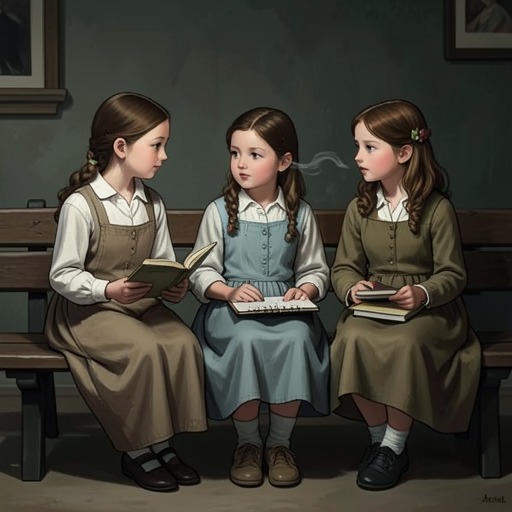
Giovanna and Ida’s friendship
The Lying Life of AdultsGiovanna and Ida’s friendship is the younger girl’s most enduring connection outside her family: it begins in a childhood trio with Angela, but develops into a distinct intimacy marked by frank appraisal, confidences, and mutual recognition. Ida is not merely a companion who reassures Giovanna; she can challenge her, surprise her, and eventually give shape to feelings neither girl has easily spoken aloud.
Childhood Friendship and Shared Ground
Ida and her older sister Angela are Giovanna’s trusted friends, raised in families whose parents have been close for decades and share similar views. The three girls have much in common: none has been baptized or taught prayers; each has received early, practical information about the body; and they have been encouraged to take pride in being girls. They read widely, behave responsibly, and share a sense of what advice might help them navigate Naples and the wider world. Their familiarity is supported by a household culture in which they can bring questions to their parents, as well as by common interests in music, films, television, and performers.
The three girls also share a private imaginative life. Although they disdain much of their contemporaries’ consumer culture, they secretly dream of becoming famous actresses and having glamorous boyfriends. Giovanna’s closeness with Angela is stronger because Angela is her age, while Ida is two years younger; still, Ida is no passive younger sister. She reads more than the others and writes poems and stories. The friends can speak frankly after disagreements and make peace, giving Giovanna reason to regard them as reliable witnesses when she begins to doubt her own appearance and judgment.
A Trusted but Independent Gaze
When Giovanna worries that she is changing for the worse, she seeks her friends’ judgment. At a family dinner, she is already feeling awkward and ungainly when Ida asks whether her shoes are new. The question is ordinary, but Giovanna, primed to hear criticism, takes it as a possible sign that others see something wrong with her. Later, in her room, she asks whether she looks scowling and whether she is becoming ugly. Ida answers that Giovanna is physically pretty, while suggesting that anxiety is what makes her seem less attractive. Her response offers comfort without simply denying what Giovanna fears: Ida distinguishes a worried expression from a change in Giovanna’s looks.
That mix of reassurance and candor recurs as the girls grow older. Giovanna tells Ida and Angela stories about Vittoria and the relatives she has begun to know, including accounts of the way Vittoria and Margherita cared for the children after Enzo’s death. Ida listens closely, asking whether Vittoria speaks to Enzo at the cemetery as the two friends speak to one another. When Giovanna says yes, Ida connects that intimacy to the idea that the two women had both been mothers to the children, just as Giovanna’s mother and Angela and Ida’s mother had, in a sense, been mothers to all three girls. The exchange shows Ida listening not only for sensational details but for the relationships that make Giovanna’s stories meaningful.
Friendship Amid Family Strain
The girls’ shared trust is tested by the adult conflict around them. After a gathering at which Giovanna watches her mother and Mariano with growing unease, Mariano intervenes when Angela asks whether Giovanna can stay overnight. He assures her mother that he will bring Giovanna home the next day. The arrangement is accepted, but Giovanna senses that the adults’ negotiation carries an unspoken significance. In Angela’s room, Ida joins the conversation and the nighttime closeness of the three friends provides a contrast to Giovanna’s private worry about what she has seen between the adults. She decides not to report that troubling scene to Vittoria, whose interpretation, she fears, would make it harder to preserve her mother’s dignity. The friendship offers companionship, but it does not make Giovanna’s suspicions disappear.
The rupture between the adults also disrupts the girls’ contact. After Giovanna’s mother leaves a visit with Costanza, Mariano disappears from the family’s usual orbit, and Giovanna sees Angela and Ida less often. The girls speak on the telephone, but none of them fully understands what has happened. They recognize that the violent quarrel between their fathers cannot be explained simply by the political subjects the men had appeared to discuss. Giovanna’s friendship with Ida thus persists within a network of adult loyalties and secrets that affects how often they can meet, even when the girls continue to seek one another’s company.
Renewed Intimacy and a Shared Journey
Years later, Ida reaches out to Giovanna in a moment of distress, asking her for a reason to leave the house. They arrange to meet in Floridiana. At the park, Ida says that she is glad to have failed her school year: she wants to leave school and write. Giovanna, who has also failed, tells her that she experienced the same outcome as painful and shameful. Ida’s answer makes the difference between them plain—she is not ashamed. Their friendship can hold that disagreement without dissolving; each can speak from her own experience rather than imitate the other.
Giovanna tries to comfort Ida by proposing a trip to see Tonino in Venice. Ida would rather go to Rome, and Giovanna understands that the city is not the real obstacle: Ida is troubled by Tonino’s treatment of Angela, who has told her about his slap and anger. Giovanna acknowledges that he hurt her sister but defends the effort he makes to behave well. Ida counters that he failed to manage that with Angela, while Giovanna argues that he was more committed than Angela was. Their exchange brings the sisters’ separate experiences into Giovanna and Ida’s friendship: Ida speaks out of loyalty to Angela, and Giovanna does not conceal her own complicated attachment to Tonino.
Ida then shares a story she has wanted to read to Giovanna for a long time. In it, a younger sister repeatedly pretends to be asleep so she can listen to her older sister and their friend whispering together; afterward, the younger girl cries because she feels excluded and unloved. Ida reads quickly and without looking up, then breaks down in tears when she finishes. Giovanna dries her tears and kisses her, responding to the feeling the story has made visible. The scene gives their friendship a new form: what had often been expressed through conversation and confidences is now disclosed through Ida’s writing, and Giovanna answers with tenderness rather than explanation.
The bond carries forward into action. The next day, Giovanna leaves for Venice with Ida, and the two promise on the train to become adults as no one ever has before. The journey closes this phase of their friendship not with a solution to their conflicts, but with a shared commitment to face what comes next together. Their connection has endured changing circumstances, family upheaval, school failure, and disagreement; Ida’s story and their departure make that mutual recognition newly explicit.