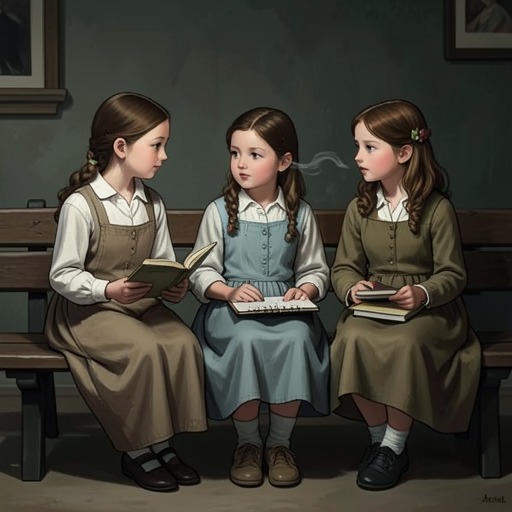
Giovanna’s adolescence
The Lying Life of AdultsGiovanna’s adolescence is a deliberately uneven coming-of-age, in which family secrets, class-marked spaces, and bodily experience unsettle the meanings she has inherited. The period moves not in a smooth line toward maturity but in gray stretches broken by vivid episodes: a descent into her father’s unfamiliar world, a new intimacy with relatives, a crisis at home, and a final departure for Venice with Ida.
Time and the Shape of Adolescence
Giovanna later describes adolescence as slow, composed of large gray blocks and sudden humps of color—green, red, or purple. The gray intervals resist precise dating: seasons blur into heat or cold, rain or sun, while the emotional episodes matter more for their hue than for their duration. Once she tries to put the period into words, however, its slowness becomes a whirlwind and its colors mix together. The retrospective form thus refuses a neat calendar of growing up; time is reconstructed through feeling rather than measured milestones.
Within this irregular passage, Giovanna manages to make up the school year she had lost, and discovers that she has a good memory and can learn from books even when she reads absentmindedly. That success improves her parents’ attitude toward her, especially her father’s, but their renewed pride brings her no satisfaction. Their presence feels like an irritating pain and a part of herself she wants cut away. She begins by distancing herself ironically, then deliberately rejects the parental bond by calling them by their names.
Crossing Naples and Discovering Kin
The city’s vertical geography gives Giovanna’s early world a boundary. Her maternal grandparents live in Museo, a place she knows and visits; her father’s relatives inhabit an undefined, nameless depth below the familiar heights of Naples. The family’s usual routes—to the Vomero, Villa Floridiana, and streets associated with her parents’ friends—belong to a world of gardens, sea glimpses, childhood games, and good manners. Beyond it, the lower city is less familiar, and the long descent toward her father’s family seems to lead to another city altogether.
On the journey to meet her paternal relatives, her father finally speaks about his origins. He points out the neighborhood where he was born and grew up, describing his family as poor, then identifies the dilapidated brick building where he lived and where his sister Vittoria still lives. The surroundings—bleak apartment blocks, warehouses, garbage-strewn greenery, puddles, and foul air—contrast sharply with the familiar upper city. His account gives the landscape a personal history, but his growing somberness also makes the journey an encounter with tensions he has rarely explained.
Vittoria later takes Giovanna to meet the family’s other siblings: Uncle Nicola, who works on the railroad, and Aunts Anna and Rosetta. The visits range across Naples, from Cavone to Campi Flegrei and Pozzuoli. Vittoria calls the trip an introduction to Giovanna’s blood, but she also turns it into an argument about what the family has withheld. When Giovanna cannot remember her relatives’ names, Vittoria blames her father for keeping their affection from her and urges her to look closely at the differences between her parents’ world and theirs.
The relatives’ small, drab apartments contain few books, and their cordial speech moves between dialect and Italian. Giovanna tries to answer in kind, making room for Neapolitan cadences in her hypercorrect Italian. The family does not ask after her father or demand that she carry greetings to him, yet they make clear that their hostility toward him does not extend to her. They call her Giannina, a name her parents never use. Under that name, Giovanna feels another version of herself emerge: more relaxed, funny, and open to affection than the girl known at home and at school.
The visits also reveal Vittoria in a different light. Rather than displaying only her aggressive side, she becomes good-natured among relatives who treat her tenderly, as someone unfortunate whom they love. Uncle Nicola remembers that she likes strawberry gelato; when he learns Giovanna likes it too, he sends one of his children to buy some for everyone. The welcome gives Giovanna a sense of belonging that her parents’ careful distance from this branch of the family had denied her.
Family Authority and the Difficult Work of Growing Up
The discovery of her father’s relatives changes what Giovanna can see, but it does not resolve the conflicts inside her own household. In the later crisis, she chooses cordiality when facing her mother and Mariano: she answers her mother pleasantly, accepts Mariano’s habitual kiss on the cheeks and his familiar glance at her breasts, then showers after they have left, as if to wash them off. The scene makes adulthood feel less like a freedom she can choose than a change already happening to her body and circumstances. She understands that growing up cannot be stopped, even as she tries to distance herself from the people and arrangements pressing on her.
Afterward, in front of the mirror, Giovanna reassesses the shame she has attached to her face. She thinks it lacks harmony, like Vittoria’s, but concludes that treating this resemblance as a tragedy was a mistake. A beautiful, refined face can conceal infernos no different from those expressed by a coarse or ugly one; beauty may harbor suffering rather than protect against it. The reflection links her struggle with appearance to a wider disillusionment: the visible surface of a person does not guarantee the life within.
Departure and an Unfinished Threshold
One of the final episodes begins as what Giovanna calls one of the most senseless enterprises of her adolescence: a Friday-night journey to Milan with Giuliana. The trip is marked by unease rather than easy intimacy. Giuliana arrives at the station with an enormous red suitcase and an overfilled purse, while Giovanna has only a small bag of essentials; after Giovanna says she will turn sixteen the next day, Giuliana seems embarrassed and apologizes for dragging her along. Their attempts at conversation do not find a comfortable tone. Even the shared food—Giuliana’s mother’s frittata di pasta—offers a brief, practical exchange rather than closeness.
At the close of the supplied account, Giovanna leaves for Venice with Ida. On the train, the two promise each other that they will become adults as no one ever has before. The vow is energetic but unresolved: adolescence ends here not with a settled reconciliation to family or society, but with companionship, departure, and an ambition to define adulthood differently. The journey gives the period its final image of movement, carrying Giovanna beyond the familiar boundaries she has spent it learning to question.