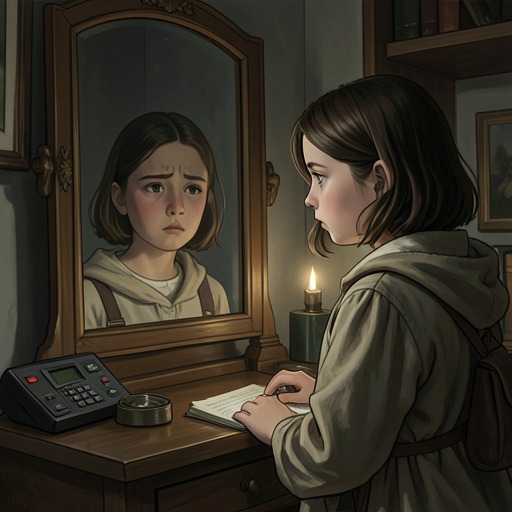
Giovanna’s first visit to Vittoria
The Lying Life of AdultsGiovanna’s first visit to Vittoria is both a literal descent into the unfamiliar districts of Naples and an initiation into the family history her parents have kept at a distance. At the door of a worn apartment building, Giovanna encounters an aunt whose blunt authority and striking appearance challenge the story she has inherited about her father’s relatives. The meeting does not end with that first, frightening impression: Vittoria’s insistence that Giovanna learn to see for herself opens a path toward relatives who welcome her with a warmth she has rarely experienced.
The city as a family boundary
For Giovanna, her mother’s relatives had belonged to a recognizable place, Museo, where she had been welcomed and showered with presents. Her father’s family, by contrast, seemed to live somewhere undefined and nameless, reached only by going down through Naples. She had seen those relatives at weddings and funerals, but the encounters felt forced; afterward, her parents would become tense and then agree, without discussion, to put the visit behind them. This estrangement made the journey to Vittoria more than an ordinary family call: it carried Giovanna across a boundary her parents had repeatedly maintained.
The city’s geography had taught Giovanna to associate familiarity with height. Her family lived in the Vomero, and the streets and gardens around Villa Floridiana were part of a happy childhood landscape. Her parents descended for work, study, shopping, and debate, but the lower city did not feel equally her own. The districts where her father’s relatives lived seemed wilder and harder to reach, and her parents appeared unusually weary and anxious when they had to go there. That inherited unease shaped Giovanna’s expectations before she ever saw Vittoria.
On the Sunday of the visit, the weather had cleared after several days of rain. Her father tried to restore their usual lighthearted rapport, but fell silent as he drove off the ring road and into rows of bleak apartment blocks, industrial sheds, damaged walls, puddles, and rubbish. He then told Giovanna that he had been born and raised in this neighborhood and that his family had been poor. In a still bleaker part of the district, he stopped beside a brick building with large patches of missing plaster and said that he had lived there, and that Vittoria still did. His account gave the journey a concrete history: this was not merely the place his daughter feared, but the place that had formed her father.
At Vittoria’s door
Giovanna entered the building alone, passing the smell of rubbish mixed with Sunday cooking and finding no elevator. She climbed broken, uneven stairs beside walls marked by broad white scars, avoiding obscene writing and drawings as she counted the floors. On the third floor, only one of three doors bore a surname: Trada, written by hand on a strip of paper pasted to the wood. Giovanna rang, waited, counted slowly to forty using her father’s old advice for moments of uncertainty, and rang again.
A shout in dialect answered. After the sound of decisive footsteps and a key turning four times in the lock, the door opened. Vittoria stood there in blue, tall and thin but broad-shouldered, with a mass of black hair gathered at her neck. She was smoking, coughing, and speaking between Italian and dialect. Her opening questions treated the second ring as an absurd disturbance; Giovanna, frightened, introduced herself as her niece. Vittoria immediately rejected the form of address, warning her to turn around and leave if she called her aunt again. Even before Giovanna understood the rules of this household, she had encountered a woman who set them without softening her voice.
Giovanna looked briefly at Vittoria’s unmade-up face and then lowered her eyes. She found Vittoria’s beauty so unbearable that she felt compelled to regard her as ugly. The contradiction captures the force of the encounter: Giovanna is not calmly assessing a new relative but trying to defend herself against an appearance and presence that overwhelm her. Later, she remembers Vittoria in sky blue, hears her rough dialect telling her to close the door, and sees herself following as though on a leash. The visit remains vivid as a physical impression before it settles into any orderly explanation.
A competing account of the family
Inside, Vittoria’s account of the past directly contests Giovanna’s father’s authority. She says that he erases people who might be better than him, and remembers how completely her own childhood depended on his approval. She had wanted to be a dancer and believed dancing was her destiny, but Andrea dismissed the ambition and sent her back to studying. Though he was earning money from private lessons and could have paid for dance school, Vittoria says he spent on books for himself instead. In her version, education was not simply a value but a standard Andrea used to decide whose desires deserved recognition.
Vittoria also describes her bond with Andrea as one of dependence and fear. As a child, she believed that the sun stopped shining when he was absent and feared that he would leave her alone if she did not behave as he wished. She says he decided what was good and bad for her, and presents her thwarted wish to dance as one example of how he made his preferences govern her life. Her story turns the successful, intellectually confident father Giovanna knows into a brother whose influence could diminish those closest to him.
The sharpest rupture in Vittoria’s account concerns Enzo. She says Andrea first let Enzo believe they were friends and then destroyed him, describing the injury in language of tearing and fragmentation. Later, when Giovanna calls Enzo a delinquent, Vittoria reverses the accusation: Andrea, not Enzo, is the bad man. She remembers Enzo as a police sergeant who was kind even to criminals, attended Mass on Sundays, sang beautifully, and taught her to play the accordion. Vittoria says that meeting him changed her view of God, and that after his death she drove away anyone who came near her. Her defense is not detached testimony: when she speaks of Enzo, emotion interrupts her, and she leaves the kitchen with her head lowered and one hand covering her eyes.
Learning to see and belong
Vittoria’s introduction to the wider family gives her challenge to Giovanna’s inherited perspective a social, not merely verbal, form. She takes Giovanna without warning to visit Andrea’s siblings: Nicola, who works on the railroad; Anna, a housewife married to a printer at Il Mattino; and Rosetta, also a housewife, married to a postal worker. Travelling through Naples in a green Fiat 500, they go first to Cavone, then to Campi Flegrei, and finally to Pozzuoli. Vittoria calls the excursion a meeting with Giovanna’s blood, insisting that these unfamiliar relatives are part of the child’s own inheritance.
Giovanna realizes that she barely remembers the relatives and may never have known their names. Vittoria notices and blames Andrea for depriving his daughter of their affection. Yet the visits reveal neither a demand that Giovanna side with them nor a performance of reconciliation: no one asks after Andrea or makes Giovanna carry a greeting back to him. Instead, the relatives make clear that they are not angry with her. Their apartments are small and drab, furnished in ways Giovanna has been taught to judge crude or vulgar; Aunt Anna’s is the only one where she sees mystery books. The family speaks in cordial dialect mixed with Italian, and Giovanna begins to answer in kind, allowing Neapolitan cadences into her previously hypercorrect Italian.
They call her Giannina, the name Vittoria uses and her parents do not. With them, Giovanna becomes relaxed, funny, and unusually open to affection; she wonders whether the new name has brought forth another version of herself. The change is not presented as a simple replacement of one identity with another, but as a difference made possible by a different welcome. Vittoria, usually capable of aggression, is good-natured during these visits, while her siblings and their families treat her with tenderness, as someone loved despite misfortune. Nicola remembers that Vittoria likes strawberry gelato; on learning that Giovanna likes it too, he sends one of his children to buy some for everyone, then kisses Giovanna on the forehead when they leave.
The first visit thus begins in fear, in a neighborhood Giovanna has been taught to experience as remote, and at a door where Vittoria refuses the familiar language of kinship. Its longer consequence is a widening of what Giovanna can recognize as family. Vittoria’s repeated demand that she look, rather than merely accept her parents’ judgments, becomes the principle connecting the frightening encounter to the warmth of the later visits. The estrangement has not been repaired, and the relatives’ silence about Andrea preserves the conflict; but Giovanna has crossed into a family world that her parents had made almost invisible, and discovered that it can offer her a different name and a different kind of belonging.