Mariano
The Lying Life of AdultsMariano is Andrea’s university friend, a history professor, and a regular contributor to a prestigious Neapolitan journal. For years he is a familiar presence in Giovanna’s family life, often talking with Andrea for hours; later, a suspected intimacy with Nella and a violent rupture with Andrea and Costanza turn that familiarity into a source of uncertainty. Seen largely through Giovanna’s childhood and adolescent perspective, Mariano is at once an established intellectual, a father within her circle of friends, and a figure whose private conduct becomes entangled with the family secrets she struggles to understand.
Identity and Place in the Family Circle
Mariano and Andrea have known each other since their university days and have remained friends. Mariano is often at the family home, where the two men argue about politics, Marxism, history, economics, and other matters they have studied for years. Their discussions make an impression on Giovanna and her friends, who understand little of the arguments but grow up believing that the men are engaged in serious work requiring study and concentration. Mariano, unlike the more reserved Andrea, also complains loudly about people in Naples, Rome, and elsewhere whom he believes obstruct their work.
Giovanna remembers Mariano as a pale, slightly puffy-faced man with blue eyes, bald and somewhat heavyset. His bitter discontent and frequent use of dialect swear words distinguish his manner from Andrea’s. The girls secretly repeat the insults they hear him use against public figures, despite the family rule against speaking dialect or swearing. Angela and Ida find the vocabulary amusing; Giovanna also senses the spite in it. His presence therefore brings both the intellectual seriousness of the adults’ conversations and a less polished, more combative register into the girls’ childhood.
Mariano is also Costanza’s husband and the father of Angela and Ida. Because he and Andrea are close, the families share dinners and visits, and Giovanna’s friendship with his daughters gives her a child’s familiar access to the household. That familiarity becomes consequential: she is present when adult relationships begin to show through gestures and silences that the children cannot fully interpret.
The Dinner and Giovanna’s Suspicions
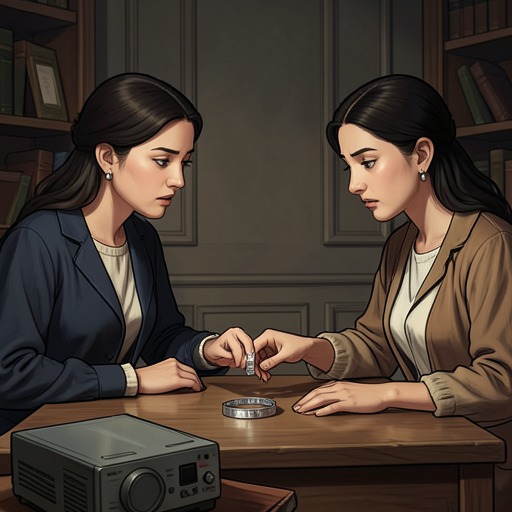
At a dinner attended by both families, Giovanna sees Mariano extend his legs beneath the table and press one of Nella’s ankles between his. The brief sight unsettles her. She notices that Nella pulls her leg away, turns toward Andrea, and later says little to Mariano, while Mariano watches her with a subdued, melancholy attention unlike his usual argumentative manner. His low, unusually gentle remarks and Nella’s restrained responses make the scene seem to Giovanna part of a larger exchange, though she cannot establish what it means.
The evening’s farewells deepen the uncertainty. As Nella is leaving, she turns toward Mariano and offers her mouth; he touches her cheek with his lips, and she does the same. Giovanna, who has already been trying to understand the contact beneath the table, fears they may kiss. She cannot decide whether what she witnessed was innocent familiarity or evidence of an affair, and the adults give her no explanation.
Giovanna considers telling Vittoria, who has urged her to look closely at her parents and report what she sees. She decides against it. She fears that Vittoria would impose a hostile interpretation, using her own charged language about desire to turn an ambiguous incident into an accusation against Nella and, indirectly, Andrea. Mariano thus becomes part of the conflict between Giovanna’s wish to understand what she has seen and her reluctance to let another adult control its meaning.
The Break with Andrea and Costanza
The questions surrounding the dinner become harder to dismiss after Mariano and Andrea have a fierce argument in the apartment on Via Cimarosa. According to Angela, the dispute begins with the subjects the men commonly debate—politics, Marxism, the end of history, economics, and the state—but turns into a personal confrontation. Mariano orders Andrea out and says he never wants to see him again; Andrea answers with insults in dialect, a register Giovanna had not associated with his usual manner.
Costanza then tries to leave to get some air. Mariano insults her and tells her not to come back. She slams the door, which swings open again, and Mariano kicks it shut; Andrea opens it once more and runs after her. The scene gives Giovanna and her friends new reasons to suspect that the quarrel is about more than political disagreement. They intuit that sex and the adults’ relationships are involved, but their knowledge remains incomplete. Giovanna, who has more clues than Angela and Ida, withdraws from their telephone conversations rather than risk bringing the unspoken facts into the open.
The narrator later understands the rupture in the context of relationships concealed for years: Andrea and Costanza had loved each other before Giovanna was born, while Mariano’s contact with Nella had prompted suspicion. Yet Giovanna’s immediate account remains shaped by what she witnessed and what others tell her. She fears that Vittoria’s report to Andrea may have triggered the fight; she also wonders whether Costanza discovered the contact beneath the table. The book preserves this uncertainty as part of Mariano’s role: he stands at the center of a crisis whose full causes Giovanna can only gradually piece together.
Separation, Return, and Changing Relationships
Andrea and Nella take almost two years to decide to separate, although they spend only brief periods under the same roof during the crisis. Andrea disappears for weeks at a time. Giovanna initially fears he has taken his life somewhere in Naples, then learns that he has been living in a house in Posillipo given to Costanza by her parents. Costanza is now permanently at odds with Mariano. When Andrea returns, he is affectionate and courteous and appears to want to resume life with Nella and Giovanna, but reconciliation lasts only a few days before the parents begin arguing again. Throughout these returns and renewed conflicts, Andrea and Nella agree that Giovanna should not see Vittoria.
Mariano’s relationship with Nella remains a source of unresolved questions for Giovanna. Later, Nella insists that the contact she had with Mariano beneath the table was without her consent. Giovanna is still troubled by what that incident, the quarrel, and the adults’ long-standing attachments reveal about people she had regarded as reasonable and trustworthy. Mariano’s significance lies not in a fully disclosed account of his motives, but in the way his proximity to both families exposes the distance between the appearances of adult friendship and the private entanglements beneath them.
Later Contact and Narrative Significance
As the families’ relationships shift, Mariano remains a familiar presence rather than disappearing from Giovanna’s life altogether. After Giovanna succeeds in making up the school year, Mariano visits and congratulates her. He embraces and kisses her, says she has grown up, and praises her appearance. He proposes that they have dinner together and talk, comparing his limited conversation with her to the interesting discussions she has had with Roberto Matese. His warm attention contrasts with the fear and suspicion attached to his earlier encounters with Nella, but the visit does not resolve the past.
Much later, Andrea tells Giovanna that peace with Vittoria is impossible, while acknowledging that the years have passed and that Giovanna has acted as a bridge. He calls her clever and says she is like him. This remark places Mariano’s old friendship with Andrea beside the family’s enduring estrangements: relationships may break, persist, or be partially mediated without returning to their earlier state. Through Mariano, the novel shows how a child’s observation of a gesture can become part of a much larger, imperfectly understood history of intimacy, betrayal, and separation.