Nella
The Lying Life of AdultsNella, Giovanna’s mother, is a Latin and Greek teacher whose gentle manner initially makes her seem like the family’s steady, reassuring center. When Andrea’s long-standing relationship with Costanza is revealed, Nella’s restrained grief, continued loyalty, and eventual separation reshape Giovanna’s understanding of love and expose how little a child can know of the adults on whom she depends.
Identity and Family Background
Nella teaches Latin and Greek at a high school in Piazza Carlo III and also corrects proofs of romance novels. She and Andrea married young, but waited until their thirties to have a child. Giovanna was born on June 3, 1979, after a difficult pregnancy and a torturous birth; her first two years brought sleepless nights, rashes, stomachaches, and tantrums. Nella went through a long depression during that period, while Andrea began giving private lessons to address the family’s financial worries. As Giovanna grew into a quiet, obedient child, her parents recovered some balance, and their work and intellectual lives again occupied the space around their love for her.
Nella’s own family is a contrast to Andrea’s obscure, tense network of relatives. Giovanna remembers the Museo grandparents and her maternal uncle as affectionate people who gave her presents; the grandparents’ deaths and the uncle’s departure ended the family’s regular visits. By contrast, Andrea’s relatives live in areas Giovanna experiences as distant and difficult to reach. Her parents’ trips down from the Vomero leave Nella and Andrea unusually anxious, and their repeated warning that Giovanna should pretend not to hear Vittoria reveals an old family conflict that Nella does not explain to her daughter.
Composure, Care, and What Giovanna Sees
Nella’s characteristic response to tension is quiet control rather than open anger. When Costanza teases her for spending so much time preparing lessons and correcting or rewriting stories, Nella answers gently that she has to work. Later, after Giovanna learns that she has overheard a painful remark about her, Nella is entrusted with repairing the damage: she tells her daughter that both parents love her, then describes how hard Andrea’s childhood and youth had been. The explanation turns toward Vittoria, whom Nella identifies as the continuing force that threatens to undo Andrea’s efforts to rise in the world.
This reassuring portrait becomes less secure when Giovanna watches Nella at dinner with Mariano and Costanza. Nella is withdrawn, makes little conversation, and avoids looking at Mariano, while he watches her closely and speaks to her in a low, unusually tender manner. When Nella hesitates over allowing Giovanna to sleep at Angela’s house, Mariano presses the matter by promising to bring her home the next day. The negotiation seems to Giovanna to carry an unspoken meaning. As the adults leave, Nella turns toward Mariano and they exchange a brief kiss on the cheek; the scene leaves Giovanna uncertain about what she has witnessed, and she chooses not to tell Vittoria, fearing her aunt would turn uncertainty into accusation.
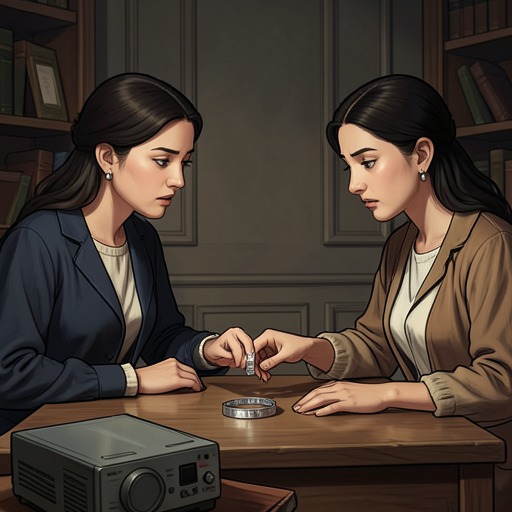
Nella’s relationship with Mariano later becomes entangled with the break between the two families. After Mariano and Andrea have a violent argument, Costanza visits Nella and helps put a white-gold bracelet on Giovanna’s wrist. Nella says the bracelet is a restitution, not a gift. The gesture, the argument, and the unexplained change in the bracelet’s ownership give Giovanna clues without giving her a complete account. Her mother’s guardedness and visible distress become part of a family story that the child must reconstruct from looks, silences, and objects.
Marriage Breakdown and Disclosure
The decisive revelation comes when Nella orders Andrea to answer Giovanna’s question about the bracelet. When he remains silent, Nella tells their daughter that Andrea has had another wife for fifteen years. The disclosure makes explicit what had been hidden behind the parents’ earlier conflict and their friends’ strained behavior. Giovanna, however, does not immediately react as Nella may expect: she has partly suspected the truth, and momentarily imagines that the family might simply accept the arrangement and recover its former peace.
The marriage’s collapse becomes material and practical as well as emotional. Nella and Andrea argue about dividing their belongings. When Andrea asks for notes in the first drawer of his desk, Nella refuses to let him take a single book, notebook, pen, or typewriter from the house. The books and working materials stand for the life they built together, and the dispute shows how separation turns familiar domestic things into contested property. Nella summons Andrea again in late winter to make the separation legal; after that, Giovanna does not see him for the rest of the summer and next sees him the following year.
Giovanna initially interprets her mother through the family’s divided loyalties. She imagines Nella as a betrayed woman waiting for Andrea’s calls, and her own anxiety makes the bracelet seem capable of carrying the family’s misfortune. She wonders whether Andrea gave it to Costanza because the object had enchanted him, or whether he had tried to remove its influence from his daughter. These explanations are Giovanna’s speculation, not facts about Nella’s beliefs; their importance lies in the way the child uses magical reasoning to make betrayal and separation bearable.
Attachment, Change, and Meaning
Over time, Giovanna’s judgment of Nella changes. Watching her mother work for long hours, carefully dressed even when no one is expected, she recognizes how much suffering Nella bears without abandoning her attachment to Andrea. Giovanna compares that loyalty with Vittoria’s devotion to Enzo: Vittoria’s love was returned, whereas Nella’s has survived betrayal. What she had treated as dependence begins to look like a strength—the ability to keep loving absolutely even when love brings humiliation and loss.
Nella herself gives Giovanna a compressed account of this inner division. She says that what she says about Andrea is one thing and what she thinks is another; although she allows herself to dwell on her anger, memories of their happy years lead her to forget that she hates him. The statement does not resolve the contradiction between resentment and fidelity. Instead, it shows that both remain active in her, and helps Giovanna understand why her mother cannot be reduced to either a victim who simply submits or a wife who has stopped loving.
As Giovanna grows older, she becomes more distant from both parents and begins calling them by their names. She sees Nella as increasingly malnourished and complaining, still preserving the possessions Andrea had been prevented from taking and remaining receptive to his occasional calls. At the same time, Nella tells her daughter that she is grown up and can take care of herself, leaving her more freedom to come and go. The change is not a clean reconciliation: the maternal bond persists, but Giovanna increasingly resists her parents’ authority and their continuing claims on her inner life.
Even after the long crisis at home, Nella remains present in the ordinary, intimate aftermath. When Giovanna returns to an empty house, goes without food, and falls asleep, Nella later sits on the edge of her bed and shakes her awake to ask whether everything is all right. The brief exchange recalls the basic care that survives the family rupture. Nella’s significance lies in that unresolved combination: a mother who protects and reassures her daughter, a woman wounded by betrayal, and a person whose enduring love cannot be explained away as either innocence or weakness.