Pascone
The Lying Life of AdultsPascone is the neighborhood in Naples where Giovanna’s paternal relatives live and where Roberto grew up. It first appears to Giovanna as a distant, unfamiliar world reached by descending from the Vomero; visits there gradually reveal a network of kinship, hospitality, grief, and dispute. Later, Pascone becomes more than the setting of her family encounters: Roberto understands it as the place to which he owes a spiritual debt, while Giuliana wants to escape it, and Giovanna’s changing view of the district marks her growing independence from the assumptions of her parents and aunt.
A city divided by distance and descent
Giovanna initially knows her mother’s relatives, who live in Museo, far better than her father’s family. The paternal relatives appear only at weddings or funerals, in encounters marked by forced greetings and a strained politeness that her parents seem to put behind them as soon as they are over. The family’s home district has no clear name in her childhood understanding. She knows only that reaching it means going down, and then further down, until the journey seems to carry her into a different city.
The movement through Naples gives this unfamiliarity a social and emotional shape. Giovanna’s family lives high in the city, and the places she associates with childhood and ease include the Vomero, streets leading to Villa Floridiana, and visits to Museo. Her parents travel farther down the city for work, shopping, study, and conversation, but those lower districts remain largely outside her own experience. The areas where her father’s relatives live consequently seem to her unexplored and difficult to reach. On the day of her first visit to the district, even her normally energetic father becomes silent and somber as the family drives past modest apartment blocks, warehouses, damaged walls, and areas of waste and standing rainwater. He tells Giovanna that he was born and grew up there, that his family was poor, and that he once lived in a building with large patches of missing plaster, where his sister Vittoria still lives.
Kinship encountered in its homes
Vittoria later takes Giovanna, without advance warning, on a tour of their paternal relatives. The route runs through Cavone, where Aunt Anna lives; Campi Flegrei, where Uncle Nicola works on the railroad; and Pozzuoli, where Aunt Rosetta lives. Vittoria describes the visits as a chance to meet Giovanna’s blood relatives. Giovanna realizes that she barely remembers them and may never have properly learned their names. Vittoria turns that recognition into a criticism of Giovanna’s father, whom she blames for keeping his daughter from the warmth of people who, though not polished or highly educated, are generous and affectionate.
The homes are small and plainly furnished, with few books, and the relatives speak in a mixture of dialect and Italian. Giovanna tries to meet them on their terms, making room for Neapolitan cadences in her careful Italian. The relatives do not ask after her father or require her to pass along greetings, but they make clear that their hostility toward him does not extend to her. They call her Giannina, as Vittoria does, rather than Giovanna, the name used by her parents, Angela, Ida, and her classmates. In their company she feels unusually relaxed and affectionate; the different name seems to bring forth a version of herself that is more open and at ease. Uncle Nicola remembers that Vittoria likes strawberry gelato, and, after learning that Giovanna likes it too, sends one of his children to buy some for everyone. The district that had seemed alien begins to offer an intimacy she has not experienced in her familiar social world.
Enzo’s household and a shared family history
Another visit brings Giovanna to the home of Margherita, Enzo’s widow, in a courtyard of pale-blue buildings. Vittoria opens the door with her own key, suggesting an established closeness between the two women. Margherita welcomes them and introduces Giovanna to her children: Tonino, Corrado, and Giuliana. A large framed photograph of Enzo in his police uniform, with a red light burning before it, makes his absence present in the household. The family repeatedly refers to what Enzo would have enjoyed, disliked, or wanted, as if his memory remains part of their ordinary conversation.
Vittoria and Margherita’s histories are bound together by their love for Enzo and by the painful past of their relationship with him. Giovanna imagines the younger versions of the women and Enzo, and tries to picture the affection and injury that must lie behind their present cooperation. What she can observe is a family arrangement that is neither simple nor free of tension. Corrado is Vittoria’s favorite, to the annoyance of the other children; Margherita tends to look to Vittoria for approval and sometimes withdraws what she has said when Vittoria disagrees; and the children love their mother while also showing wary devotion to Vittoria. They sometimes seem to protect Margherita from her, even as they respect Vittoria as a powerful presence in their lives.
The district’s significance is therefore not reducible to poverty or estrangement. It contains cramped and unpolished homes, but also the warmth and welcome that Giovanna’s parents’ world had largely withheld from her. Her aunt’s insistence that she look closely becomes a lesson in reading both place and family: hostility toward her father coexists with affection for her, and tenderness among relatives exists alongside favoritism, authority, and old wounds.
Pascone as a home and a debt
Pascone also becomes central to Roberto’s understanding of himself. He grew up there, and later tells Giovanna that his love for Giuliana is connected to a debt he owes the place of his birth. He describes that debt as a spiritual obligation to make up for what the neighborhood has given him, one that a lifetime would not be enough to repay. He sees Giuliana, whose love began on the same streets, as an embodiment of that debt. His account makes marriage more than a private choice: for him, it is tied to memory, origin, and a responsibility to the community from which he came.
Giuliana experiences the same attachment differently. She tells Giovanna that she wants to leave Pascone and Naples, marry Roberto, and live with him in Milan in a home of their own and in peace. She resents Vittoria’s desire to keep her nearby and objects to the constant conflict of family life. The contrast exposes the unequal burden that the idea of home can impose: Roberto’s sense of obligation gives Pascone moral and emotional value, while Giuliana fears that staying there will keep her from a life of her own. When Vittoria resists Giuliana’s departure, Roberto suggests that she invite Giovanna to accompany her to Milan. Giovanna learns that the invitation was his idea, a small but consequential sign that his concern for Giuliana’s future can include a role for Giovanna as well.
The district in Giovanna’s changing perspective
For Giovanna, Pascone is first filtered through her parents’ tension and Vittoria’s forceful account of the family. Her aunt urges her to look at what the relatives are like, and to compare them with the people who raised her. The visits make that instruction concrete: the relatives welcome her even though they have reason to resent her father, and the name Giannina lets her experience a self less constrained by her familiar relationships. Yet Giovanna’s attachment to Vittoria is not uncomplicated. When she later returns to the aunt’s home to give back the bracelet, Vittoria’s reproach makes clear that the object has come to stand for loyalty and gratitude as well as affection. The family dispute can turn a visit into a test of which side Giovanna has chosen.
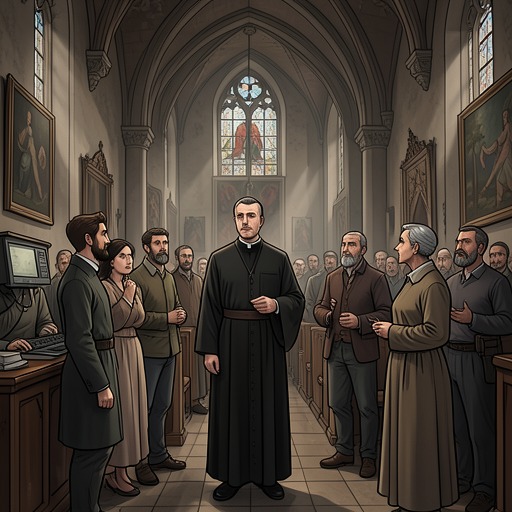
Pascone’s physical and social distance also shapes Giovanna’s first encounter with Roberto. At a crowded church gathering, she recognizes him as a young man who came from the district and has made a life beyond it. She is immediately overwhelmed by attraction and begins to imagine that she sees a singular quality in him that his neighbors cannot fully recognize. Later, she hears him explain his sense of indebtedness to Pascone, then hears Giuliana’s competing wish to get away. These accounts complicate her early idealization: the district is at once a source of belonging, a place marked by poverty and family conflict, and a point of departure from which its children make different claims on the future.
Giovanna eventually returns to Milan partly to recover the bracelet and to intervene in Giuliana’s distress, though she recognizes that her stated reasons conceal her own desire to see Roberto again. That journey extends the conflict first encountered in Pascone: family loyalty, personal desire, and the obligation to others do not align neatly. As a setting, the district supplies the routes, homes, and relationships through which those tensions become visible. As an idea, it remains contested—an inherited origin that may call for repayment, offer welcome, or become a place from which one must leave.