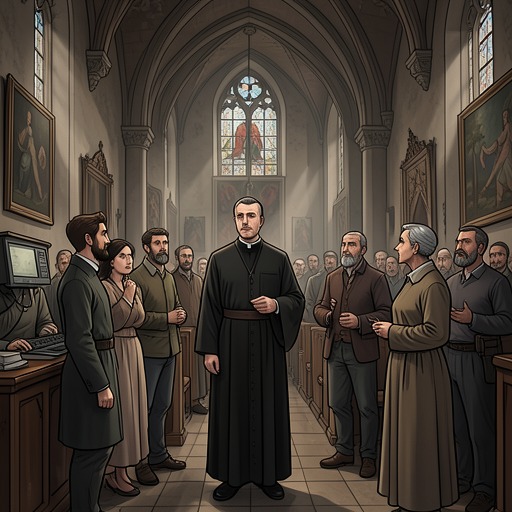
Pascone parish church
The Lying Life of AdultsThe Pascone parish church is a religious and communal meeting place whose significance in Giovanna’s life far exceeds its role as a setting. She encounters Roberto there during a crowded Sunday gathering and, before he has spoken, feels that her life has changed. The church’s talks subsequently give her a reason to return, linking intellectual curiosity and religious ambivalence with her intense attachment to him; later, the effort to remove the priest signals a rupture in the parish community she has entered.
Setting and Approach
For Giovanna, Pascone lies within a part of Naples first approached as distant, unfamiliar territory. Her family’s movements distinguish their accustomed upper-city world from the lower neighborhoods: the Vomero, Museo, and familiar streets around Villa Floridiana stand apart from places reached by descending through the city. Her father’s relatives live in a district she imagines as difficult to reach, and her parents’ visible unease during visits makes the journey feel like passage into a separate social world.
That geography becomes concrete when Giovanna travels with Vittoria toward Pascone. The church lies amid streets she has come to know through repeated visits, in surroundings that differ sharply from the cultivated settings of her childhood. The location therefore belongs not only to the city’s map but to the crossing of family and social boundaries: Giovanna is entering the neighborhood of her father’s relations and, through Vittoria, a community her parents had kept at a distance.
A Parish Gathering and a First Encounter
One Sunday, Vittoria brings Giovanna to the church, where Margherita has saved them places near the front. The crowded nave is already alive with conversation when they arrive. Don Giacomo stands at a table at the end of the central nave, and the gathering’s attention turns when he calls Roberto forward to sit beside him. The moment is presented through Giovanna’s intensely subjective perception: the room seems to fall silent as Roberto rises and approaches the table.
Giovanna is almost fifteen and has not previously felt genuinely attracted to a boy. Seeing Roberto produces an immediate physical and emotional shock, before he speaks or expresses any feeling. She understands the encounter as a turning point and makes the wish to possess his love the focus of urgent prayer, despite her uncertainty about belief in God. The church thus becomes the place where a public religious gathering and a private adolescent awakening converge.
Talks, Return, and Religious Ambivalence
The church also holds Giovanna’s attention through the talks organized there. On Sundays, Don Giacomo invites a clever friend to speak at a table set up at the end of the central nave. Giovanna tells Vittoria that she has liked hearing the talks, although she cannot readily repeat what was said. Her interest supplies a reason to attend that is distinct from her unspoken feelings for Roberto, which she does not disclose when explaining her visits.
That distinction does not keep the motives separate. Giovanna’s prayers about Roberto coexist with her reluctance to go to church and her hope that other acquaintances might appear and take her away. The parish is therefore neither simply a refuge of faith nor merely a backdrop for infatuation. It is a place where her religious uncertainty, attraction, and desire for intellectual engagement occupy the same space, sometimes uneasily.
Conflict and Significance
The parish’s life later becomes vulnerable to institutional conflict. Vittoria tells Giovanna that activities at the church are being stopped and that people want to get rid of Don Giacomo. She is angry not only with parishioners and church authorities, but also with the priest and Roberto. Her comparison of the priest to medicine that first cured and then produced harmful side effects captures the community’s changed response: an earlier source of help now seems to have left people feeling worse.
For Giovanna, the prospect of the talks ending threatens a setting bound up with her growing attachment to Roberto and her limited, difficult engagement with religious ideas. The church’s narrative importance rests in that conjunction. It makes a decisive encounter possible, offers a recurring public forum that Giovanna seeks out without fully explaining why, and eventually reveals that the community surrounding the encounter is itself divided and unstable.