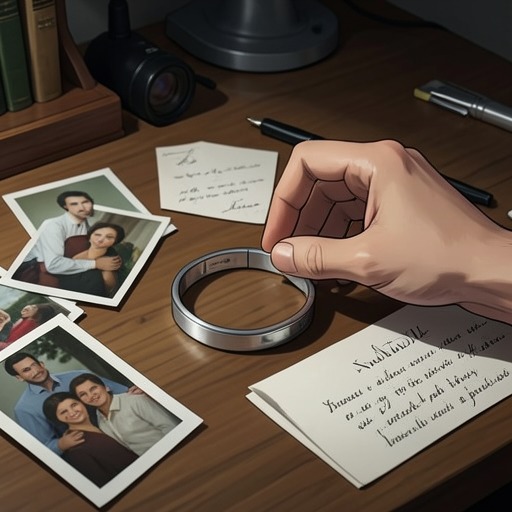
The bracelet’s symbolic meaning
The Lying Life of AdultsThe bracelet’s symbolic meaning is inseparable from the family history it carries: it passes among women as a desired heirloom, but its origins expose Enzo’s betrayal and unsettle Vittoria’s account of her parents’ love. Its shifting ownership makes it more than a keepsake. It becomes a disputed piece of evidence, a source of anxiety, and a test of whether Giovanna can recognize the difference between the object itself and the harms attached to it.
An Object Carried Across Family Divisions
The bracelet belongs to a wider inheritance of estrangement. Giovanna grows up knowing her mother’s relatives through affectionate visits, but her father’s family remains remote, associated with a long descent from the heights of Naples into neighborhoods her parents treat with fatigue and unease. Her father’s relatives seem to inhabit another city; entering their world means crossing both a geographical and a familial boundary. Against that distance, the bracelet gives family history a portable, intimate form. Its passage between generations brings unresolved ties into Giovanna’s immediate life.
When Vittoria takes Giovanna to meet her father’s siblings and their families, she frames the visits as an encounter with blood. Giovanna discovers relatives whose small, plainly furnished homes and warm welcome differ from the standards she has absorbed from her parents. They call her Giannina, a name that seems to release a more relaxed and affectionate version of herself. Vittoria urges her to look closely at the differences between these relatives and Giovanna’s parents. The bracelet’s meaning later depends on precisely this practice of looking: family inheritance cannot be understood through its formal labels alone.
The Theft Behind the Heirloom
The decisive revelation comes when Giuliana takes the bracelet from a leather pouch and asks whether she should wear it. She explains that her father, Enzo, secretly took it from her maternal grandmother, who was gravely ill, and gave it to Vittoria’s mother. The gift that might have appeared to be a conventional family present therefore began in a breach of trust. Enzo favored the mother of his lover with property taken from his own dying mother-in-law, while his wife suffered from his conduct.
Giovanna connects this account with the photograph of Enzo in his police uniform, displayed in the kitchen. In her reflection, the dead man’s image continues to hold his wife and lover together through its presence in their shared memory. The bracelet likewise binds them, but not in the harmonious way a family heirloom might promise. Its history records Enzo’s power to injure those whose affection he had already secured while trying to impress someone new to him.
That history also revises the family story Vittoria has recounted. The bracelet was formally associated with her mother and presented as a gift for a celebration, but in substance it had been taken from a woman who was dying. Giovanna understands Vittoria’s ambivalence: she claims the bracelet, yet also seems inclined to be rid of it. Its status as inheritance and as stolen property cannot be reconciled, and this contradiction makes it evidence that the celebrated idyll between Vittoria’s parents was not as untroubled as her account suggested.
Anxiety, Memory, and Competing Readings
For Giuliana, the bracelet’s past remains active in the present. She calls it a lasting sign of painful times and says that it makes her anxious and seems to bring bad luck. Her response treats the object as if it retained the suffering of the people connected to it. Giovanna answers that objects are not guilty and says she likes the bracelet. The contrast is not simply between superstition and reason: Giuliana identifies the emotional burden the heirloom carries, while Giovanna resists making the object itself responsible for the wrongdoing of its owners.
The bracelet repeatedly returns at moments of uncertainty. After Giovanna’s brief encounter with Roberto leaves her feeling that his life lies elsewhere, she wakes agitated with the image of the bracelet on Giuliana’s wrist and calls Vittoria. Later, on the journey away from Naples, Giuliana wakes Giovanna in alarm because the bracelet is missing. A call to Roberto brings relief: he has found it left in the kitchen. Yet the recovery does not settle Giuliana’s anxiety. She worries that, once she leaves, Michela may take her place with Roberto, and she does not want to return home to Vittoria’s questioning. The bracelet’s disappearance and recovery thus accompany, rather than resolve, Giuliana’s fear of losing both her relationship and control of the story around it.
Return and Reinterpretation
Giovanna eventually brings the bracelet back to Giuliana, explaining to Vittoria that it somehow ended up in her purse. Vittoria stops her from handing it over. She takes Giovanna to a mirror and directs her to look at herself, then clasps the bracelet on her wrist. The object has shifted again: once the trace of Enzo’s theft and a source of Giuliana’s apprehension, it becomes part of Vittoria’s effort to shape how Giovanna sees herself and presents herself to others.
The ending does not erase the bracelet’s compromised history. Instead, its return to Giovanna’s wrist gathers its meanings without resolving them: family inheritance, betrayal, anxiety, female attachment, and the struggle over who has the right to define what a woman’s possessions signify. Giovanna’s defense that the object is not guilty remains in tension with the painful history it makes visible. Its symbolic force lies in that tension: the bracelet cannot be reduced either to an innocent ornament or to a cursed thing, because its meaning changes with the people who claim it and the histories they bring to it.