The face of Vittoria
The Lying Life of AdultsThe face of Vittoria is not simply a resemblance between niece and aunt. It is an identity Giovanna fears has been assigned to her by her father’s contempt, her parents’ silence, and her own unsettled view of her changing body. The likeness becomes a lens through which she reads beauty, family belonging, class, and the possibility of becoming someone other than the child her parents believed they knew.
The comparison and its force
At twelve, Giovanna overhears her father say that adolescence has nothing to do with her difficulties: she is acquiring Vittoria’s face. He speaks to her mother in a tone unlike the family’s usual playful manner, unaware that Giovanna can hear through a door left open. He does not call his daughter ugly outright, but the comparison lands with that force because she understands Vittoria as a woman her father has long associated with ugliness and spite.
The remark arrives when Giovanna already feels exposed and uncertain. She had begun menstruating nearly a year earlier, was embarrassed by her developing body, worried about her smell, and felt lethargic. Her parents’ unhappiness with her and her disappointing school performance intensify her fear that she has lost the qualities for which her father loved her. Until then, his affection had seemed to guarantee that she was pretty and would remain so. The face of Vittoria threatens that assurance at its most vulnerable point.
Vittoria herself is nearly unknown to Giovanna. The child’s fear comes less from remembered encounters than from her parents’ reactions: her father speaks of his sister obscurely, while her mother tends to silence him. Giovanna imagines Vittoria as a threatening figure who might arrive at their apartment and bring disorder with her. The aunt’s face is therefore already an inherited story before Giovanna can compare it with a clear image of the woman.
An absent face made visible
Giovanna tries to establish what Vittoria looks like by searching the family photographs. In several pictures of her father’s relatives, she finds a precise black rectangle drawn over a person standing beside him. She takes the careful blocks as evidence that her father deliberately erased Vittoria from the images. When she scrapes at one with a kitchen knife, only the white of the paper appears; the photograph yields no recovered face, only proof of how thoroughly it has been obscured.
In another photograph, her father appears as a young man, smiling beside two black rectangles. Giovanna imagines the covered figures as bodies enclosed in coffins. The image makes erasure a material counterpart to the comparison she has overheard: Vittoria has been removed from the family’s visible record, yet her supposed likeness has reappeared in Giovanna. The more the aunt disappears from view, the more powerfully the girl searches for her in herself.
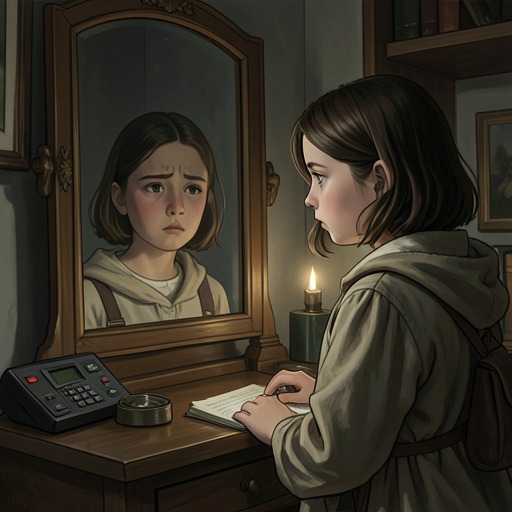
That search turns the mirror into a site of anxious inspection. Giovanna studies features she had not previously considered important—her eyebrows, eyes, forehead, hair, ears, lips, teeth, chin, and nose—and asks whether they belong to Vittoria or only to her. She also examines her changing body, wondering whether it is simply her own or an advance sign of the aunt she fears becoming. Because Giovanna has no reliable picture of Vittoria, resemblance cannot be tested against a stable likeness; each new feature can instead become evidence for the frightening possibility.
The family map and the work of looking
The feared resemblance belongs to a broader estrangement within the family. Giovanna’s mother’s relatives live in Museo, a familiar place associated with affectionate visits. Her father’s relatives inhabit an unnamed world reached by descending through Naples, far below the family’s home in the Vomero. Giovanna knows the routes through the upper city and Villa Floridiana, but the lower neighborhoods seem remote and unexplored. Her parents’ repeated anxiety before visits makes that separation feel like a boundary between different worlds.
Before meeting Vittoria, Giovanna notices how her parents prepare for these visits as if they must pass through an ordeal. Her father abandons his books, puts on a good suit, and grows tense; her mother checks everyone’s appearance. They caution Giovanna to disregard what Vittoria might say. The family’s silence does not erase its history; it teaches Giovanna to approach that history as something dangerous, divided, and difficult to see plainly.
When Vittoria takes her to meet their paternal relatives, the journey gives Giovanna a different experience of kinship. She travels with her aunt in a green Fiat 500, visiting relatives in Cavone, the Campi Flegrei, and Pozzuoli. Vittoria calls the outing a meeting with their blood. Giovanna finds that she barely remembers the relatives’ names, but they welcome her warmly, call her Giannina, and do not require her to carry messages to her father. In their company she feels more relaxed and open to affection than she does in the identity attached to her familiar name.
Vittoria insists that Giovanna look closely at what distinguishes the two sides of her family. She accuses the girl of looking without seeing and urges her to notice the people and circumstances her parents’ account leaves out. The relatives’ homes are modest, and their speech mixes dialect with Italian; qualities Giovanna has been taught to regard as crude do not prevent them from receiving her with warmth. Her experience unsettles the hierarchy between polished respectability and vulgarity, and makes family resemblance a question of what one has been taught to notice as much as what one sees.
The face as a changing judgment
At the church Christmas market, Giovanna watches Vittoria from a distance and tries to judge the face she once feared. The aunt’s moods shift between strained brightness, distraction, and visible distress. Giovanna recognizes in those changes a possible likeness between them: she reasons that both can look beautiful when their thoughts are good and become ugly when troubled. The face is no longer only a fixed inheritance; it appears to register a state of mind, and Giovanna reads her own distress in Vittoria’s.
That recognition does not dissolve the fear. Giovanna still worries that she is becoming the woman her father has taught her to despise, and she sees herself reflected in Vittoria’s unhappiness. Yet the aunt’s promise that she will come whenever Giovanna calls offers a form of kinship different from the father’s judgment. After Vittoria leaves her without exposing the family secret Giovanna had feared would be revealed, Giovanna looks in a mirror and remains convinced that no miracle can erase the face coming to her. She resolves not to spy on her parents again and not to see Vittoria, leaving the likeness unresolved rather than disproved.
Inheritance, class, and self-recognition
The concept also gathers force from the family’s opposing standards of refinement. Giovanna’s father’s world prizes education and correct speech, while Mariano’s dialect and profanity disturb the girls who have been forbidden to speak Neapolitan. Vittoria, in turn, challenges Giovanna’s polished appearance and pink clothes, accusing her of believing lies rather than truth. The girl’s face is thus judged alongside her speech, clothing, schooling, and manners: all become signs by which adults sort people into respectable or disreputable kinds.
The bracelet sharpens that conflict. Giovanna understands Vittoria as poor and uneducated, and Costanza as wealthy and cultivated, yet the jewelry once associated with Vittoria is worn by Costanza, joining women whom Giovanna has been taught to regard as opposites. The object confuses the categories through which she has been trying to understand her family. In the same way, the face of Vittoria cannot be confined to a simple inheritance of ugliness: it is produced and distorted by estrangement, class judgment, fear, and affection.
Giovanna’s crisis begins when she mistakes her father’s comparison for an authoritative account of who she is. The novel follows how that verdict enters the mirror, reshapes her attention to her body, and makes her search the family’s erased photographs and divided geography for an answer. Meeting Vittoria and her relatives complicates the image without providing a final likeness to measure. What Giovanna inherits is therefore not a settled face but a struggle over who has the right to name it, and what belonging might mean beyond her parents’ version of the family.