The family photograph of Andrea, Vittoria, Enzo, and their mother
The Lying Life of AdultsThe family photograph of Andrea, Vittoria, Enzo, and their mother is a black-and-white snapshot whose discovery brings the past into a tense present: it shows Andrea and Vittoria as young people, Enzo beside them, and their mother wearing the white-gold bracelet that Giovanna now possesses. The photograph matters not simply as a record of who once stood together, but because Giovanna recognizes a detail her mother has never seen. In that difference of looking, a family object becomes evidence, and the image unsettles the stories its viewers have told themselves about love, loyalty, and inheritance.
Discovery and Composition
One evening, while arranging family photographs, Giovanna’s mother takes out an image Giovanna has never seen. It had been hidden inside the Italian dictionary her mother had owned since high school, a place Giovanna had not thought to search. The picture is not one of the photographs previously kept in the metal box. Its concealed location makes the discovery feel incidental, but its contents bring several strands of family history into the same frame.
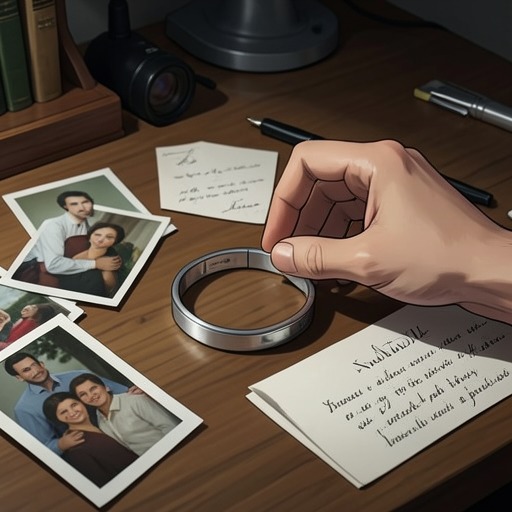
The snapshot is in black and white. It shows Andrea and Vittoria when they were young, with Enzo also present; the siblings appear happy, and Vittoria is smiling at Andrea. A tiny woman sits between them and Enzo. Giovanna recognizes her as the siblings’ mother, whose expression she reads as harsh. The image therefore gathers together people whose relationships and loyalties have been remembered differently: Andrea and Vittoria, their mother, and Enzo, who was Vittoria’s beloved and whom their mother preferred to Andrea.
The photograph’s hiding place is also bound to the mother’s private memory of Andrea. She says she kept it in the dictionary because she saw how handsome he was and remembered the reasons she loved him. For her, the picture had preserved the young man she loved; its other figures and details remained outside her attention. Its significance changes when Giovanna looks beyond that remembered image of her father.
The Bracelet Identified
Looking closely at the photograph, Giovanna takes a magnifying glass from the pen holder and enlarges the right wrist of her father and the siblings’ mother. She recognizes the bracelet on the older woman’s arm as the same white-gold bracelet that has become part of the present family conflict. Her mother bends over the photograph but does not take the lens; she says she had never noticed it.
That small detail revises the apparent history of the bracelet. The object has circulated through family hands and claims: Costanza returned it to Giovanna, while Giovanna has been considering whether it belongs to her, to Vittoria, or to a past neither woman can settle. The photograph offers concrete evidence that it was worn by the grandmother, but it does not resolve every claim to ownership. Instead, it gives Giovanna another reason to resist returning it, while making clear that inheritance here is entangled with appropriation, affection, and family grievance.
The image’s evidentiary force depends on close attention. The bracelet was visible all along, yet it remained unseen by the mother, who had looked at the photograph through the memory of Andrea. Giovanna’s magnified view does not simply add an object to the picture; it exposes the limits of the story her mother had been able to see in it.
Memory and Divergent Readings
The discovery affects mother and daughter differently. Giovanna understands that her mother may have looked at the picture many times without noticing the bracelet because she had attended to Andrea alone. The mother had placed the photograph in the dictionary like a dried flower, preserving the memory of the moment associated with the young man she loved. Once Giovanna identifies the bracelet, that sentimental keepsake also becomes a painful record of a family history the mother had not incorporated into her account.
The narrator links this recognition to the mother’s effort to sustain an idealized memory of her former husband. She recalls him as good, honest, and faithful, even as other details make that ideal difficult to maintain. The photograph’s newly noticed bracelet sharpens the contradiction: it places the grandmother, Vittoria, Andrea, and Enzo in one frame, while complicating the mother’s preferred account of their attachments. The mother does not openly display the full force of her hurt; instead, she turns toward nostalgic stories about the people in the picture.
Giovanna draws a different conclusion. She assembles a set of competing claims: the bracelet belonged to her grandmother; Vittoria and Andrea each claimed it against the other’s wishes; Costanza returned it to her; and she herself recognized what her mother had failed to see. The photograph does not pronounce a final legal or familial judgment. It gives Giovanna the confidence to keep the bracelet, and lets her make her own capacity to look directly at painful evidence part of her argument.
Narrative Significance
The photograph turns looking into an active, consequential act. Earlier, Vittoria had urged Giovanna to look carefully at family relations and to distinguish seeing from merely looking. Here the instruction takes material form: a magnifying glass brings the bracelet into focus, while the two women’s different readings reveal how attention can be directed by love, denial, or an appetite for painful truth. Giovanna sees a detail that her mother’s attachment to Andrea had left out of view.
The picture also joins private memory to family conflict without resolving the conflict. Its arrangement offers no explanation of all the tensions among the people shown, and the bracelet alone cannot establish the full history of its passage between them. What it does establish is a connection that the characters had not all acknowledged. The photograph is at once a keepsake of the mother’s love for Andrea, a witness to the grandmother’s possession of the bracelet, and a catalyst for Giovanna’s decision to claim the object. Its meaning lies in the gap between what the image contains and what each viewer is prepared to recognize.