The lying life of adults
The Lying Life of AdultsThe lying life of adults names both a family condition and the novel’s governing problem: how to tell truth from the stories people use to protect themselves, deceive one another, or make sense of what they cannot bear. Giovanna’s childhood obedience gives way to secrecy as she encounters competing accounts of her family and begins to understand that the adults who condemn lying are themselves entangled in concealment. The resulting education offers no clean division between truth and falsehood; even what Giovanna sees can become distorted by loyalty, fear, desire, and the need to believe.
A story made of uncertainty
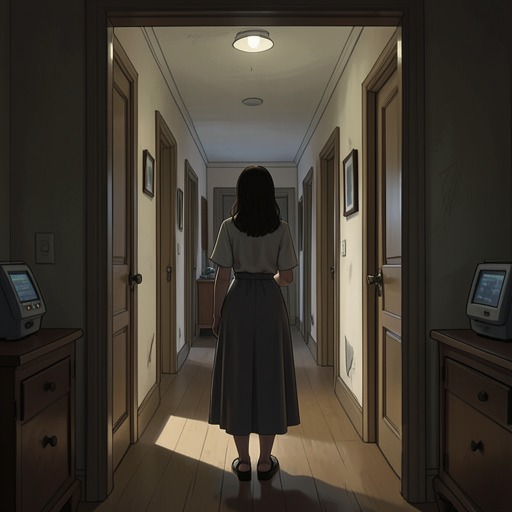
The novel announces its concern with deception through Giovanna’s retrospective account of a defining injury: two years before she leaves home, her father tells her mother, under his breath, that their daughter is very ugly. The scene remains fixed in memory, along with the family’s apartment high on Via San Giacomo dei Capri and the blue light of a February day. Yet the narrator doubts whether writing can turn that memory into a coherent life story. She describes herself not as a finished, stable self but as a tangled knot whose suffering may contain no clear path or redemption. The book’s inquiry into adult lies therefore begins with a question about narration itself: memory preserves a sentence with terrible force, but it does not guarantee that the self made from it can be neatly explained.
The child’s early view of her parents is complicated by the anxiety that surrounds visits and family encounters. Her father abandons books and notebooks, puts on a clean shirt and good suit, and grows tense; her mother repeatedly checks how everyone looks, as though correct clothing could ensure that the three of them return safely. They do not explain what threatens them, but their efforts to conceal their distress make it perceptible to Giovanna. A warning about how to respond if Vittoria says something further teaches her that adults can require a child not merely to keep a secret but to pretend not to have heard what she has heard. From the beginning, silence is presented as a family practice disguised as protection.
Learning to lie and to look
Giovanna’s father has taught her that one must never lie, and his words carry a dazzling authority for her. Nevertheless, after visiting Vittoria, Giovanna begins to deceive her parents. At first she does not invent elaborate falsehoods: she performs agreement with their orderly version of the world while privately keeping a narrow route of her own, one she can abandon if it becomes unsafe. The lie is painful precisely because she loves her parents and fears her father’s judgment. It is not a simple rejection of family loyalty but a way of making room for perceptions that the family’s authorized account cannot accommodate.
The deception also takes the form of selective truth. Giovanna hides from her parents the fact that she has come to believe something of Vittoria’s account, while concealing from Vittoria how strongly her parents’ version still holds her. When her mother asks about the visit, Giovanna tries to answer cautiously but lacks the experience to manage her concealment consistently. She is alert to a possible blush or flash in her eyes that might betray a further appointment. Her effort to deceive becomes an education in how difficult it is to control not just what one says but what one’s body may disclose.
Vittoria presses Giovanna to look beyond appearances and to notice what her parents’ polished version leaves out. During visits to paternal relatives, Giovanna encounters the family members she barely remembers: they welcome her warmly, speak in a cordial mixture of dialect and Italian, and call her Giannina, a name her parents never use. In their small, drab apartments, where the objects are unlike those Giovanna has been taught to regard as refined, she experiences an unexpected openness to affection. The name seems to make room for a different version of herself. Vittoria’s insistence that Giovanna look, rather than merely see, thus unsettles both the family’s hierarchy of taste and the child’s sense that she has only one possible identity.
Yet learning to look does not make Giovanna a reliable judge. She knows that Vittoria welcomes stories that confirm her view of Giovanna’s parents, and fears that her wish to please her aunt could lead her to invent more than she has witnessed. Instead, she searches for small, real irregularities and slightly enlarges them, uneasy about becoming either a genuinely loyal spy or an affectionate daughter. Her divided position exposes the moral cost of treating intimate knowledge as evidence in a contest between adults: even a true detail can be reshaped to serve someone’s grievance.
Family secrets and unstable evidence
The family’s arguments over the bracelet make the adults’ hidden relationships materially present to Giovanna. She struggles to understand how her father could take an ornament associated with Vittoria and intended for her, then give it to Costanza, his cultivated and wealthy second wife. The object seems to collapse distinctions that Giovanna had understood as opposites: Vittoria is poor and uneducated, Costanza rich and cultivated; one is called vulgar, the other refined. The bracelet binds these unlike women together in Giovanna’s mind, turning a piece of jewelry into an unresolved question about her father’s loyalties and the history concealed within his choices.
Giovanna tries to protect the image of a loving father by imagining that he removed the bracelet because he feared it might harm her. That explanation briefly offers reassurance, but it cannot settle her doubts about his relationship with Costanza or his separation from Giovanna’s mother. She retreats into magical possibilities, picturing the bracelet as an influence that might have bound her father to Costanza, even as she recognizes the instability of her explanations. The object does not reveal the truth on its own; rather, it gathers the competing interpretations through which Giovanna tries to endure what she does not understand.
Her perceptions of her parents’ conduct become harder to contain after she sees Mariano, her father’s longtime friend, behave inappropriately toward her mother at dinner. Giovanna fears that telling Vittoria would lead her aunt to telephone her father simply to hurt him. She therefore keeps what she saw to herself, examines it repeatedly, and tries to force away the feeling that something grave is about to happen to the family. The episode sharpens a central distinction in the novel: silence can preserve a secret, but it can also leave the person carrying it alone with uncertainty about what the evidence means and what telling it would set in motion.
Appearance, adulthood, and repetition
The adults’ lies are inseparable from the standards by which they judge people. Giovanna is rebuked for being credulous and told that her pink clothes make her ridiculous; elsewhere, the family’s distinctions between refinement and vulgarity depend on education, manners, clothing, and speech. The relatives who seem crude by her parents’ standards offer her warmth, while cultivated adults remain capable of deceit and harm. The novel does not make these reversals proof that every judgment is false. Instead, it shows how social distinctions can be mistaken for moral ones, and how an inherited vocabulary of taste can shape a child’s view of herself before she has the means to question it.
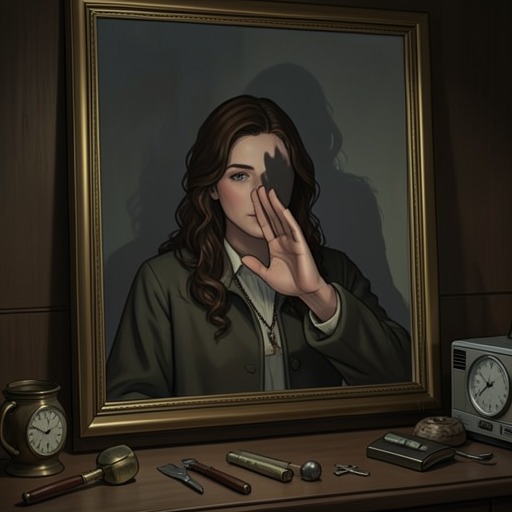
By the final stage of the crisis in her home, Giovanna understands that growing up cannot be stopped. She responds to her mother and Mariano with outward cordiality, then takes a long shower after they have left, as if trying to wash away the encounter. Looking at herself afterward, she begins to laugh at the importance she has assigned to beauty. A harmonious or refined face, she concludes, does not guarantee a life free from suffering; suffering can exist behind faces admired for their beauty just as it can appear in faces judged coarse or ugly. The judgment that once seemed to define her becomes one more unreliable adult verdict.
That shift does not produce a settled, innocent adulthood. Later, on her way to Milan, Giovanna recognizes that she is not traveling simply to retrieve the bracelet or help Giuliana: she means to betray Giuliana’s trust and pursue Roberto, the man Giuliana loves. She connects the planned betrayal to the harms Vittoria inflicted on Margherita and her father inflicted on her mother. The resemblance makes her feel guilty and afraid of becoming like the adults whose deceptions have damaged others, even as she feels entitled to act on the beauty Roberto has recognized in her. Adult life appears not as a lesson learned once but as a pattern that can be repeated under new names and justifications.
The novel’s governing pattern
The lying life of adults is therefore not limited to deliberate falsehood. It includes concealment framed as protection, truthful details used selectively, social judgments mistaken for moral knowledge, and stories that people tell themselves to bear betrayal. Giovanna’s parents seek to preserve an orderly world; Vittoria urges her to see through it; Giovanna, caught between them, learns that neither allegiance nor observation guarantees certainty. Her retrospective narration preserves the contradictions rather than resolving them into a final verdict.
The book’s ending in this respect is a beginning rather than a solution. Its contents list gives the novel’s title and begins a sequence of numbered sections, while the opening has already questioned whether the narrator can make a completed story from a self that feels tangled and unfinished. The distance between that opening uncertainty and Giovanna’s later recognition of her own capacity to deceive supplies the novel with its defining movement: she learns to distrust the adults’ claims, but also to distrust the explanations by which she might excuse herself.