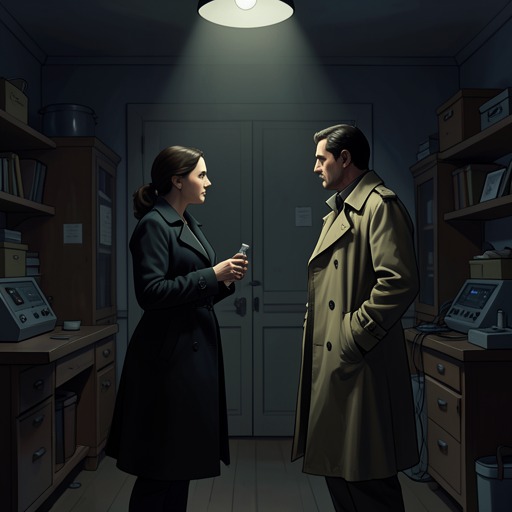
Alexandria Hotel
The Maltese FalconThe Alexandria Hotel is a San Francisco base for Casper Gutman and his associates, but it is never merely a place to meet: its suite brings Sam Spade into the center of the black bird’s pursuit, then repeatedly frustrates his attempts to control that pursuit. The hotel’s green furnishings, whisky tray, closed doors, and upper-floor corridor frame a sequence in which negotiation gives way to suspicion, force, and disappearance.
Setting and First Meeting
Spade first enters suite 12-C through a mahogany door opened by a boy he had previously encountered in the lobby of the Belvedere Hotel. The boy says nothing and stands aside. Inside, a fat man comes forward to greet Spade: Gutman, dressed in a black cutaway coat and vest, an Ascot tie fastened with a pinkish pearl, striped grey trousers, and patent-leather shoes. The description makes Gutman’s bulky body almost a spectacle in motion, each soft contour seeming to rise and fall separately as he walks.
Gutman receives Spade warmly, takes his hand, and guides him across a green rug to a green plush chair. The table nearby holds a siphon, glasses, a bottle of Johnnie Walker whisky, a box of Coronas del Ritz cigars, two newspapers, and a small, plain yellow soapstone box. These specific objects establish the suite as a place equipped for a deliberate, hospitable interview, though the unremarkable box sits among the refreshments as a quiet reminder that the meeting concerns something beyond ordinary business.
The room’s layout gives the encounter a contained, watchful quality. Three walls have closed doors; two windows in the fourth look out over Geary Street, behind Spade as he sits. The boy disappears while Gutman fills two glasses. As he offers one, Gutman presents his distrust of anyone who sets a limit on drinking as a test of character. Their first exchange thus joins polished welcome to the probing, tactical conversation that will define the hotel’s role in the story.
A Base for Gutman’s Party
The Alexandria is not a temporary stop for Gutman’s group. When Spade visits after breakfast on a later day, neither Gutman nor the other occupants of the suite is present. He learns that the party includes Gutman’s secretary, Wilmer Cook, and Gutman’s seventeen-year-old daughter, Rhea, described by the hotel staff as beautiful. They had arrived from New York ten days earlier and had not checked out. The hotel therefore provides a settled operating base for a group whose members are connected to the continuing hunt, even when they are not all visible in the suite.
The contrast between that apparently stable occupation and the group’s intermittent presence matters. Spade can establish who belongs to the party and how long they have been lodged there, but the hotel cannot guarantee that its occupants will be available when he comes looking. Its rooms offer Gutman privacy and a place to receive Spade; they do not make Gutman or his associates reliably accessible.
The Corridor and the Struggle with Wilmer
On a later visit, Spade and the boy go into the Alexandria, ride to the twelfth floor, and walk along the corridor toward Gutman’s suite. No one else is in the corridor. Spade falls a little behind, then seizes the boy from behind by both arms, just below the elbows. He forces the boy’s arms forward so the hands inside his overcoat pockets raise the coat in front of him. The boy struggles and kicks, but cannot break free of Spade’s grip.
Spade lifts him off the floor and brings him down hard on his feet. On impact, Spade shifts his grip to the boy’s wrists and crushes the boy’s hands. The thick carpet muffles the landing, while the boy’s grinding teeth mingle with the sound of Spade’s breathing. The quiet corridor, initially presented as empty space on the way to Gutman’s door, becomes the site of a sudden, controlled act of violence. The encounter exposes the practical limits of the hotel’s apparent civility: just beyond the suite where Gutman offers drinks and conversation, Spade uses force to secure himself against the danger represented by the boy.
Departures, Return, and Narrative Role
The hotel’s usefulness as a base is repeatedly unsettled by departures. On one occasion, Spade reaches the Belvedere less than ten minutes after leaving his office and finds the hotel detective Luke waiting in the lobby. Luke reports that Spade is fifteen minutes late: his quarry has already checked out, with all his baggage. Luke has managed to obtain the number of the taxi that carried him away, recording it in a battered memorandum book. The Alexandria’s connection to the chase is therefore not limited to what happens inside its rooms; a checkout from the hotel becomes a consequential loss of time, while the taxi number offers a thin but concrete trace to follow.
The hotel also stands in a larger pattern of movement between rooms, corridors, and streets. Spade returns to it to seek Gutman and his party, but the people he pursues may be absent or gone by the time he arrives. Near midnight, after reaching home, he encounters Brigid O’Shaughnessy running up the steps behind him, shaken and desperate to see him. The contrast clarifies the hotel’s particular narrative function: the Alexandria is the organized, private center of Gutman’s operation, while the story’s urgent consequences spill beyond it into taxis, other hotels, and Spade’s own doorway. Its changing availability turns a fixed address into an unstable point in the investigation, repeatedly bringing Spade close to the people he seeks without allowing the pursuit to settle.