Brigid O’Shaughnessy
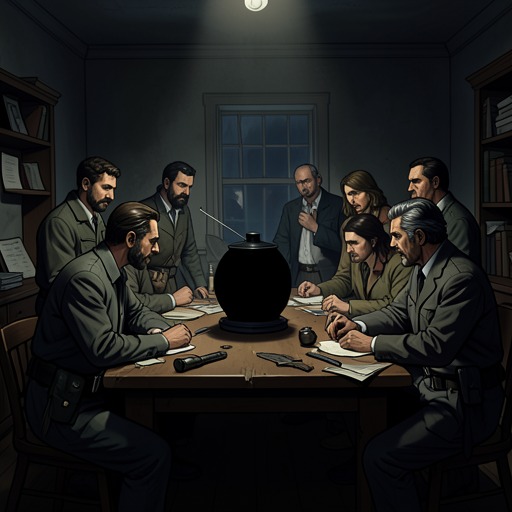
The Maltese FalconBrigid O’Shaughnessy is a client, accomplice, and central deceiver in the struggle over the black statuette. First introduced to Sam Spade as Miss Wonderly, she revises her name and story as pressure mounts, linking the disputed falcon to a chain of alliances and betrayals. The decisive reversal is personal as well as criminal: Spade identifies her as the person who shot Miles Archer and hands her over to the police, despite the intimacy between them.
Identity and Introduction
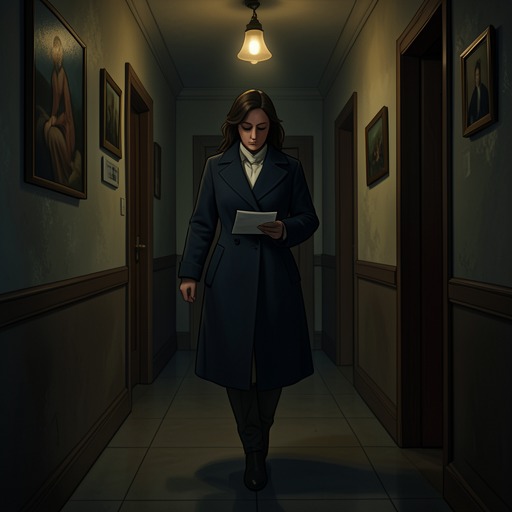
Brigid first reaches Spade through his secretary, Effie Perine, who calls the visitor Wonderly and recommends that Spade see her. When Brigid later confesses that the story she had told him was invented, Spade reveals that he and Archer had not believed it. Asked whether she is Wonderly or Leblanc, she blushes and gives her name as Brigid O’Shaughnessy. The sequence establishes identity as something she controls through successive accounts, while Spade treats each account as information to test rather than truth to accept.
Her aliases are not merely a mistaken introduction: the false story and concealed name are bound up with her attempt to secure Spade’s help without first disclosing the full history of the falcon. Her later admissions supply pieces of that history, but even these are given selectively. The reader encounters her less through a settled biography than through successive revisions under questioning.
The Falcon and Its Alliances
Brigid tells Spade that she met Floyd Thursby in the Orient and came with him from Hongkong the previous week. She says she depended on him for help, but that he betrayed her; at first, she refuses to explain what the betrayal involved. Her account places her in a relationship of dependence that quickly becomes a contest over the falcon and the money expected from its sale.
She later describes a wider arrangement in Marmara. According to her account, she had been promised five hundred pounds to help Cairo and Gutman get the falcon from a Russian named Kemidov. She says the group discovered that Cairo intended to leave with the bird and give the others nothing, so they acted against him first. That reversal did not secure her position: Thursby, she says, had promised her seven hundred and fifty pounds but planned to sell the falcon in New York without paying her share. She therefore came to Spade to find the bird and gain leverage to negotiate with Thursby.
This explanation makes Brigid a participant in successive temporary alliances, not simply the helpless client of her first presentation. Her version connects Cairo, Gutman, Thursby, and the sought-after object, but it also presents her own motive in the language of betrayal and unpaid compensation. Gutman later says his group knew Brigid too well to believe Thursby possessed the falcon; he adds that they did not then know she had entrusted it in Hongkong to Captain Jacobi for transport aboard the La Paloma while she and the others took a faster boat. He describes her as having acted as his agent, a characterization that sharply contrasts with her account of being cheated by the group.
The Murders and the Evidence
Brigid’s account of the night Archer died initially puts her at the hotel with Thursby. She says Thursby arrived at nine, that she suggested a walk so Archer could observe him, and that they ate and danced at a restaurant on Geary Street before returning around half-past twelve. She says Thursby left her at the door and that she watched Archer follow him down the street. The account places Archer on Thursby’s trail, but does not disclose who arranged the encounter’s fatal outcome.
The physical evidence gives Spade a way to reconstruct Archer’s death. Archer lies down the slope beyond a broken fence, and Spade reasons that the shot was fired from the alley, with Archer’s back to the fence; the force of the shot sent him through the broken rail and down to the boulder where he was found. The revolver is a Webley-Fosbery. Later, Tom Polhaus says the slug in Archer came from that gun and reports that a hotel bellhop had seen it in Thursby’s room that morning. That evidence supports the police’s suspicion of Thursby, but it does not establish that he killed Archer. Brigid’s eventual confession and Spade’s reconstruction point instead to her.
Other accounts tighten the chronology without resolving it in her favor. Sid Wise reports that Iva Archer came to Spade’s office more than once that night: after an unsuccessful visit she went to a movie on Powell Street, stayed until it closed, ate at Tait’s on Ellis Street, and went home alone. Wise says Iva avoided home because Miles might arrive and become angry, particularly around midnight. This places another person’s movements in the investigation’s timeline, but Brigid’s later admission identifies the concealed act at its center.
From Client to Suspect
The movement of the falcon brings Brigid back into the open. Gutman recounts that his party located her apartment and heard movement inside; when they identified themselves at the door, they heard a window opening. Wilmer went around to cover the rear and encountered Captain Jacobi escaping with the falcon. Gutman says Wilmer shot Jacobi more than once, but Jacobi continued on with the statuette and knocked Wilmer down. The account places Brigid at the apartment and describes Gutman and Cairo persuading her to help divert Spade while Jacobi tried to reach him.
Brigid also appears in Spade’s reconstruction of events aboard the La Paloma. He tells her that she arrived shortly after noon, asked for Jacobi by name, and waited until he returned at four. She spent time with him in his cabin and ate with him. Later, Gutman, Cairo, and Wilmer joined them; the visitors and Brigid talked with the captain, a quarrel occurred, and a shot was heard around eleven. The watchman found Jacobi outside the cabin and was told that everything was all right. The group left around midnight, and Jacobi was subsequently missing. These details make the captain’s movements and the falcon’s passage part of the same network of negotiation and pursuit, while Spade’s account also challenges Brigid’s assertion that she was simply stranded by her former partners.
When Spade learns that the police are closing in, he tells Brigid they are exposed and have only minutes to prepare. He presses her to explain whether Gutman sent her and Cairo to Constantinople. She hesitates rather than answering directly. As he questions her about Archer, she tries to draw him into closeness; he responds by asking why she shot him. She says she did not mean to at first and begins to explain that she changed course when Thursby could not be frightened. Spade rejects the account as a lie and confronts her with evidence that she had already rented an apartment in the Coronet, had trunks there, and had obtained the gun from Thursby. The discrepancy between her earlier account and these preparations turns the case from an investigation of Thursby into an accusation against Brigid.
Relationships, Exposure, and Ending
Brigid’s relationships are organized around unstable exchanges of trust, protection, and advantage. She says Thursby betrayed her after promising to help and then to pay her a share; her story of the Marmara arrangement likewise describes a group whose members try to leave with the falcon or deny one another its proceeds. Gutman’s later account adds his own candid explanation of the violence against Thursby: he calls Thursby Brigid’s ally and says his removal was meant to leave her without a protector and encourage her to reconcile with Gutman’s group. Brigid’s alliances therefore expose her to manipulation even as she manipulates others.
Her relationship with Spade also shifts between professional dependence and physical intimacy. She approaches him as a client seeking help, but when the danger becomes immediate she tries to draw him close while he demands facts. Earlier, when Gutman and his companions arrive, Spade sits with her on the sofa and puts an arm around her; she has stopped trembling and becomes quiet under the pressure of their presence. The gesture offers temporary shelter, but it does not settle his judgment or erase the case against her. In the final confrontation, he insists that they are both in danger of prosecution and demands the truth rather than accepting intimacy as an answer.
The ending makes the limits of Brigid’s influence plain. When Polhaus arrives with the others, Spade presents her as the person who killed Archer and turns over evidence that includes the guns, a pistol belonging to Cairo, the black statuette, and a thousand-dollar bill intended as a bribe. He jokes about Lieutenant Dundy’s apparent disappointment, but his decisive action is to place Brigid in police custody. Her changing stories have helped her move through the rival groups and keep the falcon’s trail uncertain; they cannot prevent Spade from choosing the murdered partner’s case and his own professional obligations over her appeal. The black bird remains the object around which the plot’s alliances turn, while Brigid’s exposure reveals the human cost concealed by those shifting bargains.