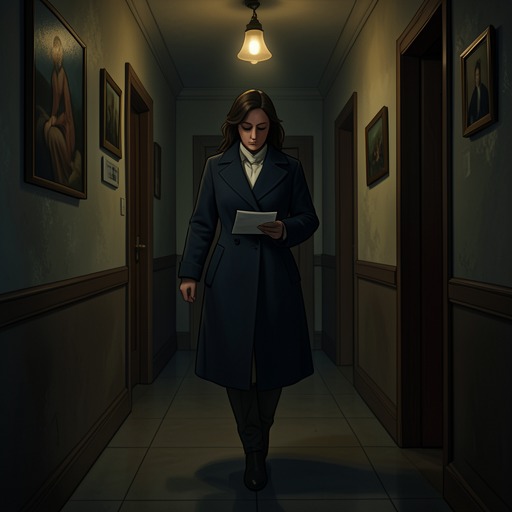
Brigid O’Shaughnessy’s endangered, concealed status
The Maltese FalconBrigid O’Shaughnessy’s endangered, concealed status is a condition of immediate physical peril and deliberate evasion: she fears that the people around the missing falcon may kill her, yet she also dreads being drawn into police questioning. Her safety therefore depends on Sam Spade’s willingness to protect her without knowing the full story, a demand that repeatedly brings her need for concealment into conflict with his need for facts. When her apartment is broken into again, the danger becomes concrete enough for Spade to move her into temporary hiding at Effie Perine’s home.
The Demand for Concealment
Brigid first makes clear that she does not want the police to know she is involved. She says she would rather die than be questioned, adding that she cannot explain herself yet, and asks Spade to shield her from the authorities. Her appeal is not merely for reassurance: she asks him to arrange matters so that she will not have to answer their questions. Spade allows that he may be able to help, but makes his protection conditional on learning what the situation is about. Secrecy is thus both her immediate refuge and the obstacle to the assistance she is asking him to provide.
The physical manner of the appeal heightens its urgency. Brigid kneels at Spade’s knees, holds her face up to him, and clasps her hands tightly; her face is described as wan, taut, and fearful. The posture turns a request for professional help into a direct plea for personal protection. But Spade does not treat visible distress as enough to resolve the practical problem. He later asks how bad a hole she is in, whether she faces physical danger, and who killed Floyd Thursby. Brigid says her predicament is as bad as it could be and confirms that death is the danger, unless Spade helps her. Asked who killed Thursby, she says she does not know.
That exchange establishes the unstable terms of their arrangement. Brigid declares the threat to be fatal while offering little that Spade can use to identify or counter it. Spade responds that he cannot work miracles out of thin air and that time is passing while she gives him nothing to work with. Her concealment is therefore not a settled refuge: it is a precarious condition that requires his intervention even as it limits his ability to act.
A Threat Reaches Her Apartment
The danger becomes more immediate when Brigid arrives at Spade’s office and reports that somebody has been in her apartment. She describes it as turned upside down and says she does not think anything has been taken, although she is not sure. Afraid to remain there, she changed as quickly as she could and came to the office. She suspects that a boy Spade allowed to follow him may have led the intruder to her; Spade denies this explanation.
Spade answers her alarm by showing her an early afternoon paper with the headline “SCREAM ROUTS BURGLAR.” The report describes a break-in that morning at Caroline Beale’s Sutter Street apartment: Beale, who lived alone, woke at four to movement in her bedroom and screamed, driving the intruder away. Two other women living alone in the same building later found evidence that their apartments had also been visited. Nothing had been taken from any of the three. The report supplies context for Brigid’s fear, but does not identify the person who entered her apartment or establish what that person wanted.
Brigid’s own account makes the intrusion part of a repeated pattern: she says this is the second burglary she has suffered that week. The absence of an obvious loss does not reassure her; she has already been afraid to stay in her home and has gone to Spade instead. Her concealed status is now shaped not only by the danger she says she faces from people pursuing the case, but by the vulnerability of an apartment where she can no longer count on being left alone.
Spade and Effie Arrange a Refuge
Spade asks Effie Perine whether she can put Brigid up for a few days, clarifying that he means at home. He explains that her place has been broken into and that she would be better off not alone; when Effie asks whether Brigid is really in danger, he answers that he thinks she is. The arrangement makes Effie’s home a temporary refuge, but its purpose is protection from exposure to danger, not a resolution of Brigid’s concealed involvement or the threats surrounding her.
Effie agrees despite recognizing the practical difficulty: her mother might be alarmed, so she proposes describing Brigid as a surprise witness being kept under cover until the last minute. Spade thanks her and plans the transfer in separate stages. Effie is to go home by taxi and make sure she is not followed. Brigid is to leave later in another taxi, also taking care not to be followed. Spade will obtain Brigid’s key from her and bring over whatever she needs from the apartment.
The precautions show how concealment operates as a concrete routine rather than a vague promise of secrecy: separate vehicles, staggered departures, attention to a possible tail, and a key that Spade will use to retrieve her belongings. They also leave the danger unresolved. Brigid is not shown returning safely to her apartment or escaping the threat; the immediate change is that Spade and Effie attempt to keep her from being alone there while avoiding a visible joint departure that might expose her whereabouts.
Protection Without Disclosure
Across these encounters, Brigid’s status is defined by a sharp imbalance between what she insists upon and what she reveals. She asks Spade to shield her from police questions, says death is a certain danger without his help, and later reports a second burglary in the same week. Yet when Spade asks who killed Thursby, she says she does not know, and she says she cannot explain the matter that makes police questioning so unbearable. The evidence establishes her fear and her concealment, but does not establish who broke into her apartment, what the intruder sought, or why she believes the police must not question her.
Spade’s response is practical rather than unconditional. He does not promise that the police will never learn of Brigid, nor does the temporary hiding place solve the mystery of the break-ins. Instead, he extracts what immediate facts he can, judges the physical danger plausible, and organizes a guarded move with Effie’s help. Brigid remains dependent on protection she cannot fully explain, while Spade remains responsible for acting amid information she withholds. That tension is the defining feature of her endangered, concealed status in these scenes: hiding may reduce her exposure for the moment, but it cannot by itself make her safe.