Casper Gutman
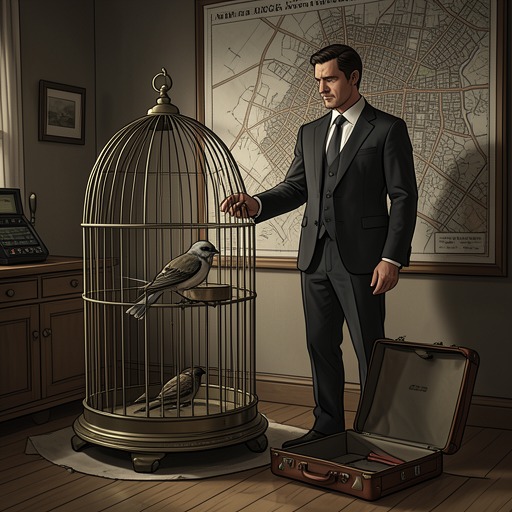
The Maltese FalconCasper Gutman, known as the Fat Man, is the experienced and calculating pursuer of the black bird. He has spent seventeen years seeking it, and his pursuit brings him into direct negotiation with Sam Spade over its supposed value and the risks of recovering it. Gutman’s genial manner and professed taste for plain dealing are part of a pragmatic style: he makes offers, withholds certainty, and treats police scrutiny as another problem to manage. When the bird proves worthless, he does not abandon the expedition; he invites Spade to join him and leaves after reminding him that the affair has exposed them all to legal risk.
Identity and Introduction
Gutman enters the story through a telephone call arranging a meeting with Spade, then appears in suite 12-C at the Alexandria Hotel. His introduction emphasizes his imposing, conspicuously dressed figure and his warm reception of Spade. The physical description makes his presence memorable, but his manner is more revealing: he enjoys conversation, welcomes a direct question about the bird, and presents himself as a man who values business conducted without evasions.
That manner does not mean he gives Spade unrestricted information. When Spade asks whether the black bird is the subject, Gutman accepts the topic but first asks whether Spade represents Brigid O’Shaughnessy. Spade declines to commit himself, saying the answer depends on circumstances. Gutman approves of the admission that Spade is looking out for himself, yet continues to control what he discloses. His sociability is genuine as a style of dealing, but it coexists with guardedness and strategic patience.
The Hunt and Its History
Gutman claims that nobody knows exactly what the bird is except himself. He presents that knowledge as the basis of its extraordinary commercial potential, telling Spade that even half of what could be made from it would sound unbelievable. The claim establishes the scale of Gutman’s ambition while leaving the bird’s value, and Gutman’s assertions about it, to be tested by events.
When he begins explaining the bird’s history, Gutman invokes the Order of the Hospital of St. John of Jerusalem, later called the Knights of Rhodes. He asks Spade about the order and begins recounting its history, connecting the present search to a much older story. Gutman’s account frames the pursuit as more than a contemporary property dispute: the bird carries a historical legend that helps explain why he has persisted for so long. His statement that he has pursued it for seventeen years gives that persistence a personal duration, though the evidence does not establish what drove every stage of the search.
Negotiation with Spade
Gutman proposes two forms of payment for delivery of the bird. He offers $25,000 when Spade hands it over and another $25,000 upon reaching New York, or, alternatively, a quarter of what he realizes from its sale. He contrasts the nearly immediate $50,000 with a potentially much larger return in a couple of months, suggesting that the eventual sum could be vastly greater. The offer gives Spade a concrete financial choice while keeping Gutman’s promised fortune uncertain.
Gutman also tries to shape the terms of the relationship. He wants to know whether Spade represents Brigid, praises him for candor, and describes himself as a man who likes talking to another man who likes to talk. Yet he does not promise to share his knowledge simply because the conversation is cordial. His approach turns trust into a bargaining question: Spade must decide what role to play, while Gutman retains the ability to delay, qualify, or refuse disclosure.
That calculation becomes explicit when Spade argues that the police need a culprit to take responsibility for the crimes. Spade insists that he has to be able to hand the authorities a victim, both to protect his standing in San Francisco and to prevent the investigation from leading back to the bird. Gutman acknowledges that the strategy has practical advantages in general but argues that this case is an exception. He doubts that the police would stop at a fall guy and maintains that their present lack of action may be safer than giving them a new clue. The disagreement exposes the limit of their apparent partnership: Spade’s concern is his continuing ability to operate in his city, while Gutman’s is keeping the hunt and its potential profits alive.
Exposure, Failure, and Departure
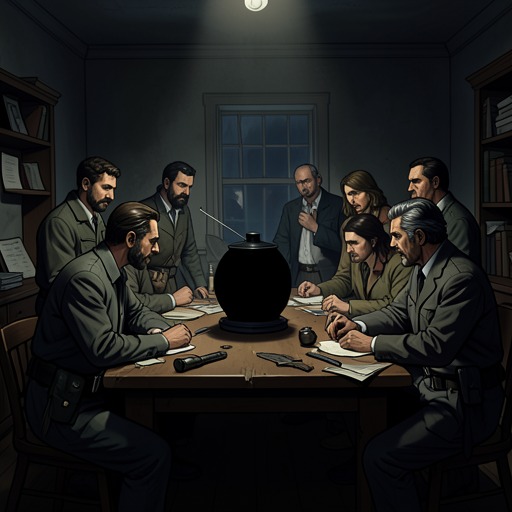
Gutman eventually receives the parcel and opens it before the assembled group. After seventeen years of searching, he holds the bird and says, “now, after seventeen years!” His excitement makes the moment a culmination of his pursuit, but he immediately insists on checking that the object is genuine. The delay between possession and certainty matters: neither his confidence nor the legend surrounding the bird can substitute for verification.
The evidence ends with Gutman asking Spade to return his $10,000. Spade keeps one $1,000 bill and hands Gutman the remaining money, calling the retained sum payment for his time and expenses. Gutman accepts the arrangement and offers Spade a place on an expedition to Constantinople. The offer shows that the failed recovery has not ended Gutman’s larger undertaking; he still wants to continue, and he regards Spade as a useful companion with good judgment and resources.
Before departing, Gutman reminds Spade that any legal difficulties arising from the preceding days may affect Gutman, Spade, and Brigid alike. He expects Spade to keep the details of their enterprise confidential and assumes Spade will manage the police even without a fall guy. Thus Gutman leaves neither with the promised fortune secured nor with the police problem settled. His exit preserves the possibility of continued pursuit while transferring the immediate burden of managing the investigation to Spade.
Character and Narrative Role
Gutman’s pursuit links the novel’s historical legend to its hard commercial negotiations. He can speak at length about the bird’s past and potential value, yet the practical terms of his dealings are payments, percentages, secrecy, and exposure to the police. The contrast makes the legend a force in the present precisely because people are willing to risk money and safety for what they believe it may yield.
His conflict with Spade also distinguishes two forms of calculation. Both men understand that information and legal jeopardy can be used as leverage, but Spade insists that he must preserve his ability to answer to the police with a culprit. Gutman would rather avoid the proposed sacrifice if it risks exposing the bird’s trail. The negotiation never resolves that conflict into shared principle: each man continues to protect his own position, and Gutman’s final invitation is another offer, not a reconciliation.
The eventual failure of the bird’s promise does not produce a moral or institutional settlement in the evidence presented here. Gutman’s long pursuit reaches the moment of possession, then turns into another departure and another possible expedition. His role therefore embodies the difference between solving the mystery of an object and bringing order to the world around it: the coveted prize fails to deliver the expected value, while the people implicated in its pursuit remain entangled in the consequences.