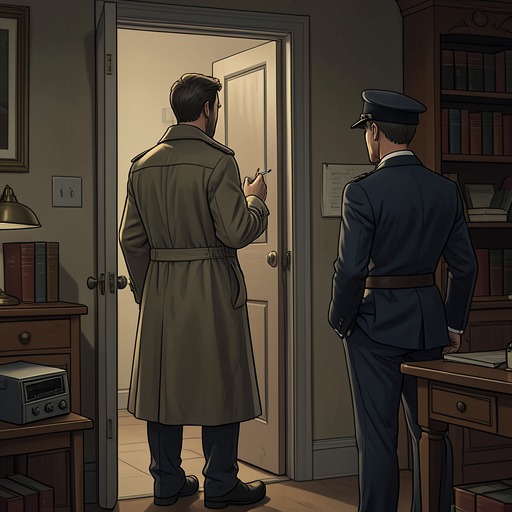
District Attorney Bryan
The Maltese FalconDistrict Attorney Bryan is the San Francisco prosecutor who seeks to convert the deaths connected to Floyd Thursby into a case the authorities can pursue. His meeting with Sam Spade exposes the tension between public investigation and a detective’s control of client information: Bryan claims the authority to demand evidence, while Spade insists that he will decide what to disclose. Bryan’s later role in Spade’s proposed fall-guy strategy makes him not only an investigator but also the imagined audience for a carefully simplified prosecution.
Identity and Introduction
Bryan is introduced as the District Attorney, a public official whose professional authority is reinforced by his manner and appearance. When Spade visits his office, Bryan stands to greet him and shakes his hand. He is described as a medium-height blond man, about forty-five, with blue eyes behind black-ribboned nose-glasses, a large orator’s mouth, and a broad, dimpled chin. His resonant voice and controlled bearing suggest power held in reserve; during the interview, that reserve gives way to emphatic gestures and stern declarations.
Spade arranges the meeting himself. After calling the detective bureau and speaking with Tom Polhaus, he contacts Bryan’s office to ask when the District Attorney can see him. Bryan agrees to a half-past-two appointment. Spade also calls Sid Wise, tells him about the appointment, and asks him to check in around four to make sure Spade is not in trouble. The arrangements place Bryan within a wider network of police and legal contacts, while showing that Spade approaches the meeting alert to its possible risks.
The Interview and Competing Theories
Bryan opens the substantive conversation by asking who killed Thursby. Spade says he does not know, but Bryan suggests that he could make an excellent guess. The question quickly becomes a contest over what Spade knows and what he is obliged to reveal. Bryan argues that knowledge of Spade’s client could lead the authorities to the killer; Spade responds that he cannot identify a client before discussing the matter with that client. The disagreement echoes an earlier confrontation with Lieutenant Dundy, when Spade likewise refuses to identify the client and insists that he will disclose the information only if and when he chooses.
Bryan’s inquiry centers on Dixie Monahan, a gambler who disappeared from Chicago after welshing on bets worth about two hundred thousand dollars. Bryan says the authorities know that Thursby had been Monahan’s bodyguard and accompanied him when Monahan vanished, but do not yet know who Monahan’s creditors were. He connects those debts to the danger facing both the gambler and his associate, then asks where Monahan is. Spade maintains that the question does not clarify matters for him, leaving Bryan’s theory unconfirmed.
The discussion generates three possible explanations for Thursby’s death. Bryan proposes that Monahan’s creditors killed Thursby because of his association with Monahan, to reach Monahan through him, or because he would not lead them to Monahan. Alternatively, Bryan suggests that Monahan’s friends killed him, or that Thursby betrayed Monahan to his enemies and was killed after falling out with them. Spade jokes that Thursby might instead have died of old age and mocks the investigators for seeing the influence of gambler Arnold Rothstein everywhere. The levity does not resolve the theories; it underscores the distance between Bryan’s effort to classify the murder and Spade’s refusal to endorse the available explanations.
Bryan says the answer must lie in one of his three categories and presses Spade for information that could identify which. Spade replies that the information he could provide would undermine the investigators’ gambler-revenge scenario. Bryan then asserts his office’s authority: he is the District Attorney, he says, and whether the conversation is formal or informal does not permit Spade to withhold evidence of a crime, apart from constitutional grounds. The exchange sharpens the institutional conflict. Bryan frames disclosure as a duty of law enforcement; Spade treats the information as bound up with his client relationship and his own judgment about how the case should be handled.
Authority, Judgment, and Strategy
Bryan’s authority is present even when the encounter begins cordially. He shakes Spade’s hand and accepts the meeting, but the conversation moves from an informal discussion toward a declaration that he remains a sworn officer of the law at all times. Spade, for his part, questions whether the talk is truly informal and resists being placed in the position of a witness who must supply whatever information the prosecutor requests. Bryan’s argument makes the limits of informality explicit: the office’s legal obligations, as he understands them, remain in force regardless of conversational tone.
Later, while negotiating with Casper Gutman over the falcon and the people entangled in the case, Spade explains how he expects Bryan to behave. He characterizes the District Attorney as more concerned with how a case will appear on paper than with pursuing every person who might be guilty. In Spade’s analysis, Bryan would rather abandon a doubtful prosecution than risk losing at trial; he might also let several accomplices go if concentrating on one defendant made conviction more likely. This is Spade’s strategic assessment, not an independent statement by Bryan, and it is offered to persuade Gutman that the authorities can be guided toward a manageable case.
Spade’s proposed arrangement depends on that assessment. He expects Bryan not to want the falcon’s full story if it makes the prosecution complicated, and to accept a version of events in which Wilmer Cook becomes the principal defendant. Spade offers to keep the falcon from tangling the case and argues that focusing on Wilmer would give Bryan a simpler route to conviction. The episode turns the prosecutor’s institutional role into a tactical consideration: Spade is not merely trying to keep information from the authorities but attempting to shape the account they will find usable.
Significance
Bryan represents the official demand for a coherent criminal case, but his character is chiefly revealed through Spade’s resistance and later calculations. In the interview, Bryan insists that public office and the duty to pursue crime outrank the convenience of an informal conversation. In Spade’s later account, however, the prosecutor’s practical concern for a case’s chances becomes a weakness that can be anticipated and used. The two moments are not identical portraits: Bryan speaks for the authority of prosecution, while Spade supplies a potentially self-serving reading of how that authority operates.
That tension fits the novel’s hard-edged world of competing claims to information and accountability. Spade will not disclose his client merely because a prosecutor demands it, yet he also builds his plan around what he believes Bryan will choose to prosecute. The law remains consequential, but the outcome is approached through bargaining, selective disclosure, and the construction of a case that can be made to stand. Bryan’s role therefore connects the detective’s private code to the public machinery of criminal responsibility, without making the two forms of judgment the same.