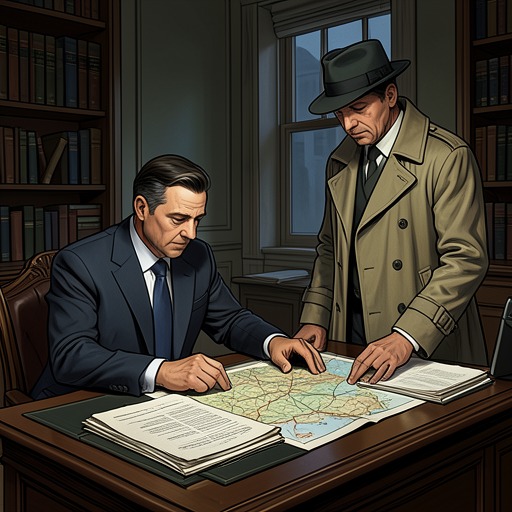
Hotel Belvedere
The Maltese FalconHotel Belvedere is Joel Cairo’s stated lodging and a recurring point of contact in Sam Spade’s efforts to find him. Its lobby brings together Cairo’s absences and appearances, Spade’s searches, and the silent young man who follows the detective; a sheet of the hotel’s writing paper, marked with Spade’s addresses, also turns the hotel into a trace connecting Cairo to Spade’s movements.
Cairo’s Lodging and a Trace of Spade
When Cairo agrees to work with Spade to recover the falcon, he gives Hotel Belvedere as the place where Spade can communicate with him and specifies room six-thirty-five. The arrangement is presented as a discreet association, with Cairo expecting mutual benefit; he then asks for his pistol back, and Spade hands it over. The hotel thus enters the story not merely as an address but as Cairo’s designated base for a transaction whose trust remains limited and practical.
Among the possessions Spade examines after knocking Cairo unconscious is a sheet of Hotel Belvedere writing paper. On it, Cairo has written Spade’s name and the addresses of his office and apartment in small, precise letters. Spade checks Cairo’s belongings carefully, even opening the back of his watch-case to make sure nothing is hidden, before returning to his chair and waiting for him to wake. The hotel stationery is a concrete link between the two men: Cairo has recorded where Spade can be found, while Spade has Cairo’s stated room at the hotel as his own point of contact.
The Lobby as a Place of Search and Surveillance
Spade’s visits make the hotel lobby part of his routine of tracking Cairo. After buying tobacco and eating dinner, he asks for Cairo at the desk and learns that he is not in. The young man following Spade is sitting in a far corner of the lobby. Spade then goes to the Geary Theatre, where Cairo’s orchestra-seat ticket may bring him into view, while the follower remains nearby. The hotel’s unsuccessful first contact therefore does not end the search; it is one stop in a sequence that carries Spade from the desk to the theatre and back into Cairo’s orbit.
The same pattern recurs later. After leaving Brigid at Coronet Apartment Building, Spade returns to Hotel Belvedere and again learns at the desk that Cairo is absent. The young man is there too, seated on a divan from which he can see the elevators and apparently reading a newspaper. Spade notices him and crosses the lobby to sit beside him, within a foot. What might look like an ordinary hotel waiting area becomes a place where Spade can observe the observer: the follower’s position gives him a view of arrivals, but Spade’s deliberate proximity makes the surveillance itself visible.
Cairo’s Return
At eleven twenty-one, Cairo finally comes in from the street. He is visibly worn: his forehead is bandaged, his clothes look limp and stale from too many consecutive hours of wear, and his face is pasty, with sagging mouth and eyelids. Spade meets him in front of the desk and greets him easily. Cairo straightens his tired body before replying without enthusiasm. The lobby’s function shifts from a site of waiting and failed contact to the setting for their reunion, with Cairo’s physical condition carrying the signs of strain into the encounter.
Across these visits, Hotel Belvedere organizes a modest but revealing pattern of access. Cairo names it as the place to reach him, yet Spade repeatedly finds him absent; the young follower, meanwhile, appears in the same public space and watches the elevators. The hotel does not resolve the pursuit or explain the follower’s purpose, but it concentrates the story’s uncertainty into ordinary acts of arrival, waiting, and watching. Its paper preserves Cairo’s attention to Spade’s addresses, while its lobby puts both men—and the surveillance between them—within sight.