Joel Cairo
The Maltese FalconJoel Cairo, also called the Levantine, is a discreet but forceful intermediary in the pursuit of the black bird. He approaches Sam Spade with an offer of five thousand dollars to recover a statuette, then uses a pistol to press his demand when Spade does not simply comply. Cairo’s later cooperation with Casper Gutman and Wilmer Cook reveals him as a connector among the competing parties: he helps identify the route by which the bird reached San Francisco, but his knowledge does not give him control of it.
Appearance and First Approach
Cairo enters Spade’s office with a carefully composed appearance: a dark, close-fitting suit, a black derby, yellow gloves, and a ruby set against his green cravat. His manner is as deliberate as his clothes. He bows, sits primly, and chooses his words with care, presenting himself as a cultivated client rather than an obvious threat. The contrast between that formal courtesy and his later actions establishes the measured surface that he maintains throughout his dealings with Spade.
Cairo says he is trying to recover a misplaced ornament, a black statuette in the shape of a bird. On behalf of its rightful owner, he offers five thousand dollars and promises that no questions will be asked. The offer gives Spade a clear outline of the object’s importance while leaving its ownership, history, and Cairo’s own standing deliberately unresolved. Cairo is seeking the Falcon, but at this first meeting he supplies neither the owner’s identity nor the story of how the object came to be missing.
Negotiation and Pressure
When Spade’s attention turns back to Cairo after an interruption, Cairo produces a compact pistol and orders him to clasp his hands behind his neck. The shift from payment to armed pressure is abrupt: Cairo’s polished approach has not been a guarantee of peaceful negotiation. Yet the move does not settle matters in Cairo’s favor. Spade recognizes the exposure created by Cairo’s presence in the wake of the recent killings and turns the encounter into leverage, insisting that Cairo must cooperate or face the consequences of being implicated.
Cairo had made inquiries about Spade before approaching him and assumed that the detective would put profitable business ahead of other considerations. That calculation helps explain why Cairo offers money and then expects their dealings to continue as a transaction. Spade’s response makes their relationship more complicated: he treats Cairo at once as a potential client, a source of information, and a man whose involvement can be used against him. Their association is therefore never simply an employer-and-investigator arrangement.
Alliances and the Falcon’s Route
Cairo’s information links the search in San Francisco to the broader contest for the bird. Brigid O’Shaughnessy tells Spade that she met Floyd Thursby in the Orient, and later says that the group she worked with was trying to obtain the Falcon from a Russian named Kemidov. Gutman’s account fills in Cairo’s part in the chain: after Cairo had left police headquarters, Gutman contacted him, and they recognized the advantage of combining their efforts. Cairo, who had been looking for Brigid in Hong Kong, had heard that she and Captain Jacobi were associated there. When he later saw the Paloma’s arrival reported in the newspaper, he inferred that Brigid had entrusted the bird to Jacobi for the voyage to San Francisco.
Cairo’s deduction makes him a useful information broker, but it does not make him master of the object or of the people carrying it. He, Gutman, and Wilmer visit Jacobi while Brigid is aboard the ship. After a difficult conference, they believe that Brigid has agreed to terms and leave with the expectation that they will pay her and receive the bird. Instead, Brigid, Jacobi, and the Falcon slip away from them. Cairo has helped locate the route and bring the parties together, but the bird remains beyond his grasp.
Gutman’s account also clarifies Cairo’s connection to Thursby. Gutman says that Cairo and the others did not believe Thursby possessed the Falcon, even though Brigid and Thursby were allies. They wanted to remove Thursby as a protector and persuade Brigid to reconcile with them. Gutman says that Wilmer had followed Thursby, that Thursby refused a proposed deal because of his loyalty to Brigid, and that Wilmer later killed him. These details place Cairo within a coordinated alliance that used negotiation, surveillance, and violence, while showing that his understanding of the bird’s movements depended on information gathered from others.
Renewed Contact and Growing Conflict
Cairo continues to deal with Spade even as the alliances around them become more dangerous. On one visit, he arrives excited and reports that Wilmer is watching the house after seeing Cairo with Spade. He protests that he had come in good faith and considers the surveillance a sign that Spade’s actions have exposed their association. Spade replies that Cairo himself had been invited in good faith, but acknowledges that he should have anticipated Wilmer’s appearance. The exchange makes clear that Cairo is both a participant in the plot and a vulnerable link between the factions: being seen with Spade gives Wilmer a reason to monitor him.
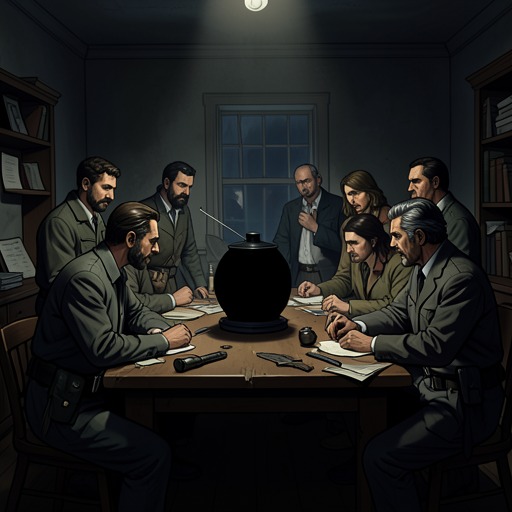
Later Cairo comes to Spade’s office tired and with his forehead bandaged. Spade greets him without open hostility, but their interactions continue under the pressure of mutual suspicion and shared danger. At a subsequent meeting with Gutman and Wilmer, Cairo sits beside Gutman while Wilmer stands in the doorway with a pistol. The arrangement places Cairo inside Gutman’s party, but the visible weapon and the tense gathering also emphasize that this alliance rests on force as well as common purpose. Cairo’s earlier private approach has become part of a larger, unstable group.
Exposure and Narrative Role
When Spade finally reports the case to Tom Polhaus, he identifies Cairo as an associate of Gutman and Wilmer and tells the police that the group is leaving town. He supplies descriptions and a location for Gutman’s party, and says that he believes he has the guns used in the killings. Cairo, once able to present himself in Spade’s office as a paying client with an unnamed principal, is now named as part of the network Spade hands over to the police.
Cairo’s importance lies in the passage of information through his hands. He makes the first explicit offer for the black bird, brings together knowledge about Brigid and Jacobi, and helps Gutman recognize the Paloma as the likely route by which the Falcon arrived. But he repeatedly fails to secure the object: Brigid and Jacobi escape the conference with it, and Spade’s final disclosure to the police dismantles the secrecy on which Cairo’s dealings depend. He is neither merely a mannered negotiator nor the controlling force behind the hunt. His role is that of a skilled intermediary whose connections advance the pursuit while leaving him exposed to the shifting loyalties and consequences of the people around him.