La Paloma
The Maltese FalconLa Paloma is the ship that carries the Maltese Falcon from Hong Kong to San Francisco and draws the novel’s competing pursuers into a single chain of events. Its arrival gives Joel Cairo a clue to the Falcon’s route; its cabin becomes the site of negotiations among Brigid O’Shaughnessy, Captain Jacobi, Casper Gutman, Cairo, and Wilmer Cook; and its later fire and Jacobi’s disappearance leave the bird moving through the city by a route none of them fully controls.
Arrival and the ship’s significance
A shipping-news list places La Paloma among the vessels arriving from Hong Kong at 8:05 a.m. The information first appears as a small, easily overlooked line among other arrivals. Sam Spade compares a newspaper page with a fragment taken from Cairo’s wastebasket, identifies the ship’s name, and follows that clue. The arrival notice matters because Cairo had previously heard in Hong Kong that Jacobi and Brigid had been seen together. Seeing La Paloma listed in the paper, Cairo inferred that Brigid had entrusted the Falcon to Jacobi for transport to San Francisco while she and her associates took a faster boat.
The ship thus carries more than cargo: it supplies a concrete link between the Falcon’s uncertain whereabouts and the network of people searching for it. Jacobi does not know what the object is, Gutman later explains, while Brigid has arranged for him to bring it across. The resulting information gap is decisive. Brigid can use Jacobi as a carrier without making him a knowing partner in the struggle, but Cairo and Gutman can recognize the ship’s arrival as a chance to intercept the Falcon.
Brigid and Jacobi aboard
Spade reconstructs Brigid’s movements from her arrival at the Ferry Building a little after noon. La Paloma lies only a few piers away, and Brigid goes directly there, asking for Jacobi by name. He is away on business and, according to Spade’s account, did not expect her at that time. Brigid waits until four o’clock, when Jacobi returns. They spend the interval before the meal in his cabin, and she eats with him.
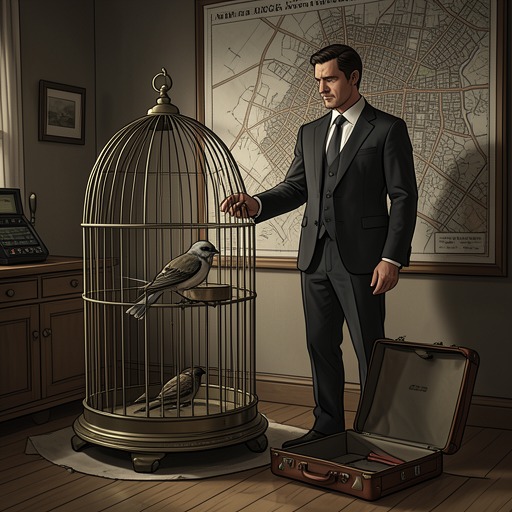
The ship’s cabin then becomes the setting for a meeting that gathers the rival sides around the hidden object. After the meal, Gutman, Cairo, and Wilmer arrive together. Brigid is still aboard, and the five spend a long time talking in Jacobi’s cabin. The crew proves difficult to question, but a watchman reports a quarrel and a gunshot at about eleven o’clock. A fresh bullet hole high in one corner of the cabin suggests that the shot did not pass through a person, though the account remains limited by the information Spade can obtain. The watchman says Jacobi met him outside afterward and told him everything was all right.
Around midnight, Jacobi and his four visitors leave together, all apparently walking normally. The next day, Jacobi fails to keep an appointment with shipping agents, and no one can find him to inform him of the fire aboard his ship. These details make La Paloma’s cabin a temporary meeting place rather than a secure endpoint: conversation and apparent agreement do not settle possession of the Falcon, and the people who leave together soon separate into pursuit and concealment.
Negotiation, escape, and fire
Gutman later explains that he, Cairo, and Wilmer went aboard while Brigid was with Jacobi. By midnight, they believed they had persuaded her to make terms: she would go with them to Gutman’s hotel, where he would pay her and receive the Falcon. But, as Gutman admits, Brigid, Jacobi, and the bird slipped away during the journey. The escape reverses the apparent outcome of the cabin conference. The pursuers have located the carrier and negotiated for the prize, yet they lose both the woman and the object before reaching the hotel.
The fire is discovered in the ship’s hold, toward the rear, late the following morning. Spade says it had probably started the previous day and that it caused damage, though the fire was put out. Gutman says the group did not deliberately set it, while conceding that Wilmer may have been responsible: Wilmer had been searching for the Falcon while the others talked in the cabin and may have been careless with matches. The cause is therefore reported as a likelihood, not established certainty. With Jacobi missing, people aboard La Paloma are reluctant to discuss the fire, and the absence of the captain makes the ship harder to investigate.
The fire’s consequences extend beyond damage to the vessel. It marks the breakdown of the plan to take the Falcon directly from Brigid, while the uncertainty around its cause gives Spade a possible additional charge against Wilmer if the investigation of Jacobi’s shooting requires one. In the novel’s chain of evidence, the fire is both an obstacle to reconstructing events and a clue to the hurried, unstable pursuit surrounding the ship.
The ship’s aftermath and narrative role
La Paloma’s captain is eventually identified as Captain Jacobi, master of the ship. Spade connects Jacobi’s appearance at his office with the vessel through the arrival notice, Brigid’s account of seeing the ship on fire, and his reconstruction of her visit to the docks. Jacobi has been shot during the later pursuit but manages to escape with the Falcon under his arm and bring it to Spade’s office. The ship’s story therefore continues after its departure from the immediate action: its cargo and captain re-enter the plot in the city, where the Falcon changes hands again.
The account of Jacobi’s shooting comes from Gutman’s later explanation. After locating Brigid’s apartment, Gutman and Cairo hear movement inside and announce themselves; they then hear a window open. Wilmer runs around to the rear to cover the fire escape and encounters Jacobi in the alley with the Falcon. He shoots Jacobi more than once, but Jacobi does not drop the bird. Jacobi knocks Wilmer down and escapes. These events are related as the pursuers’ account, and the broader investigation supplies a separate, earlier clue: a policeman had seen smoke blowing over Brigid’s ferry from a burning boat, which she identified as La Paloma.
As a plot object, La Paloma connects a shipping notice to the book’s central pursuit and makes the Falcon’s passage legible only in fragments: a newspaper arrival, Brigid’s movements, testimony about a cabin meeting, a fire, and the missing captain. The ship’s importance lies not in a settled account of everything that happened aboard, but in how each new piece of information changes the pursuers’ understanding of where the Falcon has gone. Its route brings the contest into San Francisco, while its fire and Jacobi’s disappearance ensure that arrival does not mean recovery.