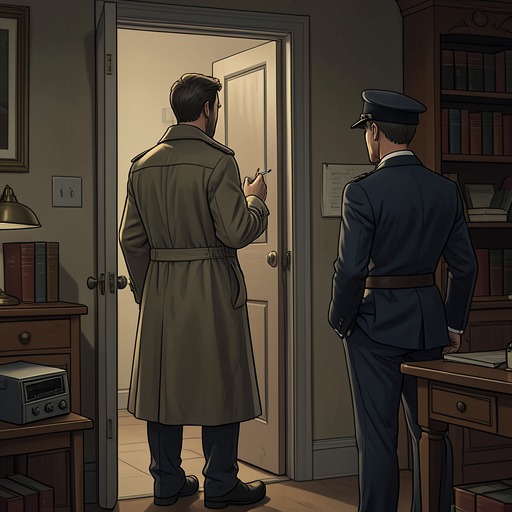
Lieutenant Dundy
The Maltese FalconLieutenant Dundy is the San Francisco police officer who repeatedly challenges Sam Spade during the investigation, turning their encounters into contests over information, authority, and the terms of accountability. He presses Spade over the murders, threatens to pursue him, and seeks to use available complaints and warrants to detain the people involved. Against Spade’s private-investigator methods, Dundy represents the police’s power to investigate and arrest—but his approach also exposes how much the case depends on tactical choices about whom to charge and what evidence to present.
Identity and Introduction
Dundy first arrives at Spade’s apartment with Tom Polhaus. Spade greets both men and invites them in; Dundy is described as compactly built, with a round head, grizzled hair and mustache, a five-dollar gold piece pinned to his tie, and a small, ornate diamond-set secret-society emblem on his lapel. The scene introduces him through both his official presence and his controlled, watchful manner: when Spade challenges him, Dundy holds his gaze, moving only his eyes.
The meetings do not begin with open cooperation. Spade permits a search only on the condition that the police have a warrant, and tells Dundy he cannot identify his client until he has discussed the matter with that client. Dundy answers that Spade can disclose the information to him or in court, invoking the murder investigation to press for compliance. Spade refuses to let police displeasure dictate his conduct, establishing the central opposition between Dundy’s demand for information and the detective’s insistence on controlling what he reveals.
Pressure and Escalation
Dundy makes the case against Spade more personal by emphasizing the timing of Floyd Thursby’s death: Thursby was shot outside his hotel thirty-five minutes after Spade left Burritt Street. He also raises Spade’s failure to stop at the scene of Miles Archer’s death. The timing and the unanswered questions give Dundy grounds to scrutinize Spade, while Spade responds by rejecting Dundy’s physical and verbal pressure rather than volunteering an explanation.
The conflict continues when Dundy and Polhaus come to Spade’s door at night. Spade refuses to let them enter and offers them the choice of speaking where they are or leaving. Dundy warns that Spade has escaped consequences before but cannot continue indefinitely. He then brings up the rumor that Spade and Archer’s wife were having an affair, widening the inquiry from the killings to Spade’s private entanglements and potential motives. The exchange makes clear that Dundy is willing to use suspicion and pressure to unsettle the detective, while Spade meets the threat with defiance.
Police Procedure and the Suspects
Dundy’s authority is most practical when he describes the route from accusation to detention. He tells Joel Cairo that a sworn complaint alleging an assault would be enough for a warrant clerk to issue a warrant and allow the police to lock the accused up. The proposal illustrates how quickly the competing parties’ violence and accusations can be turned into procedural leverage: a complaint may be legally sufficient to secure a warrant even while the larger case remains tangled. Spade recognizes the danger of that approach and jokes that if Cairo makes a complaint, they can swear one against Cairo in turn, leaving the police to arrest everyone.
When Brigid challenges the police to make Cairo tell the truth, Dundy responds that they will do so and then tells Polhaus that they should bring the whole group in. His readiness to pull in the lot of them reflects a broad enforcement strategy rather than a settled account of each person’s role. The people caught in the dispute include Brigid, Cairo, and Spade, whose explanations and interests conflict; Dundy’s proposed mass arrest would put them all under police control, but would not by itself resolve what happened or who was responsible.
Conflict with Spade’s Method
Dundy and Spade differ not only over evidence but over the investigator’s obligations. Spade refuses to disclose the identity of a paying client before speaking with that client, and he later explains to Casper Gutman that he expects to handle the police by giving them a victim they can prosecute. In Spade’s view, a detective can defy the authorities only while prepared for a day of reckoning and able to present a criminal. Dundy’s pressure supplies the institutional danger that makes this strategy necessary: Spade is not free of police power, even as he attempts to manage what the police know and whom they pursue.
Spade also argues that the district attorney is likely to prefer a clear, winnable case over a confused prosecution of multiple equally guilty accomplices. He proposes that the authorities be given Wilmer as the readily prosecutable defendant while Spade controls what they hear about the falcon and the others. Dundy is not present in this exchange, but his earlier threats and his interest in bringing the whole group in establish the police pressure that Spade’s plan is designed to channel. The contrast is between Dundy’s power to pursue suspects and Spade’s attempt to shape the case the authorities will ultimately be able to make.
Narrative Role
Dundy functions as Spade’s recurring institutional opponent, not simply as an obstacle who can be dismissed. His questions about the client, the timing of Thursby’s death, and Spade’s conduct after Archer’s murder keep the detective’s own exposure in view. His threats and proposed use of warrants give the investigation a procedural dimension: suspicion becomes pressure, complaints can become grounds for detention, and a broad arrest may substitute temporarily for a clear resolution.
That opposition sharpens the novel’s distinction between solving a mystery and securing an outcome that can survive legal scrutiny. Spade’s insistence that he must eventually hand over a criminal is a response to the prospect of police and prosecutorial reckoning. Dundy represents that reckoning as an immediate force, while Spade tries to turn it to his advantage by controlling the evidence and selecting a viable target. Their encounters therefore frame the case as a struggle over who will define its final account—not only the detective who manages the clues, but also the authorities empowered to act on them.