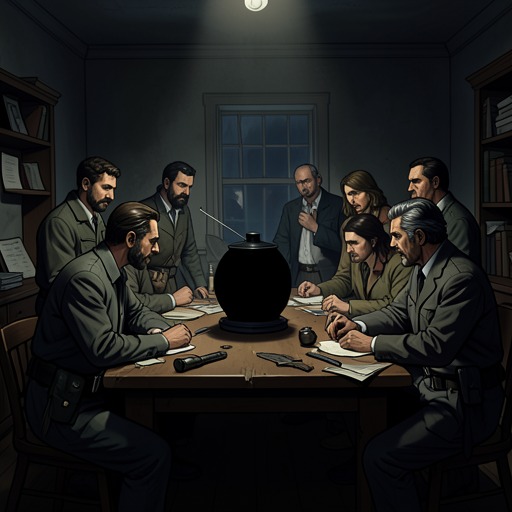
Sam Spade
The Maltese FalconSam Spade is a San Francisco private detective whose investigation of the black bird is inseparable from the murder of his partner, Miles Archer. He moves between clients, rival seekers, and the police by treating information as leverage; yet when the case reaches its end, his choice to surrender Brigid O’Shaughnessy rests on a professional obligation he says cannot be set aside by personal feeling. His defining tension is between a practiced willingness to bargain and a rule against letting a partner’s killer escape.
Identity and Bearing
Spade’s face is described through repeated angular shapes: a long, bony jaw and jutting chin, a second V formed by his mouth, and nostrils that curve into another smaller V. His yellow-grey eyes sit horizontally beneath brows that rise from creases above a hooked nose; pale brown hair comes to a point on his forehead. The narrator says he looks pleasantly like a blond satan, an image that fits a character whose geniality can turn quickly into menace.
His manner is as controlled as his appearance is striking. He can greet his secretary, Effie Perine, with easy familiarity, but answers Lieutenant Dundy in a voice as hard and cold as his eyes. The shifts are not a break in character so much as a working method: Spade changes his tone to suit the pressure in the room, while keeping control of what he reveals and of who may act on his premises.
The Investigator at Work
When he reaches the alley where Archer’s body has been found, Spade identifies himself to a policeman as Sam Spade and says Tom Polhaus called him. At the scene, he studies the broken fence, the position of the body, and the revolver. He reconstructs a possible sequence: Archer was shot near the fence, fell backward through it, and came to rest against a boulder down the slope. The reconstruction shows his habit of turning physical details into a working account of events, though the scene’s evidence is presented as an inference rather than a complete proof of the shooter’s identity.
Spade’s relations with the police are combative but practical. When Dundy and Polhaus press him, he first resents what he takes to be an effort to pin the case on him. He then explains that Archer’s death has unsettled him and that the detectives’ evasive approach made him defensive; once he understands what they are trying to do, he says, the immediate friction is over. The exchange establishes a recurring pattern: Spade resists being managed by official authority, but can distinguish hostility from useful cooperation.
His investigative work also depends on reconstructing movements and checking them against testimony. When a woman worries that Effie may have been followed, Spade insists he made sure the route was clear before putting her in a cab, rode with her for a dozen blocks, and watched for another half-dozen after getting out. The detail matters because it shows his confidence is grounded in specific precautions, not merely in bluster. He is alert to the difference between someone failing to arrive and being followed there, and challenges the assumption that those outcomes are the same.
Clients, Rivals, and Information
Spade does not accept Brigid’s account as a substitute for investigation. She says she met Floyd Thursby in the Orient, travelled with him from Hong Kong, and relied on him before he betrayed her; she initially withholds how. Spade presses her for a usable line on Thursby, making clear that even a relationship presented as trust and dependence must be translated into facts if he is to act on it. Later, she explains that she had helped the group try to obtain the falcon from a Russian named Kemidov, while still declaring the details none of Spade’s business. Their dealings are marked by intimacy and guarded disclosure, but his role as investigator keeps him asking what the story leaves out.
Joel Cairo approaches Spade with another version of the same problem: an ally under observation and a valuable object whose whereabouts remain contested. When Cairo discovers that a boy is watching the house after seeing him with Spade, he complains that he came in good faith. Spade replies that the visit was indeed arranged in good faith, while admitting he should have anticipated the boy’s appearance. The moment shows his information network at work and its limits: Cairo’s movements have become visible to another party, and Spade must manage the consequences without pretending he can control every observer.
Spade turns the balance of power with Cairo when Cairo refuses to identify the person behind his inquiry. Spade argues that Cairo has involved himself in the recent killings and therefore has reason to cooperate rather than risk police attention. Cairo, in turn, says he had made inquiries and judged Spade reasonable enough to keep profitable business relations separate from other considerations. The exchange exposes both men’s assumptions: Cairo expects negotiation to prevail, while Spade makes the danger of refusing him part of the negotiation itself.
When Casper Gutman settles in to discuss the black bird, Spade refuses to define himself simply as Brigid’s representative. Asked whether he is acting for her, he says the answer is uncertain and depends on what happens next. His position lets him negotiate with Gutman without surrendering the ability to change sides. That conditional stance suits a case in which alliances shift and no participant can assume that a shared interest will last.
The Falcon, the Murders, and the Fall Guy
Spade’s questions connect the pursuit of the falcon with the chain of violence around it. He learns that Brigid gave the bird to Captain Jacobi in Hong Kong to bring it across on the Paloma while she and her companions took a faster ship. Gutman later confirms that he and his associates did not believe Thursby possessed the bird, and explains that Thursby had refused to abandon his loyalty to Brigid. Wilmer had located and followed him; after a failed attempt to make a deal, Wilmer killed him. These disclosures clarify why Thursby’s death did not resolve the contest: the sought object had travelled by another route, through Jacobi.
Spade’s account of the ship’s last hours adds another link. Brigid visited Jacobi aboard the Paloma; Gutman, Cairo, and Wilmer later joined them. The visitors and the captain argued, a gunshot sounded in Jacobi’s cabin, and the group left together around midnight. When Jacobi later arrives at Spade’s office mortally wounded, Spade does not stop at the mystery of the parcel he carries. He steps over the dead man, cuts through the rope and several layers of wrapping, and uncovers the black, bird-shaped figure. The object confirms that the falcon has reached him, but its arrival also brings the violence of the ship’s struggle into his office.
Possessing the falcon does not, in Spade’s view, solve the danger posed by the murders. In his negotiation with Gutman and Cairo, he says the police need a victim they can hold responsible for the killings. He insists on the fall-guy strategy as a condition of managing the case: without someone to deliver to the authorities, he argues, his history of surviving official scrutiny will not protect him when the reckoning comes. Gutman objects that this case is an exception and implies Spade is being paid to accept it. Spade rejects that reasoning, presenting the handover of a culprit not as a convenient preference but as the practical limit that makes his independence possible.
Professional Code and Ending
Spade’s final decision turns on Archer’s death, even though he tells Brigid that he disliked his partner and had intended to end their business arrangement. He distinguishes personal regard from professional obligation: Archer was his partner, and letting the killer go would be bad for their organization and for detectives generally. He compares a detective who catches a criminal and releases him to a dog asked to catch a rabbit and let it go. In his account, the demand that he surrender Brigid is not a romantic rejection but a consequence of the work and of the rule he believes the work entails.
After Gutman and Cairo leave, Spade telephones Polhaus and reports that Wilmer Cook shot Thursby and Jacobi. He identifies Gutman and Cairo as involved, describes Rhea Gutman, and warns that Wilmer is considered good with a gun. When Polhaus arrives with the others in custody, Spade presses Brigid forward and identifies her as Archer’s killer. He also hands over the boy’s guns, one of Cairo’s guns, the black statuette, and the thousand-dollar bill connected with the attempted bribe. The decision converts his private investigation into a police case, and gives the authorities both a suspect and physical exhibits.
Spade’s final conduct is therefore neither simple loyalty to the police nor a refusal to bargain. He has spent the investigation using access, guarded disclosures, and shifting alliances to stay ahead of people who want the falcon. But he draws a line at allowing Archer’s killer to leave, and at allowing the other implicated parties to escape alongside her. The falcon’s value has organized the competing schemes; the ending is organized instead by Spade’s insistence that professional responsibility requires a person to answer for Archer’s murder.