Sam Spade’s status as a murder suspect
The Maltese FalconSam Spade’s status as a murder suspect is not a single accusation but a pressure that gathers around his investigation into Miles Archer’s and Floyd Thursby’s deaths. Lieutenant Dundy treats Spade’s secrecy, professional connections, and relationship to the victims as grounds for suspicion; Spade, in turn, refuses to let police pressure dictate what he tells them. The case makes his position precarious, but it also clarifies his own distinction between evading police authority and accepting responsibility for a partner’s murder.
The first confrontation
The suspicion begins at the scene of Archer’s death. Spade sees Archer’s body below a broken fence, where a length of the top rail has been torn away and the body lies on a slope near a boulder. From the position of the body and the damage to the fence, he reconstructs a shooting: Archer was standing by the fence when the gunman fired, and the shot sent him backward through the rail and down the slope. This is a physical reconstruction, not an admission of involvement; nevertheless, Spade’s immediate command of the circumstances places him in the center of the inquiry.
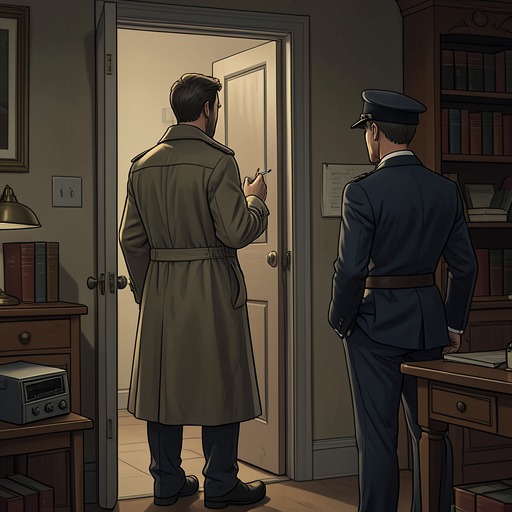
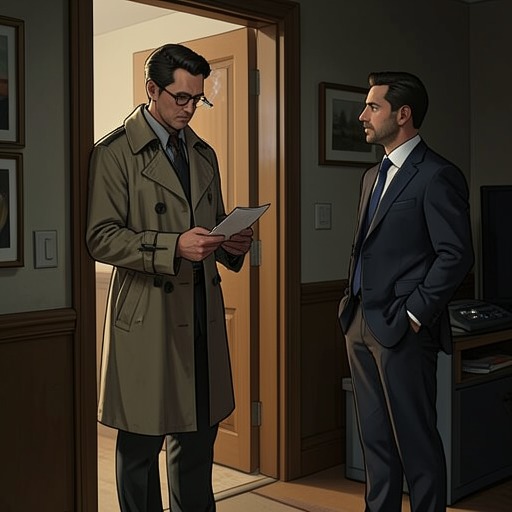
At Spade’s apartment, Dundy confronts him directly and asks what he wants. Spade answers in a hard, cold voice, while Tom Polhaus tries to make clear that the police do not want unnecessary trouble. The exchange establishes the unequal pressures at work: the police have the authority to investigate a murder, but Spade regards himself as an independent professional rather than a subordinate to their demands.
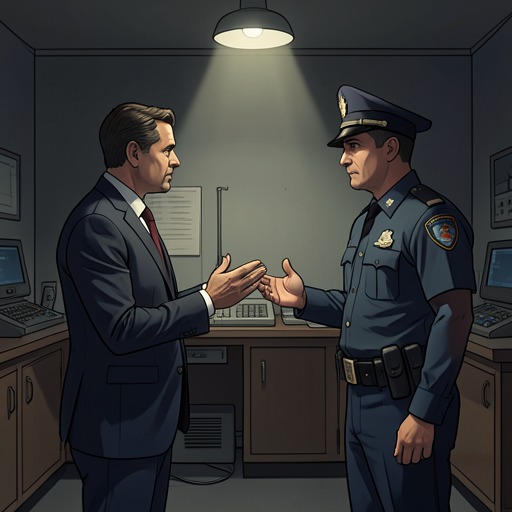
Dundy asks why Spade was tailing Thursby. Spade corrects the premise: Archer, not Spade, had been following him, on behalf of a client who was paying for the work. When Dundy demands the client’s identity, Spade refuses to disclose it before speaking with the client. Dundy warns that Spade will have to tell him or testify in court; Spade insists that he will choose whether to answer. His refusal protects the confidentiality of his business, but in a murder investigation it also gives the police reason to regard him as withholding information.
Two deaths and a widening case
Dundy sharpens the suspicion by pointing out that Thursby was shot outside his hotel thirty-five minutes after Spade left Burritt Street. He also raises talk of an affair between Spade and Archer’s wife, Iva, and asks whether that could explain Archer’s death. Spade dismisses the insinuation and exposes the difficulty in Dundy’s changing theory: if Spade killed Archer to be with Iva and then killed Thursby to make Thursby appear responsible for Archer’s death, the police could continue attributing further killings to him without limit. His sarcasm contests the logic of the accusation, though it cannot by itself settle the question of what happened.
The police possess evidence that initially ties Thursby to Archer’s murder. Polhaus says that the Webley-Fosbery revolver was Thursby’s and that the bullet recovered from Archer came from it. A bellhop at Thursby’s hotel had seen the distinctive revolver in Thursby’s room on the morning of the murder. This evidence supports a link between Thursby and Archer’s death, but it does not establish that Spade was uninvolved in either killing; nor does the surviving account treat the gun as a complete resolution of every question surrounding the case.
The widening inquiry brings Spade into contact with people whose conflicting accounts connect the deaths to the search for the black bird. Brigid O’Shaughnessy tells him that she met Thursby in the Orient and came with him from Hongkong; she says he had promised to help her but betrayed her. Later, she identifies the Russian Kemidov as the man from whom her associates were trying to obtain the bird. These revelations place Spade’s client, Thursby, and the object of the pursuit within one unstable network, while leaving important parts of Brigid’s account unexplained.
Spade also learns that Joel Cairo has been watching the house after Spade introduced him to a boy outside a theatre. Cairo complains that he came to Spade in good faith and believes he has been exposed to a trap. The episode adds another strand of surveillance and mistrust to the investigation: Spade’s dealings with the people pursuing the bird are visible to others, and the disclosure of one connection can endanger or implicate another.
Evidence and competing explanations
The police investigation and Spade’s private inquiry repeatedly overlap. He gives Dundy little information because, as he says, he knows little; he also protects the client who hired Archer until he can consult that client. Dundy interprets such reticence in the context of two murders and a detective who was connected to the dead men. Spade treats it as a professional boundary. Their conflict is therefore not simply over whether Spade is guilty, but over who controls the information on which suspicion depends.
The account later supplies a competing explanation for Thursby’s death. Gutman says that Thursby was Brigid’s ally and a notorious killer, and that removing him would leave her without a powerful protector and encourage her to reconcile with Gutman’s group. Gutman further explains that his party did not believe Thursby possessed the bird. They knew Brigid had given it to Captain Jacobi in Hongkong to bring across on the Paloma while she and Thursby took a faster boat. Gutman says he tried to negotiate with Thursby, found him loyal to Brigid, and had Wilmer follow him back to his hotel after the attempted deal failed. This account places the killing within the struggle over the bird and identifies Gutman’s group as an alternative source of responsibility; it is Gutman’s explanation, rather than an independent finding by the police.
Brigid’s movements and the events aboard the Paloma add further context to the intersecting cases. According to the account Spade gives her, she first went to his place between half past nine and ten, tried again about half past ten, then went to a late movie because she did not want to be home when Archer arrived. He also recounts that she reached the Paloma shortly after noon, asked for Captain Jacobi, waited until he returned at four, and spent time with him in his cabin. That evening Gutman, Cairo, and Wilmer came aboard. The group argued; a shot was heard in Jacobi’s cabin around eleven, and a fresh bullet hole was later found there. All five people were said to have left together around midnight. These details complicate any easy separation of the murders from the pursuit of the bird, but they do not, on their own, prove that Spade committed either murder.
The suspect’s defense and professional code
Spade’s strongest defense is not that he has no connection to the case, but that connection is not proof and that his conduct follows a rule he says he has learned through experience. When negotiating with Gutman, Spade argues that a detective can withstand the law only so long as he is ready, when the reckoning comes, to hand over a criminal whom the authorities can prosecute. He says that he has previously defied everyone from the Supreme Court downward because he never forgot that he would eventually need a victim to present to the police. Without such a person, he says, his position would collapse. Gutman doubts that this approach is practical in the current case and urges him to make an exception for money; Spade rejects the suggestion. The rule is a tactical means of surviving police scrutiny, but it also reveals the limit he places on his independence: defiance must ultimately be backed by a deliverable culprit.
Spade’s insistence that he will not let Archer’s killer go is inseparable from his explanation of what it means to be a detective. He admits that Archer was a poor partner and says he had intended to remove him from the business when their year-long arrangement ended. But he argues that a partner’s character does not cancel the obligation created by the partnership: when a detective’s partner is killed, the detective is supposed to act. Allowing Archer’s killer to escape would, in his view, damage not only their own organization but detectives more broadly. He compares letting a criminal go after tracking one down to asking a dog to catch a rabbit and release it. The analogy makes his position sound instinctive, while his references to professional duty make it institutional as well.
Meaning and limits of the suspicion
The novel keeps suspicion alive by making Spade both an investigator and a man with reasons to conceal information. He withholds his client’s name, resists Dundy’s questions, and maintains dealings with people implicated in the search for the bird. Those choices help explain why the police question him, but the evidence presented here also resists reducing suspicion to guilt: the weapon links Thursby to Archer’s death, and Gutman describes a separate motive and chain of action behind Thursby’s killing. Suspicion is sustained by the overlap of professional secrecy, private investigation, and murder rather than resolved by a single accusation.
Spade’s final argument to Brigid shows why his suspect status cannot be separated from his decision about what to do with the people around him. He says the only way he could have let her go would have been to let Gutman, Cairo, and Wilmer go as well. His stated obligation to pursue Archer’s killer thus extends beyond personal loyalty to the dead partner: it makes the handling of the entire group a question of professional consistency. The police may treat Spade as a suspect, and he may resist their control, but he insists that he must ultimately provide them with a criminal. That tension—between a private detective’s independence and the public demand for an answer—is the defining condition of his suspected status.