San Francisco District Attorney's Office
The Maltese FalconThe District Attorney’s office is the city institution that tries to turn the linked murders and the missing black bird into a prosecutable case. Its role comes into focus through a meeting between District Attorney Bryan and Sam Spade: Bryan presses for information about Spade’s client and Miles Archer’s assignment, while Spade refuses to surrender what he knows on demand. The office is therefore more than a setting for an interview. It represents the formal authority to investigate and prosecute, but also the practical limits and strategic choices that shape official justice in a case tangled with private loyalties, withheld information, and competing suspects.
Mandate and Institutional Setting
The office contacts Spade after he has been unable to find Brigid O’Shaughnessy. Effie Perine tells him that Bryan wants to see him, and a messenger reports that Casper Gutman would also like to talk with him before half-past five. Spade then arranges a two-thirty appointment with Bryan and asks Sid Wise to call around four to check that he is not in trouble. The appointment is thus set against a widening network of private negotiations and police attention; Spade treats a visit to the prosecutor as a situation requiring preparation and a safeguard, not as a routine exchange.
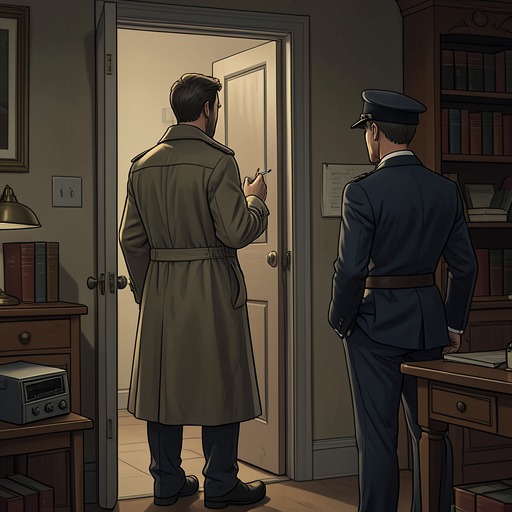
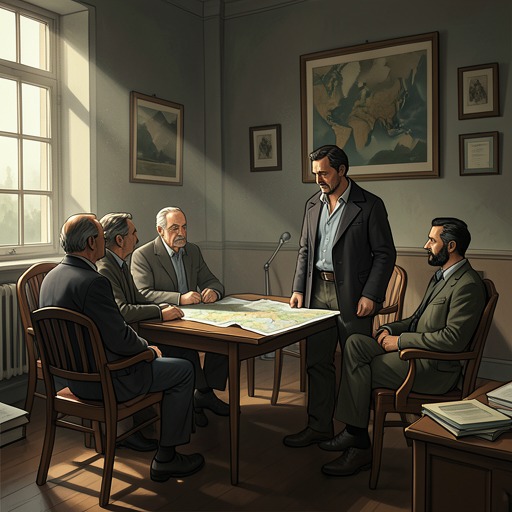
Bryan receives Spade in his office, where a stenographer is present and two other men are summoned. Spade knows one of them, Thomas, while the younger man sits apart with a notebook and pencil. Bryan offers to dismiss the stenographer and says the meeting is not intended as a formal inquiry. He also says he does not share the police theories about Spade. But his assurance of informality does not remove the office’s institutional purpose: Bryan soon presses Spade to identify the person for whom Archer had been following Floyd Thursby, treating that answer as a route toward identifying Thursby’s killer.
The Interview and the Contest over Evidence
Spade declines to name his client, explaining that he cannot do so until he has discussed the matter with that client. Earlier, when Lieutenant Dundy demands the same information, Spade insists that he will decide whether to disclose it and refuses to let police displeasure dictate his conduct. His resistance carries into Bryan’s office. Bryan proposes a direct investigative inference: if Spade tells him who commissioned Archer to follow Thursby, Bryan says, he can tell Spade who killed Thursby. Spade rejects the premise and warns that the information he could provide would undermine the prosecutor’s preferred theory of the case.
Bryan frames the issue as a matter of public duty. He says that, as District Attorney, he—not Spade—must judge what information can be used, and that an officer of the law remains responsible for evidence of crime whether a conversation is formal or informal. Spade points out the contradiction between that claim and Bryan’s earlier invitation to treat the meeting as an informal talk. He is willing to have his words recorded and signed, but Bryan says no signature is required; the stenographer is present only for convenience. The exchange reveals a distinction between procedural form and practical pressure: the interview is presented as unofficial, yet Bryan asserts the office’s authority to demand information all the same.
Bryan’s theory makes the unknown client central to explaining Thursby’s murder. He argues that learning the client’s identity would quickly tell him who killed Thursby, while Spade rejects both the inference and the police’s existing theories. When Bryan insists that the solution must lie among three proposed categories, Spade answers with an additional possibility—that Thursby died of old age—and mocks what he sees as the investigators’ fixation on a familiar criminal model. The disagreement is not simply about a missing name. Bryan wants information that will sort the evidence into a chargeable theory; Spade believes the information would complicate that theory and that the office would not use it as he intends.
Prosecutorial Judgment and the Case for a Fall Guy
Spade’s later account of the office’s likely behavior makes his distrust more specific. He describes Bryan as a prosecutor concerned with how a record will look on paper and more inclined to drop a doubtful case than to risk losing it at trial. Spade does not claim that Bryan knowingly frames people he believes innocent. Instead, he argues that Bryan may accept or shape evidence that supports guilt, and that the office may choose to convict one suspect while allowing other equally guilty accomplices to go free if pursuing everyone would muddle the case.
That assessment is the foundation of Spade’s proposed strategy with Gutman. He argues that a detective can withstand pressure from the authorities only if, when the reckoning comes, he can deliver a recognizable criminal to headquarters. In his view, a victim whom the authorities can charge is a practical defense against accusations that he has obstructed justice. He expects Bryan to favor a simple, winnable case against Wilmer Cook over a wider prosecution that would force the office to untangle the falcon, Thursby, Captain Jacobi, and the other participants. Spade predicts that Bryan would prefer to discount Wilmer’s account of the falcon as an effort to confuse the case, rather than risk weakening a conviction by pursuing every connection.
The proposal is transactional rather than a claim that the office will discover the whole truth. Spade’s calculation depends on what Bryan can plausibly prove and what will look coherent to a jury. Gutman objects that the connections among Thursby, Jacobi, and Wilmer could make Spade’s simplified account impractical. The exchange leaves the office’s anticipated decision-making at the center of their bargaining: both men evaluate Bryan not only as an officer of the law, but as a prosecutor managing the risks of a case.
Limits of Cooperation and Narrative Significance
Spade ends the meeting with Bryan by rejecting further informal discussions. He says he has nothing to tell Bryan or the police and is tired of being accused by people on the city payroll. If Bryan wants to question him again, Spade says, he must arrest or subpoena him; Spade will then appear with his lawyer. He leaves after saying that they may meet at the inquest. His departure turns a strained interview into an explicit boundary: Spade will not accept the office’s authority as a reason to volunteer evidence outside a formal process.
The office’s function in the novel is consequently defined by a tension between lawful authority and case-building pragmatism. Bryan insists that the prosecutor, not a private detective, decides what evidence matters; Spade answers that evidence cannot be separated from the theory and outcome the office is prepared to pursue. The resulting conflict illuminates the limits of cooperation among investigators, police, and prosecutors. It also explains why Spade’s contemplated handover of a suspect is not equivalent to a complete account of the crimes: the office may receive a case designed to be prosecutable, while important relationships and the falcon’s history remain outside the explanation it chooses to present.