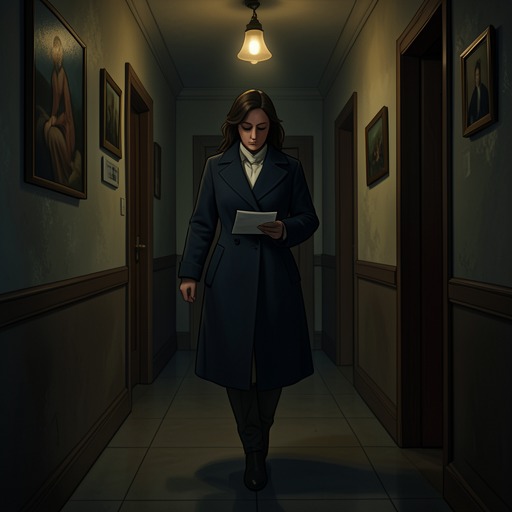
Spade exposes and turns over Brigid
The Maltese FalconSam Spade exposes and turns over Brigid is the decisive resolution of the murder investigation: Spade rejects the story that Floyd Thursby killed Miles Archer, reconstructs Brigid’s plan from the circumstances of the shooting, and hands her to the arriving detectives. The revelation transforms Brigid from a client whose account shaped the inquiry into its concealed killer, while Spade’s refusal to protect her makes professional obligation outweigh their intimacy.
Causes and the misleading case
The investigation begins with a scene that appears to support a straightforward account of Archer’s death. A section of fence has been torn away, and Archer’s body lies on a slope below it, near a boulder. Spade reads the physical arrangement as evidence of a shot fired in the alley: Archer was standing with his back to the fence when the gunman fired, and the impact sent him backward through the broken rail and down the slope. That reconstruction establishes the circumstances of the killing, but it does not establish who fired.
The weapon initially points suspicion toward Thursby. The police say the Webley-Fosbery revolver belonged to him, and that the bullet recovered from Archer came from it. A hotel bellhop had seen the unusual gun in Thursby’s room that morning. Those details make the weapon a strong link in the case against Thursby, but they do not prove that he used it to kill Archer. The difference between possession of the murder weapon and the identity of the shooter becomes central to Spade’s later challenge.
Brigid’s earlier account adds a second layer of misdirection. She told Spade that she had met Thursby in the Orient and come with him from Hong Kong, where he had promised to help her before betraying her. The explanation presented her as dependent on Thursby and endangered by his actions, while leaving the nature of the betrayal unspecified. Her story gave Spade a reason to investigate Thursby, but its omissions concealed that she had arranged for Archer and Spade to become involved in following him.
The timing of Iva Archer’s movements had also complicated the inquiry. According to Sid Wise, Iva first went to Spade’s place between half past nine and ten, returned after driving around, then went downtown when Spade was still out. She spent time at a Powell Street movie theatre and later ate at Tait’s on Ellis Street before going home alone. She said she had not wanted to be home when Miles arrived, since his presence around midnight made him angry. This account supplies a detailed competing timeline, but the eventual exposure of Brigid identifies a different person as Archer’s killer.
Spade’s reconstruction and Brigid’s confession
Spade rejects the assumption that Thursby shot Archer by reasoning from Archer’s experience and position. Archer had spent years as a detective; Spade cannot believe he would have been caught in a blind alley with his gun tucked away and his overcoat buttoned by the man he was following. Nor does Spade think Thursby could have tricked or driven Archer into that position. He concludes that the scene and Archer’s conduct do not fit the theory that Thursby was the shooter.
When Spade tells Brigid that Thursby did not shoot Archer, her astonishment confirms that this conclusion overturns her expected version of events. Spade then asks directly why she shot Archer. His accusation is grounded in the arrangement she made before the murder: she had asked Spade and Archer to handle the matter themselves because she wanted the person shadowing Thursby to be someone she knew and who knew her. She had obtained Thursby’s gun that night and rented an apartment in the Coronet before the date she had given Spade. A rent receipt Spade found there placed the rental five or six days earlier than her account suggested; trunks in the apartment, and none at the hotel, further supported his reconstruction of her preparations.
Brigid acknowledges that her initial explanation was a lie. She says she had expected Thursby to be difficult to frighten and hoped that, if he knew someone was following him, he would confront that person. If Thursby killed Archer, she would be rid of Thursby; if Archer died, she expected Thursby to be caught and would be rid of him instead. When Thursby did not attack Archer, Brigid borrowed the gun and killed Archer herself. Her admission confirms that the plan was not simply an encounter that went unexpectedly wrong: she had arranged the pursuit to create a possible fatal confrontation, then acted when the outcome she wanted did not occur.
Spade’s final questioning separates her confession from her attempt to soften it. Brigid begins by saying she did not mean to kill Archer at first, but Spade rejects that account and points to her prior arrangements. He presses her to acknowledge that she had planned for Thursby to be blamed for the killing. Her response confirms the essential outline, even while qualifying its exact execution. The scene therefore resolves both who killed Archer and how Brigid sought to make the murder serve her purpose: Thursby was to become the apparent killer, whichever man died in the confrontation.
The decision to surrender Brigid
The disclosure takes place against the continuing pressure of the Falcon investigation. Earlier, Spade had refused to let Lieutenant Dundy search his rooms without a warrant, and he had insisted that he could not identify his client before speaking with that client. Those exchanges establish his resistance to police pressure and his insistence on controlling the information he shares. At the same time, Lieutenant Dundy had made clear that Archer’s death was a murder case, not a matter Spade could dismiss as a private business dispute.
The competing group around Casper Gutman gives the ending a further practical complication. Gutman explains that his party found Brigid’s apartment and heard movement inside. When the occupants heard that the visitors were at the door, someone raised a window; Wilmer Cook ran around to cover the rear and encountered Captain Jacobi carrying the Falcon. Wilmer shot Jacobi, but Jacobi continued with the statuette, knocked Wilmer down, and escaped. Gutman’s account links the pursuit of the Falcon to a separate killing and to the effort to divert Spade from the delivery. It also supplies the surrounding criminal circumstances in which Spade must decide what to tell the police.
Before bringing Brigid out, Spade takes three pistols from the table and keeps the bathroom door under observation, warning the others not to try to leave. He also accepts Gutman’s money long enough to count nine thousand-dollar bills, then returns all of it. The exchange matters because the money could have become part of a deal or a bribe; instead, Spade gives it back and proceeds to examine the trick that has disrupted the negotiations. His handling of the weapons, the money, and the exits turns the room into a controlled space while he establishes what happened.
Brigid makes one final effort to draw Spade into closeness as the police arrive. He tells her that he will not let her make a fool of him, but she comes into his arms before the doorbell rings. Spade answers the arrival by opening the corridor door with his arm still around her, then presents her to the officers. He identifies her as Archer’s killer and lists the items he is handing over: the guns belonging to Wilmer, one of Cairo’s pistols, the black statuette at the center of the struggle, and a thousand-dollar bill Gutman had supposedly used to bribe him.
Consequences and significance
The handover closes the gap between Spade’s private reconstruction and official custody. He does not merely accuse Brigid in conversation: he physically brings her forward to Lieutenant Dundy, Tom Polhaus, and two other detectives, while surrendering material connected to the wider case. His accusation gives the police a direct answer to the murder that began the investigation, while the objects he identifies preserve the connection to the other participants and to the Falcon.
The ending also reverses the roles that Brigid’s story had assigned. She first appeared to be a dependent woman betrayed by Thursby; Thursby then seemed to be the likely killer because his gun fired the fatal bullet. Spade shows that the gun and the killing have been arranged to direct suspicion away from Brigid. His conclusion does not rest on a single revelation but on the mismatch between the physical scene, Archer’s experience, Brigid’s altered timeline, the early rental receipt, and her own admissions.
Spade’s conduct leaves the intimacy between him and Brigid unresolved as a feeling but settled as a choice. He does not deny that she has tried to persuade him, and the final embrace makes the personal pressure visible. Yet he turns her over rather than allowing affection to determine the outcome. The murder is solved, but the resolution is not a restoration of trust: it is the moment Spade refuses to become an accomplice to the woman whose original story brought him into the case.